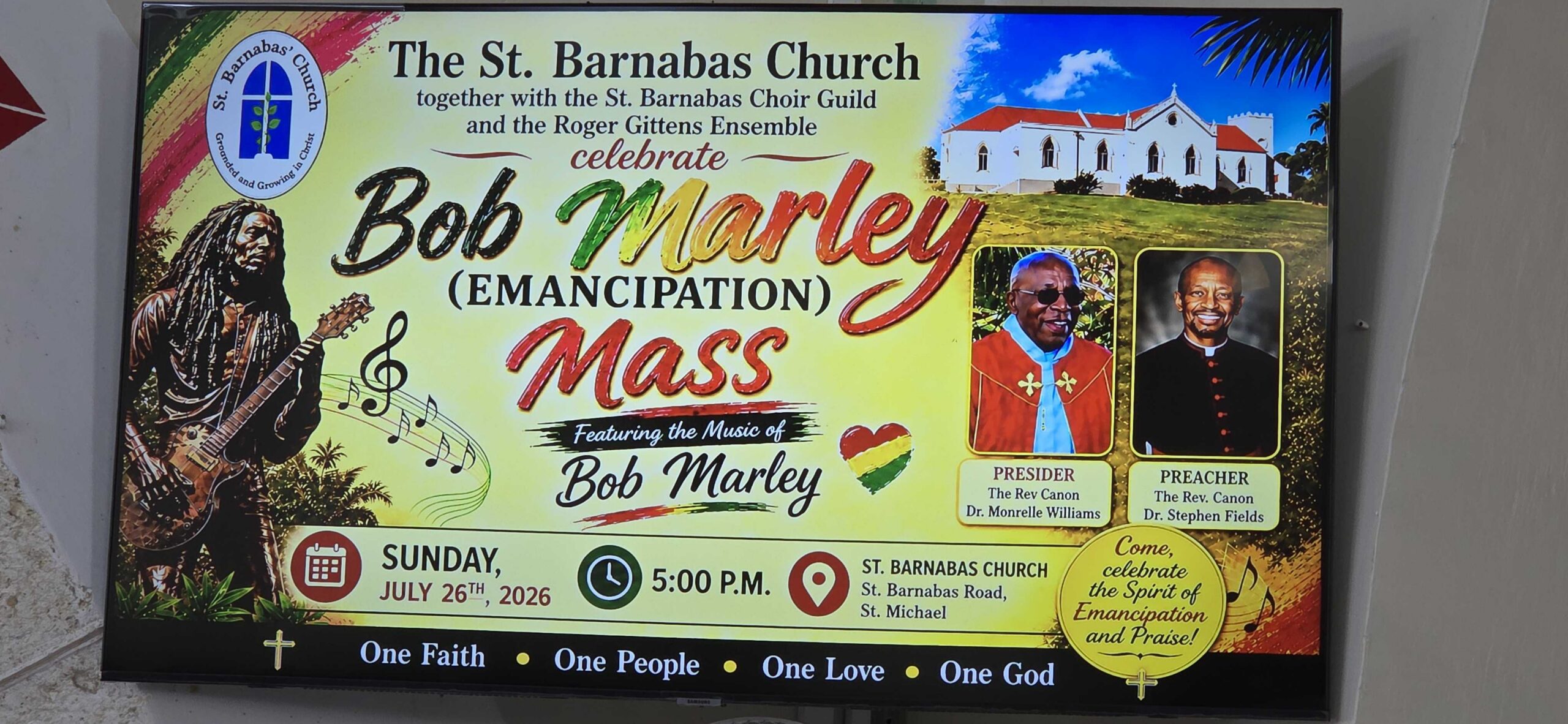
A high-profile religious and cultural conflict has emerged in Barbados, as St Barnabas Anglican Church defends its upcoming “Bob Marley Mass” against fierce condemnation from Rastafari leaders, who have labeled the service an act of spiritual and cultural piracy and demanded its immediate cancellation.
The special Eucharistic service, scheduled to coincide with this weekend’s national commemoration of the 1838 emancipation from chattel slavery, integrates the iconic music of reggae legend Bob Marley into a traditional Anglican liturgical structure. Church leaders frame the event as a thoughtful theological engagement with the consistent themes of justice, liberation, repentance, hope, peace, reconciliation, and human dignity that run through Marley’s discography — themes they say align closely with core Christian scriptural values.
The liturgy for the service was originally crafted in 2025 by Canon Dr Stephen Fields during his tenure as sub-dean of St James Cathedral in Toronto, Canada. It debuted that same year during Black History Month to mark the 80th anniversary of Marley’s birth. Canon Dr Monrelle Williams, priest-in-charge at St Barnabas, later brought the service to Barbados to anchor the island’s Emancipation Day observances. Church officials have also stressed that all musical arrangements used in the service have been properly licensed through Fifty Six Hope Road Music Limited, the official entity that manages Marley’s estate, confirming the event operates within legal copyright frameworks.
Despite the church’s framing, the National Rastafari Registry Secretariat and Trust has launched uncompromising opposition to the service, arguing it misappropriates a central spiritual and cultural figure of the Rastafari faith while erasing the community’s ongoing struggles for equal rights. In a scathing public statement, the group questioned both the timing and underlying intent of the event, pointing to the long-standing silence of the Anglican Church in Barbados on the Rastafari community’s campaign to secure legal recognition for the sacramental use of cannabis, a core tenet of their religious practice.
The statement accuses the church of hypocrisy: “You cannot ignore the living Rastafari community, remain silent while our constitutional rights are stripped away, and then turn around to exploit our Prophet for Emancipation Day marketing. This is not inclusivity; it is spiritual and cultural piracy.” Rastafari leaders add that inserting Marley’s work into an Anglican service fundamentally distorts his core message. They note that Marley was an outspoken critic of European colonial Christian institutions, and that his work centered anti-colonial liberation — a cause that directly pushes back against the historical role of the Anglican Church as an instrument of colonial rule. “Emancipation Day represents liberation from the exact mental and spiritual slavery that the colonial church enforced,” the statement reads. “To host a ‘Bob Marley Mass’ within the walls of the historical oppressor, while continuing to ignore the struggles of living Rastafarians, mocks the very essence of freedom.”
In response, St Barnabas has acknowledged the legitimacy of Rastafari concerns about systemic discrimination and social exclusion, saying these issues carry meaningful weight and deserve urgent national attention. “These concerns should not be dismissed. They present an opportunity for honest reflection and constructive dialogue,” the church’s statement reads. “The Church recognises that reconciliation is achieved not merely through words but through listening, mutual respect, and a shared commitment to justice. The celebration of the Mass may well be the catalyst for a long overdue conversation about the rights of the Rastafari community in our country.”
Church leaders also point to Marley’s own complex spiritual history to contextualize the service: while Marley was a committed Rastafari for most of his adult life, he was baptized into the Ethiopian Orthodox Church shortly before his death in 1981. The service, they insist, does not seek to redefine or co-opt Marley’s legacy, but rather to highlight overlapping values between Christian theology and the themes woven through his music.
Despite the church’s call for dialogue, Rastafari leaders maintain that any meaningful engagement must start with the cancellation of the service, a formal apology, and concrete policy action to address the community’s unmet constitutional rights and long-standing historical grievances.
To contextualize the conflict, Rastafari theology draws significant inspiration from Christian scripture and tradition, but reinterprets these texts through the lens of African liberation, resistance to white colonial oppression, and the lived experience of the Black diaspora. For most Rastafari, mainstream Christian churches are inextricably linked to the colonial project that subjugated African and diasporic communities, creating a deep historical rift that shapes current debates over cultural and religious ownership.