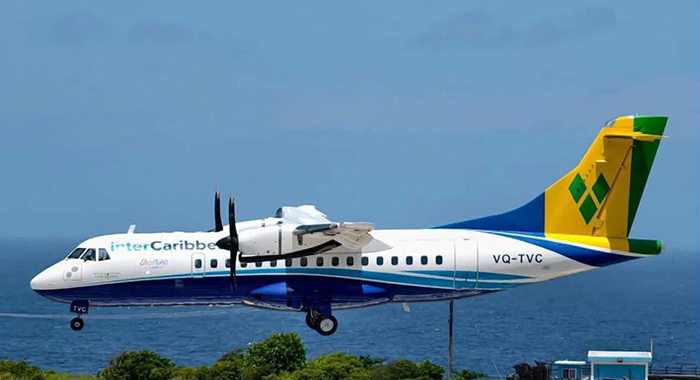
On a historic Thursday, St. Vincent and the Grenadines (SVG) celebrated a major milestone for both its tourism industry and national identity with the official unveiling of a custom-branded InterCaribbean Airways aircraft. Named the “Spirit of Saint Vincent and the Grenadines,” the plane prominently displays the country’s national flag, and officials frame the initiative as a transformative step forward for destination marketing and collective national pride.
Shafia London, Chief Executive Officer of the SVG Tourism Authority, emphasized that the branded aircraft carries far more meaning than just increased marketing visibility. For London, the collaboration represents a powerful tangible symbol of mutually beneficial partnership, enhanced regional connectivity, and aligned shared ambition between the national tourism body and the regional airline. She outlined that sustainable tourism relies on two non-negotiable pillars: first, developing an attractive destination that sparks travelers’ interest, and second, guaranteeing reliable, accessible access for those visitors. Reflecting on the aftermath of the global COVID-19 pandemic, London recalled that traveling to and from SVG required immense patience, meticulous advance planning, and frequent compromise from visitors and industry operators alike. She credited InterCaribbean with directly addressing this challenge by expanding its regional route network and growing its on-the-ground presence in SVG, fundamentally improving access to the island nation.
Every flight operated by the branded aircraft into SVG’s Argyle International Airport delivers widespread economic opportunity across nearly every segment of the local economy, London noted. From hotels, guesthouses, restaurants and taxi services to tour guides, local attractions, small-scale farmers, fisherfolk, artisans and independent small businesses, the increased visitor flow created by improved connectivity ripples through communities across the islands. As the SVG Tourism Authority enters what London calls “a new era of destination marketing,” this strategic partnership ensures that when potential travelers are inspired to visit SVG, accessibility no longer stands as a barrier — it becomes a seamless possibility.
Tourism Minister Kishore Shallow positioned the unveiling of the branded aircraft as a deliberate, bold declaration that SVG is claiming its space in the highly competitive Caribbean tourism marketplace. “The ‘Spirit of Saint Vincent and the Grenadines’ is a declaration that St. Vincent and the Grenadines is taking its rightful place in the Caribbean marketplace — a bold statement,” Shallow stated. Every flight that carries the nation’s flag across the region acts as a moving invitation for travelers to explore SVG, experience its local culture, and consider investment opportunities in the country, he added.
Shallow tied the launch of the branded aircraft to what he described as remarkable, accelerating momentum across SVG’s entire tourism sector. He pointed to a string of recent and upcoming high-profile activities, including international viral promotion of the country from content creator IShowSpeed, the SVG Sailing Week event (sponsored in part by InterCaribbean), the One Fest celebration on Canouan Island, and the launch of two new targeted marketing campaigns: “Love SVG” and “Go Grenadines”. Looking ahead, Shallow teased a forthcoming public-private partnership with Global Ports Holding to expand SVG’s cruise tourism sector, and confirmed a packed calendar of upcoming events, including Caribbean Premier League (CPL) cricket matches scheduled for August 7 to 9, which will include a “real surprise” yet to be announced to the public. Already, the sector is seeing strong results: hotel occupancy has surged across the country, with every room booked during the recent Vincymas festival and all accommodations already sold out for the upcoming CPL fixtures.
Shallow acknowledged that SVG does not have the large marketing budgets of some of its larger, more established regional competitors. But he explained that the government and Tourism Authority are closing this gap through intentional strategic planning, targeted institutional strengthening, and efficient, strategic use of limited public resources. He highlighted the recently restructured and strengthened Tourism Authority, now led by new board Chair Shelly-Ann Fraser and CEO Shafia London, noting that the agency is working to maximize the impact of every staff member and every dollar of public investment allocated by the prime minister and cabinet. The push to expand cruise tourism through the Global Ports Holding initiative is a deliberate strategy to increase the number of ship calls to SVG and boost passenger spending, and Shallow reported that global cruise industry stakeholders have responded to the plan with significant enthusiasm.
SVG Prime Minister Godwin Friday described the custom-branded aircraft as a “branded flying ambassador” for the nation, and a highly visible expression of collective national identity. “Wherever it flies throughout the Caribbean, it will carry the spirit and beauty of our country with it,” Friday said. Every landing and departure of the aircraft sends a clear message that SVG is open for business, eager to welcome visitors from across the region and beyond, he added. The prime minister reiterated that tourism remains a foundational pillar of SVG’s economy, supporting jobs, entrepreneurs, farmers, fisherfolk, artisans and families across the country’s multi-island territory. To unlock the full economic potential of the tourism sector, he explained, the government must prioritize building strategic private-sector partnerships, upgrading critical infrastructure, and improving overall accessibility for visitors.
Friday noted that reliable regional air connectivity remains one of the most persistent shared challenges across the Caribbean, a topic regularly raised and discussed at CARICOM summits, and that SVG holds specific responsibility for advancing transportation cooperation across the bloc. In this context, he welcomed InterCaribbean as a critical partner in improving regional travel access and commended the airline for aligning with the national vision of promoting the SVG brand across the entire Caribbean region.
Trevor Sadler, CEO of InterCaribbean Airways, traced the airline’s rapid growth from its origins as a small local operation based in the Turks and Caicos Islands to its current position as a leading regional carrier serving 24 destinations across 18 Caribbean countries. The airline has steadily expanded its fleet and capacity over the years, evolving from small 9- and 15-seat aircraft to 30-seat Embraer 120s, then adding 50-seat Embraer 145 jets to its fleet in 2018, and today operating 11 modern ATR aircraft. Sadler announced that the airline is on the cusp of introducing eight new 76-seat Embraer 170 jets, which offer twice the flight range of the existing Embraer 145 fleet and will open up opportunities to expand into new untapped markets across the region.
With the addition of the “Spirit of Saint Vincent and the Grenadines” ATR to the fleet, Sadler confirmed the aircraft will operate across the entire Caribbean, with intentional scheduling to ensure frequent flights into Argyle International Airport. The distinctive branding also acts as a natural conversation starter, he pointed out: with SVG’s flag displayed on the nose and tail of the aircraft, “we hope everyone who’s not familiar with that flag is going to take a moment to ask the question… and now get curious about coming here.” A core part of InterCaribbean’s mission is hiring local team members from the islands it serves, Sadler highlighted, pointing to three new Vincentian employees joining the airline — including Faith Exeter, who will serve as head of public relations and partnerships, and Alston Samuel, who takes on the role of head of base maintenance — as examples of the airline’s commitment to local inclusion in its growth.
Prime Minister Friday framed the partnership with InterCaribbean as part of a broader, whole-of-government strategy to upgrade SVG’s transportation and tourism infrastructure. He outlined ongoing investment to optimize operations and facilities at Argyle International Airport, including recently completed upgrade works. The government has also approved and planned major improvement projects for the smaller airports serving Canouan, Union Island and Bequia, building on construction work that has already begun. Beyond air infrastructure, the government plans to upgrade local roads, seaports, tourist attractions and visitor amenities across the islands. “World-class destinations require world-class infrastructure and top-notch service,” Friday said, adding that quality service must be understood as rooted in professionalism, not servitude.
Friday tied the growth of tourism to the government’s overarching four-pillar national economic strategy, which prioritizes agriculture, tourism, the blue economy — including commercial fishing, the yachting sector, and the Otley Hall Marina and Shipyard — and the new economy, encompassing information technology, sports, crafts and the creative industries. Closing the event, Friday urged all Vincentians to feel a sense of national pride when they see the branded aircraft traveling across the region. The plane embodies “our warmth, our history, our aspirations, and our resilience as a people,” he said, and concluded, “We take a back seat to no one.”