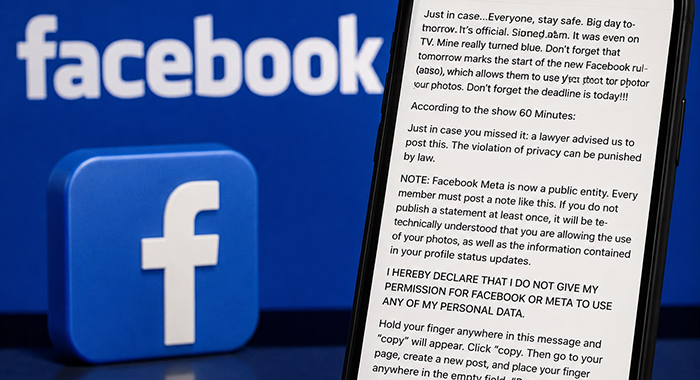
Across St. Vincent and the Grenadines and the broader Caribbean region, a misleading viral message about Facebook (Meta) privacy rules reappears in users’ timelines every few months. This persistent hoax opens with a dramatic, urgent warning claiming that a new official Meta policy will take effect tomorrow, granting the company rights to use any user’s photos, with a response deadline set for the same day.
The message then prompts users to copy and paste a pre-written statement declaring that they do not grant Facebook or Meta permission to use their personal photos or private data. The vast majority of users who share this post do so with sincere, good intentions: driven by legitimate anxiety over online personal privacy, they hope to shield themselves, their families, and the content they upload from misuse. These privacy concerns are not unfounded, and they should never be dismissed out of hand.
However, digital privacy experts and technology advocates confirm that sharing this copied statement does absolutely nothing to protect users’ content, alter Meta’s established platform policies, or revoke the user agreement each person consented to when creating their Facebook account. While the hoax is crafted to sound official, this veneer of formality does not grant it any legal weight.
Versions of this rumor have circulated for more than a decade, with shifting details that never alter the core misleading claim. Some iterations say a lawyer recommends posting the statement; others claim the new policy was announced on national television, or consistently frame the policy change as set to start “tomorrow.” No matter how the wording changes, the central claim remains false.
When a user creates a Meta account, they explicitly agree to the platform’s publicly available Terms of Service and Privacy Policy. A casual personal status update cannot override these pre-negotiated binding terms, nor can it create a new, separate legal agreement between an individual user and Meta. Put plainly, posting a “I do not grant permission” statement cannot revoke the usage rights users already agreed to when joining the platform.
This recurring hoax highlights exactly why widespread public digital literacy is such a critical public priority. As responsible technology advocate Darron Rodan John notes in this opinion piece, digital literacy – rather than sharing legally meaningless statements – is one of the most effective tools for ordinary internet users to protect their privacy online. Instead of relying on viral tricks, users should be taught to understand how social media platforms operate, how their personal data may be used, and what actionable steps they can take to control their own information.
John also clarifies a common point of confusion between content ownership and usage permission. Most users retain full copyright ownership of the original photos and content they create themselves. But when content is uploaded to Facebook’s platform, users grant Meta specific permissions to store, display, process, and distribute that content as part of operating the service. Sharing a copied status post cannot withdraw these pre-granted permissions.
This does not mean users should dismiss privacy concerns entirely; on the contrary, these anxieties are valid and deserve serious attention, especially in tight-knit small communities like St. Vincent and the Grenadines. In such contexts, photos, screenshots, and personal data can spread extremely quickly from Facebook timelines to private WhatsApp groups, other social platforms, and off-platform personal conversations. Once content is copied, downloaded, forwarded, or reposted by another user, the original creator often has almost no control over where it ends up or how it is used.
The real risk to personal privacy extends far beyond what technology companies may do with user data. It also includes what other individual users can do with the information people voluntarily share publicly.
Instead of sharing the false privacy declaration, John outlines practical, effective steps Facebook users can take to protect their privacy. These include regularly reviewing and updating account privacy settings, limiting the audience that can access personal posts, checking whether older content remains publicly visible, vetting unfamiliar friend requests before accepting them, and avoiding posting sensitive personal information such as government ID documents, banking details, travel itineraries, or home addresses.
Users are also advised to think carefully before sharing photos of minors, private family matters, or information that could expose another individual without their explicit consent.
The repeated resurgence of this false message exposes a much broader global challenge: millions of people use digital social platforms every day without fully understanding the user agreements they have entered, the inherent risks of sharing personal data online, or their own responsibilities as platform users. Digital technology has advanced at a breakneck pace over the past two decades, but public education about responsible, safe digital use has rarely kept up.
To address this gap, John argues for expanded, accessible digital literacy education across schools, workplaces, community centers, and public awareness campaigns. All citizens should learn core skills: how to spot common online misinformation, identify suspicious content and links, adjust and manage platform privacy settings, secure personal passwords, and vet dramatic viral claims before sharing them with others.
Before sharing any urgent, alarmist online message, John urges users to pause and ask four key questions: Who created this content? Does it come from a verified official source? Have the claims been fact-checked? Is it pushing for immediate action based on an artificial deadline? Misinformation almost always relies on creating fear and false urgency to drive rapid sharing.
The next time this recurring Facebook privacy hoax appears on a user’s timeline, there is no need to copy and share it. Instead, John says users should take the moment as a reminder to review their own privacy settings and encourage friends and family to do the same.
A casual Facebook status update can never supersede Meta’s binding Terms of Service, and a viral fear-driven message can never replace informed, intentional decision-making about online privacy. To stay safe online, users must stay alert, stay informed, and think critically before sharing any content.
This piece is an opinion column from Darron Rodan John, a responsible technology advocate. The views expressed are the author’s own and do not necessarily represent the editorial stance of iWitness News.