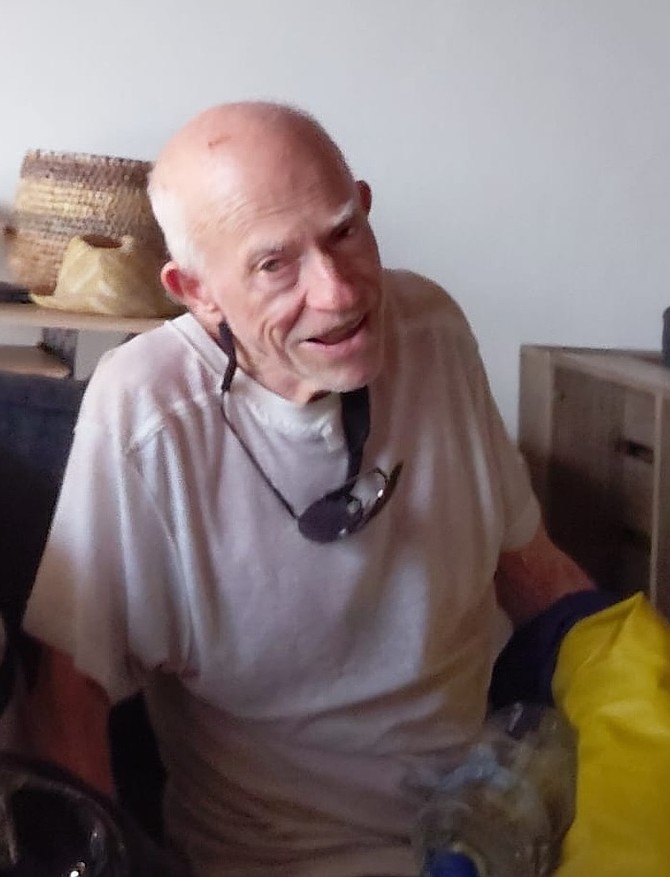
An 80-year-old American military veteran who ran his 35-foot sailboat aground on a Bahamian reef after two straight days of manual steering without sleep is speaking out about the overwhelming compassion he received from local fishermen and rescue workers who brought him safely to shore and helped repair his damaged vessel for the onward journey to Florida.
The incident unfolded earlier this month as Raymond Rosen set sail from the Dominican Republic’s northern coast bound for Hollywood, Florida, where he planned to visit his 101-year-old mother. What should have been a familiar voyage turned dangerous when a series of unexpected challenges left Rosen stranded hundreds of meters from shore.
Rosen explained that his boat’s engine had failed before departure, leaving him unable to rely on his autopilot system — which requires engine power to keep the navigation batteries charged. With no experienced sailing partner available to join the trip, he took on the full burden of steering the vessel by hand nonstop for nearly 48 hours. Having made the same crossing before with a co-pilot, Rosen admitted he had drastically underestimated the physical and mental toll of navigating alone for such a long stretch.
“After two nights without any sleep, I was hand steering for two days, and on the third night without any sleep, at one or three o’clock in the morning, I crashed into the reef off of the cay,” Rosen recalled. He added that he had deviated from his planned stop at Salt Cay to attempt a navigation check near West Caicos, but failed to spot his target landmark before falling into an exhausted sleep.
When he woke, a deafening crashing noise jolted him awake. Still disoriented from sleep deprivation, he initially believed he had been knocked off course in the open ocean, only to realize his sailboat had run aground on a reef just hundreds of meters from a beach near Booby Cay, a small islet off Mayaguana, the southernmost island of the Bahamas.
After confirming his vessel was irreparably stuck, Rosen deployed his emergency positioning beacon into the water and waited for official rescue teams to respond. Hours passed with no sign of a coast guard response, but that did not mean he was alone. Local fishermen out on a routine catch spotted the sailboat’s mast sticking up above the water and immediately altered their course to investigate.
Lloyd Strachan, one of the fishermen who joined the rescue, explained that he and his two crewmates were harvesting conch near Booby Cay when they spotted the stranded vessel. When they reached the reef, they found the elderly veteran weak and in distress. Though their boat was already loaded with the day’s catch and their fuel supply was only calculated for the planned fishing route, they did not hesitate to prioritize helping Rosen. Strachan noted that fuel costs have risen sharply in the region, currently running around $9 a gallon, making the unplanned detour an additional financial burden — but he stressed that human life will always outweigh any temporary economic loss. “Life comes first,” he said firmly.
Strachan told reporters Rosen told him he had not eaten for two days and was severely dehydrated, so the team rushed to get him to shore as quickly as possible, telling him to grab only his most important documents and belongings before transferring him to their fishing boat.
Once Rosen was brought ashore, the Royal Bahamas Defence Force notified Patrick Collie, superintendent of Mayaguana’s volunteer search and rescue team, shortly after 6 a.m. Collie immediately set out on the 27-mile trip to Booby Cay to assist. By the time he arrived, the fishermen had already extracted Rosen from the damaged sailboat.
Collie, who has spent 18 years working in land and sea rescue on Mayaguana and received specialized rescue training from the U.S. military, initially assumed the sailboat was too badly damaged to salvage. When he inspected the vessel and found it was still afloat, he launched a recovery operation to pull it off the reef. Rosen was taken to a local clinic for a medical assessment and treatment for dehydration, then settled into a local hotel while Collie and his team worked to repair the boat. Over two days, the team removed the sailboat from the reef, fixed the broken engine, repaired a leaking rudder, and got the vessel back into seaworthy condition.
Beyond repairing the boat, Collie also arranged for an experienced local sailor to accompany Rosen for the final leg of his journey to Florida, to prevent a repeat of the dangerous exhaustion that caused the grounding. Collie emphasized that for him, the job of a rescuer does not end when the stranded person reaches land. “As the search and rescue man, for me, my job finished when they see he up on land. But as the human side, my job finished when I see he up and running and leaving Mayaguana in good condition,” he explained.
Looking back on his frightening ordeal, Rosen said the experience exposed him to both kindness and hardship, but he made a point to single out Collie and the local fishermen for extraordinary praise. “I ran into the best of humanity and the worst of humanity all in one spot,” he said. “Patrick Collie is the best of humanity.”