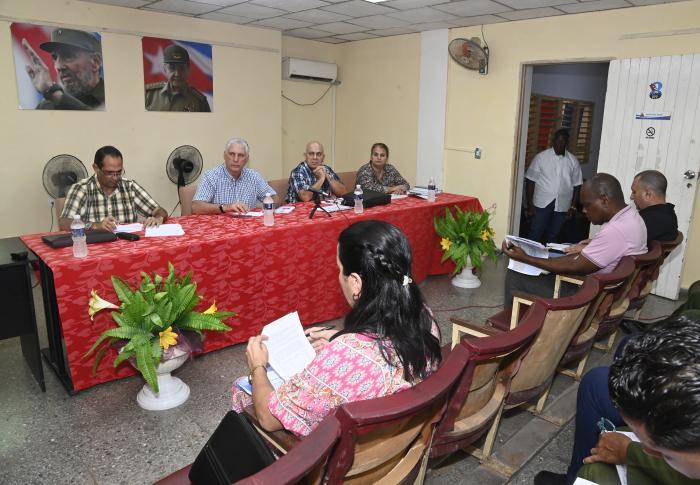
On a Wednesday afternoon in July, Cuban President Miguel Díaz-Canel Bermúdez, who also serves as First Secretary of the Central Committee of the Communist Party of Cuba, wrapped up a series of grassroots working visits with stops at the Municipal Defense Councils of Cotorro and Habana del Este, two municipalities in the country’s capital Havana.
This tour brought direct exchanges between Cuba’s national leadership and local governance teams across all 15 of Havana’s municipalities to a close, but Díaz-Canel emphasized that the practice of on-the-ground problem-solving will not end. Following this round of engagements, new direct consultations will be organized in the near future to keep national leadership connected to local realities.
The president framed the ongoing challenges facing Cuban communities as largely rooted in the relentless economic pressure exerted by foreign powers against the island nation. As Diaz-Canel noted during discussions in both Cotorro and Habana del Este, these external constraints create massive daily obstacles for ordinary Cubans working to build stable, prosperous lives.
During Wednesday’s meetings, local leaders highlighted that while each municipality has its own unique set of circumstances, Cotorro and Habana del Este share many pressing priority issues. Two of the most urgent concerns for both local governments are reliable electricity distribution and consistent access to clean drinking water, topics that were laid out clearly for national leadership during the talks.
Joining the president for these discussions were other senior Cuban officials, including Roberto Morales Ojeda, a member of the Political Bureau and Secretary of Organization of the Central Committee of the Communist Party of Cuba; Liván Izquierdo Alonso, President of the Havana Provincial Defense Council; and Yanet Hernández Pérez, Governor of Havana, alongside multiple other local and provincial leaders.
Beyond utility access, shared challenges across the two municipalities include expanding support for vulnerable populations, boosting domestic food production, and ensuring fair and efficient distribution of food supplies to residents. Listening directly to public feedback and aligning political work with community needs has long been a core strategy for Cuban governance, a principle that was clearly on display during these meetings.
During the consultations, the Cuban head of state asked granular questions about key community demographics: the total number of retirees residing in each area, the count of residents who are neither employed nor enrolled in education, the size of vulnerable populations, and the untapped potential for local solutions from emerging grassroots economic actors.
Two key policy areas received particular attention from the president. First, he revisited the operation of the Family Care System (SAF), the government program that connects low-income and vulnerable residents with targeted food assistance, noting its critical role in supporting community well-being. Second, expanding adoption of Renewable Energy Sources (RES) occupied a central spot on the discussion agenda, with national leadership calling for sustained effort to help more public and private entities transition to these clean energy resources.
Díaz-Canel also pressed for updates on a series of outstanding local priorities: How many retirees are still waiting to receive their pension payments? Are regular community food fairs being held as planned to improve access to affordable goods? What progress has been made on expanding the Community Youth Network? Local leaders responded with full updates on the incremental, daily work underway to address each of these issues, framing the effort to improve quality of life as a persistent, meticulous battle that matches the pace of emerging challenges.
In closing reflections, Díaz-Canel emphasized that local municipal-level governance is the frontline where battles for improved quality of life are won, and will continue to be won. This is particularly true, he noted, for efforts to unlock all available societal capacity to build shared prosperity, and to advance municipal autonomy — a reform priority that has become a central topic of national debate as Cuba implements 176 sweeping economic and social transformations to modernize the country.