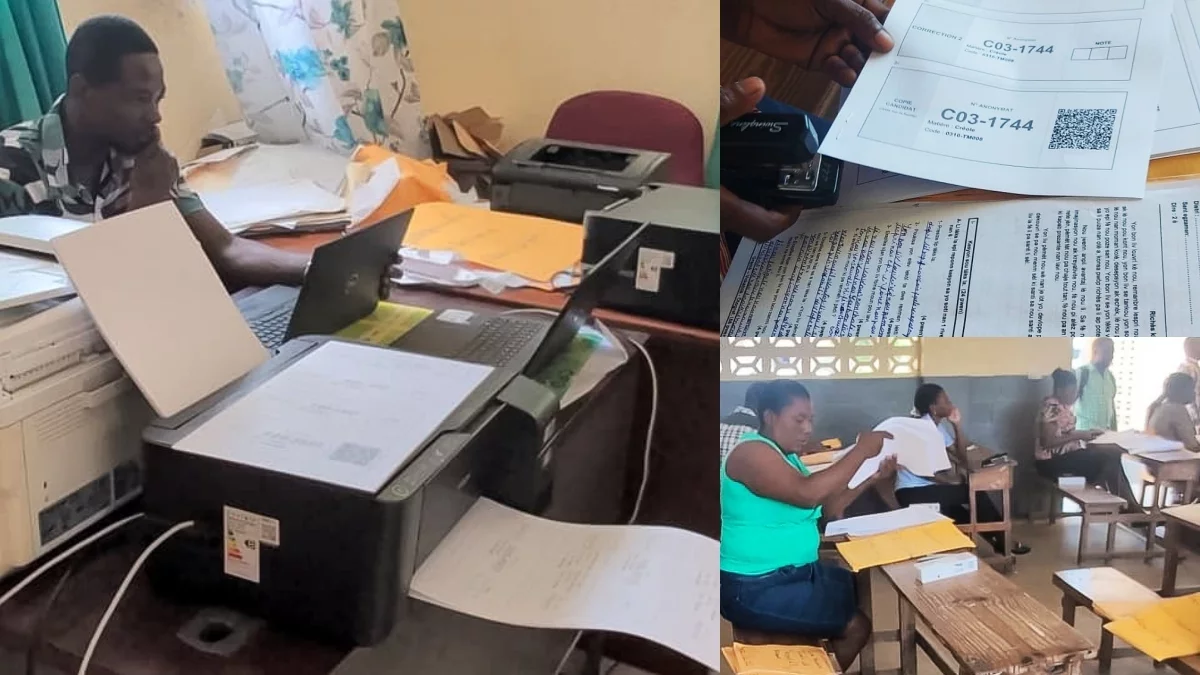
In a landmark shift for public examination administration, Haiti’s Departmental Directorate of Education for the Northeast (DDE-NE) has launched a fully technology-driven marking process for the 2026 9th AF exams, leaving century-old manual workflows behind. The systemic overhaul was designed to address longstanding vulnerabilities in traditional marking, cut avoidable human error, boost procedural transparency, and ensure every candidate receives a final grade that accurately reflects their actual performance.
For decades, exam marking in the region relied on partially manual operations, from hand-writing candidate identification codes on marking envelopes to manual entry of finalized scores into central databases. While administrative teams consistently managed the process to the best of their ability, the manual framework carried inherent risks: transcription mistakes, reversed candidate codes, and data entry errors that could ultimately alter a student’s final result and impact their academic trajectory.
To eliminate these risks permanently, DDE-NE rolled out three key layered innovations as part of its new fully secure marking protocol this exam cycle. First, the department replaced hand-written envelope coding — long the top source of administrative error — with individually generated, strictly confidential secure marking sheets for every candidate and every subject. By securing exam paper identification from the very start of the process, the department has strengthened the reliability of the entire marking workflow.
The most transformative change comes to post-marking score processing. Where teams once manually transferred marks from marking grids to central digital databases, all grids are now scanned and automatically uploaded to the department’s computer system immediately after marking. This automation cuts the risk of manual data entry errors drastically while also accelerating overall result processing. Every score assigned by an examiner is recorded directly into the system with no intermediate transcription step.
The digital overhaul has also reshaped the roles of marking center teams, shifting their focus from repetitive administrative work to high-impact quality oversight. Inspectors and operations staff no longer spend hundreds of collective hours entering marks; instead, their core responsibility is now verifying the accuracy of digitized data, flagging potential anomalies, and certifying that results meet compliance standards before final validation. This reorganization lets institutional human resources focus on quality control rather than repetitive tasks, further reducing the chance of preventable error.
A third key innovation brings full end-to-end traceability to the marking process. For the first time, every examiner is issued a personal electronic badge that automatically logs their arrival and departure from marking sessions, as well as the total number of papers they complete during each shift. This system gives DDE-NE leadership precise, real-time oversight of all operations: every step is traceable, every action is documented, and every staff member’s role is recorded with full transparency.
Beyond procedural modernization, the reform advances a deeper core goal: upholding fairness for all test-takers. In high-stakes national examinations, a single mark can shape a student’s future academic opportunities, and DDE-NE’s reform prioritizes protecting every candidate’s fundamental right to an accurate assessment of their work. By minimizing human error and expanding layered control mechanisms, the department is working to deliver on that promise.
This marking overhaul is just the latest step in a months-long push by DDE-NE to digitize all its public education services. Prior reforms have already modernized administrative tracking, staff attendance monitoring, and general education activity management, and the new marking process represents the next milestone in this ongoing digital transformation. Through the initiative, DDE-NE underscores a core principle: technology is not a goal in itself, but a tool to deliver better public governance and a fairer education system for all students in the region.