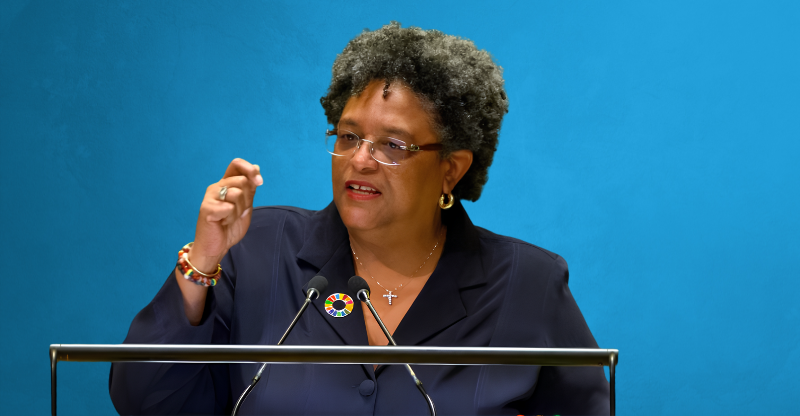
When companies face insolvency, bankruptcy or permanent closure, outstanding workers’ wages must be settled before any other creditor claims are addressed. That is the core mandate of new labor legislation Barbadian Prime Minister Mia Mottley defended before the country’s Parliament Tuesday.
Mottley presented the Protection of Wages Bill for its second reading in the House of Assembly, framing the proposal as a critical update to existing worker protection frameworks. The legislation formalizes and reinforces workers’ legal right to collect all owed wages and employment-related payments even when their employer can no longer operate, positioning unpaid wages as a non-negotiable legal obligation rather than an optional debt that can be set aside during insolvency proceedings. It marks the latest in a series of worker-focused bills advanced by the Mottley administration, designed to shore up employee protections amid ongoing global economic uncertainty.
“Leaving a job or seeing that a business fails in which you are working does not erase the obligation to pay the employees,” Mottley told lawmakers. She emphasized that safeguarding workers’ income during business collapse is not just a matter of individual financial security, but a critical step to preserve the country’s social fabric. Mottley noted that existing insolvency laws already grant priority status to workers and the National Insurance Scheme (NIS) over other creditors, a provision rooted in the recognition that failing to protect workers during business failure would cause irreversible social harm.
“One of the reasons why in our insolvency legislation, there is priority given to workers and to NIS is because we understand the social fabric that will be torn if we don’t protect the people even in the face of closures, in the face of insolvency, and ultimately even in the face of bankruptcy,” she added.
A key provision of the new bill, Clause 18, establishes a clear, enforceable timeline for settling outstanding wages when employment ends. The clause mandates that all unpaid wages and other owed amounts must be distributed to workers no later than the payday of the next scheduled pay period following the end of employment. This rule applies explicitly to cases where a business ceases operations with unpaid wage obligations.
To illustrate the bill’s core requirement, Mottley offered a simple example: if a shuttered business owes a worker $2,000 in unpaid wages, that worker must receive the full amount before any payments are made to other creditors, such as goods suppliers that hold claims against the insolvent company. Mottley also noted that the clear guidelines in the legislation are particularly helpful for small business owners navigating financial hardship, as it clarifies which obligations take legal priority when cash flow is limited.
“I’m saying this for the benefit of small employers as well. So that you know that if you’re going through a rough time and the money’s short, and you’re going to decide who you have to pay, don’t go break the law and pay the creditor; pay the worker first,” she said.