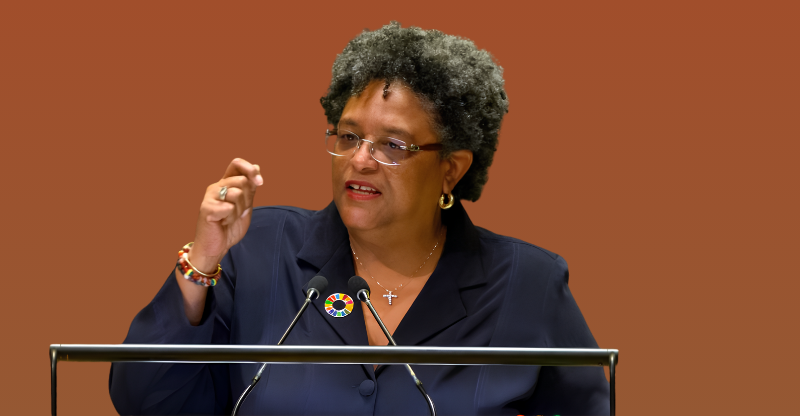
During Tuesday’s debate on the landmark Protection of Wages Bill in Barbados’ House of Assembly, Prime Minister Mia Mottley issued a stark warning to local business operators: companies that chase excessive short-term profits by cutting corners on worker compensation and working conditions are sabotaging their own long-term success.
Mottley, who addressed the chamber amid emerging allegations of workplace abuse against a major local construction and engineering firm, argued that the unsustainable pursuit of “fast money” can never be the foundation of a truly successful enterprise. When businesses squeeze every possible dollar out of their workforce, she explained, the outcome is almost always widespread employee dissatisfaction and what she termed “malicious compliance” — a disengageed approach to work that erodes operational performance from the inside out.
Her comments came in the wake of formal accusations levelled against the JADA Group by the Barbados Workers Union, which is led by government backbench MP Toni Moore. Following the union’s claims that the construction firm had forced its mostly migrant workforce to endure squalid living and working arrangements, Mottley conducted an unplanned on-site inspection of the JADA project to assess conditions firsthand.
In her address to parliament, the prime minister outlined specific, disturbing details that underscored the need for stronger worker protection frameworks. She pointed to reports that up to 80 workers were being housed in ramshackle temporary structures, with no access to basic facilities for cleaning or cooking. Additionally, she said, workers were routinely forced to log far more than the standard 40-hour work week without receiving legally required overtime pay.
While Mottley did not name the JADA Group explicitly in her parliamentary comments, the clear reference to the ongoing controversy highlighted the government’s commitment to cracking down on exploitative labor practices. She emphasized that employee experience is inextricably linked to every core metric of business success: from workplace productivity to customer service quality to long-term brand reputation.
“When an employee does not feel valued, they cannot bring that sense of care and respect to customer interactions,” Mottley explained. “That doesn’t just hurt tips or gratuities for the worker — it drives away future business for the company.” Employers that cut corners on safe, dignified working conditions do not just harm their staff, she added — they ultimately undermine their own day-to-day operations and future growth.
The prime minister pushed back against the pervasive business mindset that frames large profits as dependent on cutting labor costs. She argued that properly treated, well-compensated workers deliver higher productivity that directly boosts a company’s market competitiveness. “If treated properly, if fed properly, workers will give you a level of productivity in most instances that will make the difference between how competitive your business is or not,” she said.
Closing her remarks, Mottley called for a fundamental shift in how Barbadian businesses view their workforce. “We have to move away from this thing of believing that companies can only make egregious profits, excess profits, large profits on the backs of human beings,” she said, reaffirming that the Protection of Wages Bill is a critical step toward ensuring fair labor standards across the country. Companies that continue to prioritize maximum profit extraction over worker well-being, she warned, will only put their own long-term viability at risk.