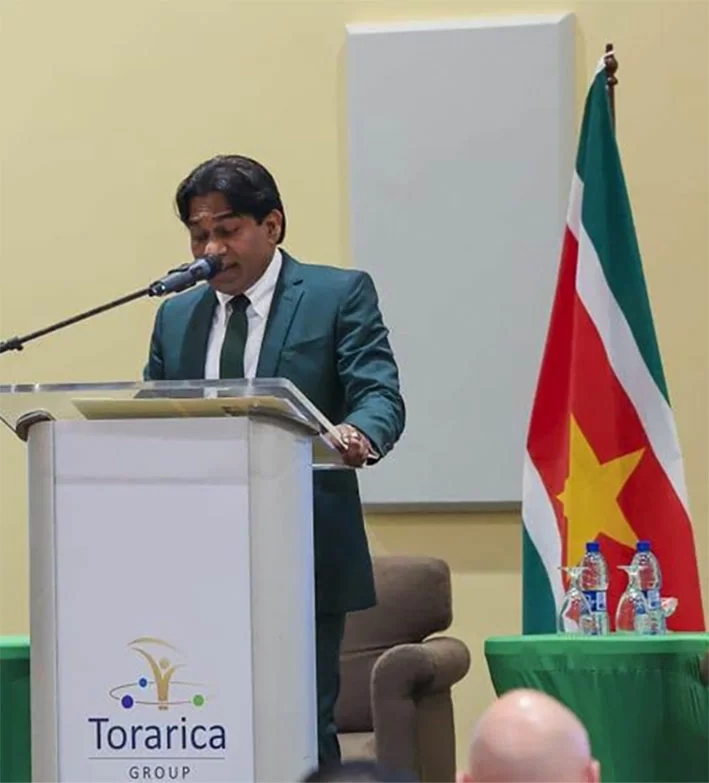
At the national Anti-Corruption Congress held on Tuesday at the Torarica Hotel Ballroom, Iwan Rasoelbaks, President of the Suriname Court of Justice, put forward a landmark proposal to overhaul the country’s anti-corruption framework. His core recommendation calls for the establishment of a dedicated, specialized anti-corruption unit that operates directly under the authority of Suriname’s Public Prosecution Office (Openbaar Ministerie, OM), staffed with experts in financial investigation, tax analysis, and digital forensics.
Rasoelbaks emphasized that countering corruption requires a fundamentally different approach than investigating traditional criminal offenses. Unlike conventional cases that often rely on witness testimony and physical forensic evidence, corruption investigations center on unpacking complex financial flows, cross-border transactions, and layered illegal financial structures. Standard, outdated investigative methods are not sufficient to unravel these sophisticated criminal schemes, he argued.
“A corruption investigation is inherently different from a traditional criminal probe,” Rasoelbaks told conference attendees. To address this gap, he advocated for a multidisciplinary team that brings together accountants, tax specialists, financial analysts, data scientists, and digital investigative experts. This specialized unit, under the direct oversight of the Public Prosecution Office, would be tasked with handling complex financial probes, tracing illicit corrupt money flows, and seizing criminally obtained assets.
Drawing on global best practices, Rasoelbaks pointed to successful anti-corruption performers such as Singapore, which has invested heavily in strong independent institutions, specialized investigative capacity, government transparency, and cross-border cooperation. This holistic strategy, he noted, has not only delivered more effective corruption control but also boosted public and investor confidence in government.
The court chief also referenced the 2027 policy agenda of Suriname’s Ministry of Justice and Police, which already outlines priorities aligned with his proposal. The government’s upcoming plan includes provisions for establishing an anti-corruption desk within the ministry, a separate specialized anti-corruption unit within the Suriname Police Corps, expanded financial investigative capacity, and deeper collaboration with international partners. The policy explicitly lists corruption control as a top national priority.
Rasoelbaks stressed that strengthening investigative capacity is a critical necessity for Suriname, as corruption does not merely undermine the rule of law—it also acts as a major drag on the country’s economic development. Nations that fail to adequately address corruption, he warned, inevitably face eroding trust from both domestic and international investors, as well as strained relationships with global partners.
In closing, Rasoelbaks underlined that no single government body can win the fight against corruption alone. Effective investigation and prosecution of complex corruption cases require robust coordinated collaboration between police, the Public Prosecution Office, the judiciary, regulatory oversight bodies, and international partners. “Only through collective, joint effort can we take the next critical step forward in the fight against corruption,” he told the gathering.