Barbados is set to make regional religious and cultural history this weekend, as St Barnabas Church in St Michael debuts the Caribbean’s first ever “Bob Marley Emancipation Mass” — a groundbreaking worship service that weaves the iconic reggae artist’s music into traditional Anglican liturgy to explore Christian themes of justice, unity and liberation.
Framing the unprecedented event through a deliberate theological framework, church leaders argue that Marley’s decades-spanning discography carries a profound, enduring message that aligns closely with core Christian scripture. The service is scheduled to kick off at 5 p.m. on Sunday, and is held in partnership with the Barbadian government as a key part of national Emancipation season observances, marking July 26 as a Day of National Significance.
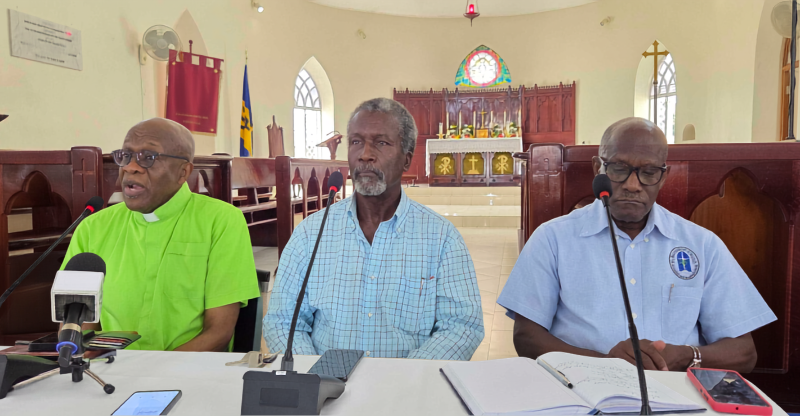
The unique liturgy used for the mass was originally debuted at St James’ Cathedral in Toronto, and penned by Reverend Canon Dr Steven Fields — a Barbadian priest currently serving in Canada, who is returning to his home country to deliver the sermon at this inaugural gathering. At a recent press conference held at the Chapel Gap church, rector Reverend Canon Dr Monrelle Williams stressed that the event is first and foremost an act of formal Christian worship, not a public concert, and is designed to encourage faithful communities to engage with secular art through a new, spiritual lens.
“This service is built around the idea that there is a theology to be found in the body of work of the late Bob Marley,” Williams explained. “There is a message that is there that is both timeless and quite relevant because Bob Marley’s music echoed the cries of the oppressed. It is a call to unity, and it speaks to a hope for liberation.”
Williams added that Marley’s songwriting offers a critical framework that pushes Christian communities to confront the lived realities of marginalized people across the globe. The iconic lyrics, he noted, challenge believers to reimagine God not as a distant, uninvolved observer of human suffering, but as an active, revolutionary force in the ongoing fight for earthly justice. By rejecting what Marley called the oppressive “Babylon system”, worshippers are called to live out a bold, inclusive, and transformative love that reflects Christian values.
Integrating Marley’s work into traditional Anglican worship has required adjusting the structure of a standard Sunday service. Where conventional masses rely on traditional hymns to mark key segments of worship, this event will replace seven hymn slots with some of Marley’s most spiritually charged tracks, which will accompany moments ranging from the opening processional to the collection of offerings and Holy Communion. The setlist includes some of Marley’s most beloved global hits: Could You Be Loved, War, Three Little Birds, and One Love.
A live band assembled by veteran musician Roger Gittens will lead the musical performance, backed by a lead vocalist, the St Barnabas Church choir, and parish organist Christopher Gibbs. Theological themes will also be brought to life through liturgical dance, with performers moving to Marley’s rhythms from the opening call of worship.
Addressing ongoing questions and potential criticism surrounding the fusion of Rastafarian cultural associations with mainstream Anglican doctrine, Williams offered clarity on Marley’s personal spiritual journey in the final years of his life. “When Bob Marley died, Bob Marley died as a Christian. He was baptised into the Eastern Orthodox Church, so he’s Christian just like we as Anglicans are Christian,” he said. “So the Rastafarians identify themselves with his music, but his music does not belong to them. It belongs to all of us.”
Church warden Stanley Alleyne echoed this inclusive perspective, pointing to the universal Christian values embedded in Marley’s most famous anthem. “Speaking of love, we’re talking about unconditional love, and that’s what human beings are supposed to represent as far as I’m concerned,” Alleyne said. “So that song, Bob Marley’s song One Love, is for me his signature song.”
The full Diocese of Barbados has formally endorsed the unconventional service. Williams confirmed that he consulted the island’s Anglican bishop, the top liturgical authority for the denomination in Barbados, to gain approval. “I shared the service with him, sought his permission to do it, and he was very receptive to the idea,” the rector said, noting that the bishop expressed significant excitement for the initiative despite being off-island for the weekend.
Church warden Junior Jordan emphasized that Sunday’s mass carries unprecedented regional cultural and religious significance. “It’s actually going to be history in the making, because it’s a first for the Caribbean, it’s a first for Barbados, and certainly it’s a first for St Barnabas Church. We are making full preparations for the large crowd that we expect to appear,” Jordan said.
To accommodate the expected influx of worshippers and attendees, the church has erected an outdoor overflow tent to supplement indoor seating, and has finalized a parking agreement with the nearby Lloyd Erskine Sandiford Centre to add extra spaces for congregation members.
Church leaders say they hope the mass will serve as a model for re-examining contemporary Caribbean culture through a spiritual lens, ultimately inspiring meaningful positive social change across the region. “What we are trying to do is to say, here is a body of music by an icon of music in the Caribbean that has within it some really positive lyrics,” Williams said. “Here is an opportunity to see Bob Marley’s music and to hear Bob Marley’s music in a Christian context, bringing a positive message to people.”