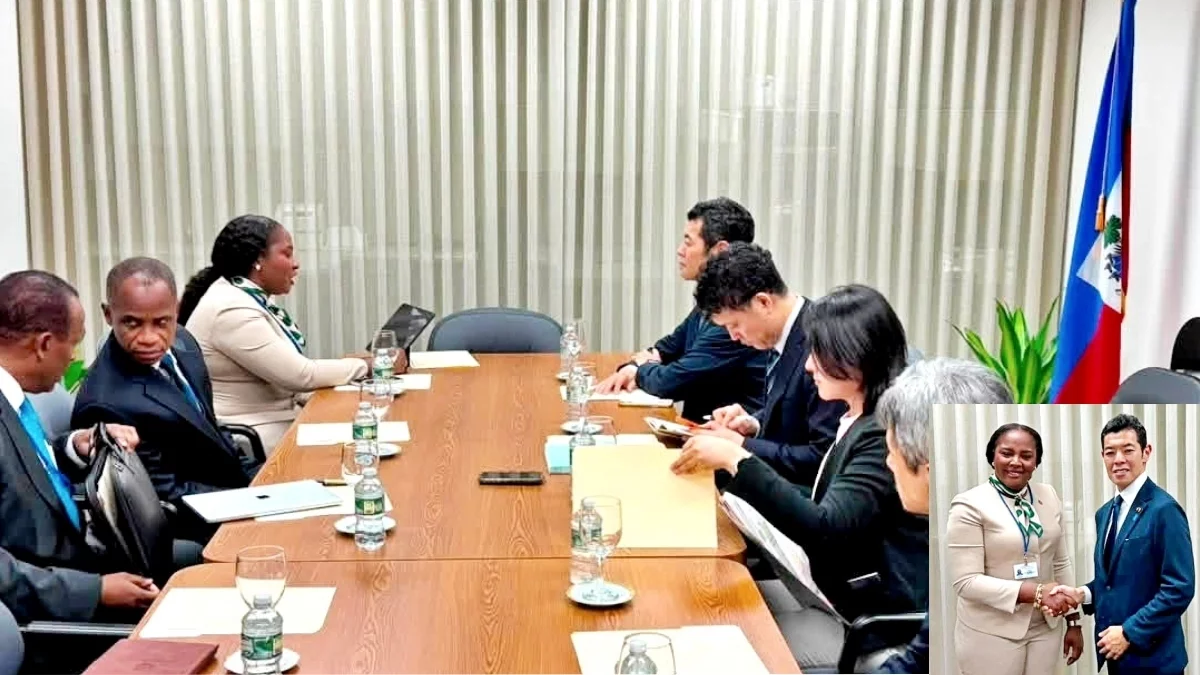
Amid the high-level convenings of the UN Economic and Social Council (ECOSOC), top diplomatic officials from Haiti and Japan gathered this week at Haiti’s Permanent Mission to the United Nations for targeted talks focused on revitalizing long-standing bilateral development cooperation. The meeting brought together Sandra Paulemon, Haiti’s Minister of Planning and External Cooperation, and Kiyoto Tsuji, Japan’s Minister of the Environment, to align on shared priorities and outline next steps for expanded support to Haiti’s ongoing recovery efforts.
Opening the discussion, Minister Paulemon extended Haiti’s formal and deep gratitude to the Japanese government for its unwavering support spanning more than 15 years, particularly in the aftermath of Haiti’s catastrophic 2010 earthquake. In that crisis, Japan stepped forward to mobilize more than $100 million in combined humanitarian aid, cash donations, technical expertise, and targeted reconstruction assistance, a commitment that has delivered tangible benefits to Haitian communities across multiple key sectors.
Paulemon emphasized that Japanese-backed initiatives have directly advanced Haiti’s progress toward the UN Sustainable Development Goals, with successful projects spanning public health, education, agricultural development, critical infrastructure, and disaster risk reduction. She highlighted a roster of completed, impactful works: the full reconstruction and equipping of the Jacmel general hospital, the major rehabilitation of Léogâne’s community water supply system, the construction and upgrade of dozens of primary and secondary schools across vulnerable regions, farmer-focused agricultural extension programs, and nationwide disaster preparedness training initiatives that have strengthened local response capacity.
During the meeting, Paulemon outlined the core priorities of Haiti’s newly drafted national framework, the Economic, Social, and Territorial Stabilization and Recovery Program (PNSREST), which the Haitian government is finalizing to guide its multi-year recovery and stabilization agenda. She formally invited Japan to contribute to the program’s centralized common financing Basket Fund, which is designed to pool international resources to advance Haiti’s top national recovery priorities. She also added a request for targeted budgetary support from Japan to back Haiti’s upcoming 2026-2027 national budget, which is currently in the final stages of preparation.
A key request put forward by the Haitian delegation centered on resuming a long-standing humanitarian aid mechanism that has been paused since 2020. Paulemon asked Japanese officials to reactivate the country’s humanitarian aid program, which was previously implemented through Haiti’s Bureau for the Monetization of Development Assistance Programs (BMPAD). She stressed that restoring this channel would be critical to expanding support for Haiti’s most vulnerable populations and accelerating the government’s ongoing economic and social recovery work. She also requested expanded partnership in technology and innovation, noting that Japan’s global leadership in technological transformation, climate and disaster resilience, and risk management offers a valuable blueprint that Haiti can leverage to strengthen its own institutional capacity and improve the delivery of public services.
In response, Minister Tsuji acknowledged the deep, positive diplomatic roots that tie the two nations together, recalling a striking moment of mutual solidarity following the 2011 Great East Japan Earthquake and tsunami: even in the wake of its own devastating national disaster just one year prior, the Haitian people and government extended meaningful support to Japan during its time of crisis. That reciprocal solidarity, he noted, forms the foundation of the strong bilateral relationship today.
Tsuji confirmed that the Japanese government will give full, careful consideration to all of the requests put forward by the Haitian delegation, covering everything from technological partnership to participation in the PNSREST framework. He signaled clear positive momentum on the request to resume BMPAD-mediated humanitarian aid, noting that Japan would move forward with reviewing the proposal in close coordination with the Japanese Embassy in Port-au-Prince to identify the most effective forms of support for Haitian communities. Following the meeting, Haiti’s Ministry of Planning announced that it will continue sustained bilateral discussions with Japanese authorities to turn the outlined cooperation prospects into tangible, large-scale projects that support long-term stabilization, inclusive economic growth, social development, and recovery across Haiti.