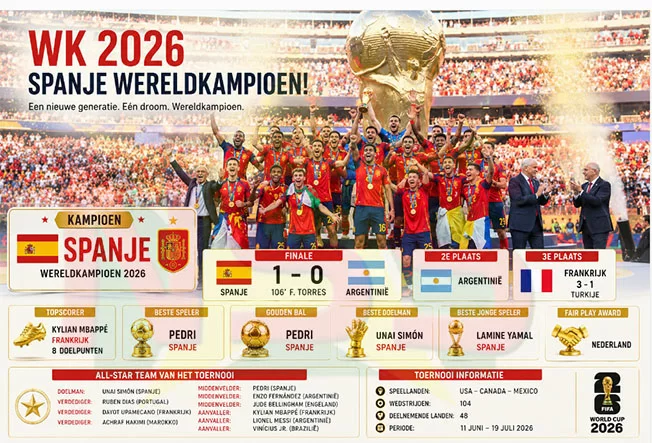
The largest FIFA World Cup in history drew to a close on Sunday, capped by Spanish captain lifting the golden trophy high above his head, with gold medals awarded to both finalists by United States President Donald Trump. After a month of thrilling matches hosted across three North American nations — the United States, Canada, and Mexico — Spain claimed global football’s highest honor, defeating defending champions Argentina 1-0 in extra time to secure their second World Cup title. The historic win also gives Spain a unique double: it remains both the reigning European and World champion. The decisive goal came in the 106th minute, with substitute Ferran Torres slotting home the match-winner that broke Argentina’s stubborn resistance.
This 2026 tournament made history as the first World Cup co-hosted by three countries, and its closing ceremony delivered a fitting conclusion to the month-long global spectacle. As fireworks illuminated the stadium sky and tens of thousands of fans cheered in celebration, President Donald Trump joined FIFA President Gianni Infantino to hand out medals to both squads. When the Spanish captain stepped forward to lift the World Cup trophy to the roar of the crowd, it marked a new iconic chapter in the long history of Spanish national football, known across the globe as La Roja.
The final’s road to that trophy lift extended 120 total minutes of tight, tactical play. For Argentina, the second-place finish ends its reign as world champions, and the final will likely go down as Lionel Messi’s last World Cup match, leaving the legend one short of a dream back-to-back world title.
FIFA built far more than just a football match for the 2026 final, launching an extensive multi-part entertainment extravaganza that began long before the opening kickoff. The pre-match ceremony brought together A-list musical artists, global football legends, and Hollywood stars for a star-studded performance. Jennifer Hudson, Robbie Williams, and Nicole Scherzinger all took the stage, as the tournament trophy was formally presented to fans. The combination of elaborate pre-match festivities and heightened security protocols pushed kickoff a few minutes behind the original schedule. History was also made during the halftime break, as the 2026 final became the first World Cup final to feature a full-scale halftime show. Madonna opened the performance, joined in attendance by Brazilian football icons Ronaldo and Ronaldinho, followed by sets from global superstars including BTS, Justin Bieber, Shakira, and Burna Boy. The lineup also included celebrated Venezuelan conductor Gustavo Dudamel and beloved characters from *The Muppets*, cementing the event’s status as a global cross-cultural celebration.
This massive production showcased how far the World Cup has evolved from a simple 16-team football tournament to a massive global media and entertainment enterprise. Yet despite all the star power on display, the defining moment of the night came not from a celebrity or politician, but from a Spanish substitute who found himself in the right place at the right time to score the winning goal.
The match itself was far more subdued and tactical than the glitzy ceremonies surrounding it. Spain took control of possession from the opening whistle, using sustained ball retention, fluid positional rotations, and high pressing to force Argentina deep into its own half. Argentina defended in a compact block, looked to win physical duels, and leaned on the experience of its veteran core and spectacular saves from goalkeeper Emiliano Martínez. Martínez emerged as one of the match’s standout players, recording 10 saves — a new record for a World Cup final, per Fox Sports analysis — that kept Argentina in the game long enough to force extra time. But Spain kept pressing, and finished the entire tournament without conceding a single goal across seven matches, a remarkable defensive achievement.
Argentina’s task grew even more difficult just before the end of regulation, when Enzo Fernández picked up his second yellow card for a foul on Pau Cubarsí, leaving the defending champions to play the entire extra period with just 10 men. The decisive moment came six minutes into extra time: Nico Williams played a perfectly timed pass to Ferran Torres, who finished the chance with one smooth movement. After more than 100 minutes of constant Spanish pressure, Argentina’s resistance finally broke. The defending champions pushed hard for an equalizer in the final minutes of extra time, but Spain’s defense held firm to protect the narrow lead.
When the final whistle blew, exhausted Argentinian players collapsed on the pitch, while Spanish players, substitutes, and coaching staff rushed onto the field to celebrate together. The title was decided by a single goal, but the victory was the product of a cohesive Spanish side that grew stronger, more confident, and more dominant with every match across the tournament.
The 2026 World Cup title confirms Spain’s return to the absolute pinnacle of global football. Sixteen years after Spain won its first World Cup in 2010 — also a 1-0 extra-time win — La Roja has once again claimed global football’s top prize. This success caps off an unprecedented run of dominance for Spanish football: Spain won the UEFA Nations League in 2023, claimed the European Championship title in 2024, and took home Olympic gold in men’s football that same year. Under head coach Luis de la Fuente, this young Spanish side has completed that incredible run to become the simultaneous holder of the European and World crowns.
The title also proves that Spain is no longer dependent on the iconic generation of Xavi, Andrés Iniesta, Sergio Busquets, and Iker Casillas that defined 2010’s win. A new young cohort has written its own place in Spanish football history: players like Lamine Yamal, Nico Williams, Pedri, Pau Cubarsí, and Ferran Torres represent a new era that combines Spain’s traditional technical quality with modern speed, aggressive pressing, and tactical discipline. Spain’s run through the knockout stage further underlined the legitimacy of their title: they defeated Austria, Portugal, Belgium, and France in sequence before overcoming Argentina, with controlled, dominant performances across every knockout round that made clear the title was no one-match fluke.
For Argentina, the loss ends an extraordinary reign as defending world champions. Head coach Lionel Scaloni’s side traveled to North America with a chance to make history as the first nation to win back-to-back World Cup titles since Brazil in 1962. That historic achievement fell just one match short, but Argentina can hardly be labeled a failure. The side reached its second consecutive World Cup final, confirming its place among the global elite. Before the final, Argentina had scored 19 goals, the highest total for any team at a single World Cup since Brazil’s legendary 1970 side also hit 19 goals.
Argentina’s road to the final was far from easy: the side defeated Cape Verde, Egypt, Switzerland, and England in the knockout stage. While the side did not always play at its best, it carried the same match-hardened mentality, veteran experience, and mental strength that carried it to the 2022 World Cup title in Qatar. But against Spain, Argentina could never find its usual attacking rhythm. Pushed deep into its own half, reduced to 10 men, Argentina ultimately could not overcome a Spanish side that controlled more possession and created more high-quality chances. Even in defeat, reaching two consecutive World Cup finals is a rare achievement that only a handful of national teams have managed in the entire history of the tournament.
Unsurprisingly, all post-match attention turned to Argentine captain Lionel Messi. The 39-year-old legend stepped onto the World Cup final pitch for the third time in his career, and his second consecutive final. Leading into the match, the game was framed as a generational clash between Messi, the greatest player of his era, and 16-year-old Spanish phenom Lamine Yamal, one of the most promising young talents the sport has ever seen. Before the final, Messi had scored eight goals and notched four assists, playing a central role in Argentina’s run to the final.
But in the match, Spain successfully limited Messi’s impact, using a collective zonal marking approach that closed down all space around him rather than assigning one permanent marker. Messi dropped deep into midfield to try to find openings, but Argentina rarely could get him into a position to create a decisive chance. In the final minutes of extra time, he tried to drag his side forward one last time, but the equalizer never came. After the final whistle, Messi stood on the World Cup final podium once again, but this time he did not step forward to lift the trophy. While he has not formally confirmed that this was his final World Cup match, the next tournament in 2030 will come when Messi is 43 years old, giving the night an unspoken air of farewell even without an official announcement.
The defeat does little to shift Messi’s standing as one of the greatest players in football history. He already holds the 2022 World Cup title, multiple other international honors with Argentina, and a club career that cements his legacy. But the image of this final will differ from Qatar: instead of Messi lifting the trophy above his head in celebration, it will be Messi watching from close range as a new champion is crowned.
The 2026 World Cup was the first expanded tournament to feature 48 teams, hosted across three North American nations. The expansion led to 104 total matches for the first time in tournament history, with a 32-team knockout stage. FIFA has called the new expanded format a major success, but the larger tournament has also sparked ongoing debate over fixture length, physical and mental load on players, and the growing commercialization of the global event.
Across the month, the tournament delivered stunning upsets, early eliminations of traditional powerhouses, and breakthrough performances from smaller nations. Traditional giants proved far from unbeatable: Brazil was knocked out by Norway, Germany fell to Paraguay on penalties, and Morocco reached the quarterfinals for the second consecutive tournament. France finished third after a high-scoring match against England. But above all the storylines of the 2026 World Cup, the defining narrative will always be Spain’s historic triumph: La Roja entered the tournament as European champions, and left as the undisputed champions of the world.