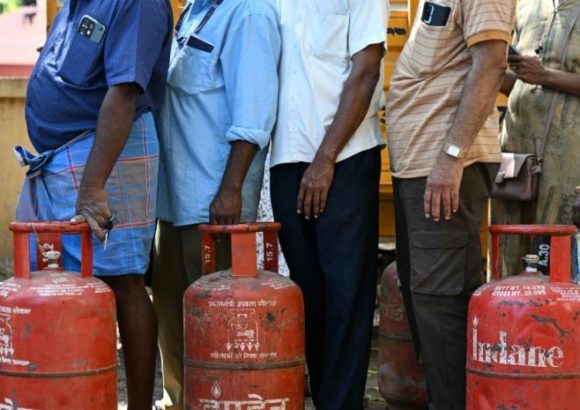
A controversial proposal to adjust the composition of liquefied petroleum gas (LPG) sold in the Dominican Republic has sparked fierce debate, with top energy industry leaders warning of catastrophic safety risks if the change moves forward, while analysts back the plan as a much-needed solution to sky-high consumer fuel costs.
The debate was ignited by a recent investigation from the Energy Institute of the Autonomous University of Santo Domingo (IEUASD), which found that the weekly Import Parity Price (PPI) calculation conducted by the Ministry of Industry, Commerce and MSMEs (MICM) has left LPG overpriced by roughly 30 Dominican pesos (RD$) per unit for local consumers. As one of its core reform recommendations, the institute has proposed shifting the standard LPG mixture from its current 70% propane and 30% butane blend to a 90% propane composition, a change that industry analysts confirm would cut end-consumer prices, since propane trades at a lower cost than butane on global markets.
However, senior energy sector executives have pushed back hard against the suggestion, highlighting that the vast majority of residential LPG storage cylinders in the country are not equipped to handle the increased pressure that comes with a higher propane blend. To understand the risk, industry leaders note that pure propane sits at a storage pressure of 250 pounds per square inch (PSI), while pure butane holds at just 100 PSI. The existing 70/30 blend lowers overall pressure to a range that is manageable for most tanks, drastically reducing the risk of catastrophic failure.
Carlos José Martí, CEO of the Martí Group, explained that the country’s existing fleet of 25 to 50-pound residential LPG cylinders is already in dangerously poor condition. Many of these aging tanks are repaired informally in unregulated neighborhood yards, with no formal safety inspections to confirm they can hold standard pressure. If pressure is increased by raising the propane share, Martí warned, the country could see a wave of deadly, preventable explosions.
Francisco Camino, technical services director for major local LPG supplier Tropigas, echoed these urgent safety warnings. Camino added that a common unregulated practice among homeowners makes the risk even higher: many residents paint their old gas cylinders to hide visible signs of deterioration, leaving structural flaws and corrosion undetected by both users and distributors. “If tanks can fail at current pressure levels… imagine what could happen if that pressure rises,” Camino explained, emphasizing that higher pressure inherently translates to greater public safety risk. He also noted that Tropigas maintains stricter filling protocols that keep its incident risk near zero, but most other operators across the country do not have the same safeguards. Beyond tank condition, Camino added that ambient temperature also interacts with pressure to amplify risk, a factor that cannot be ignored in the Dominican climate.
Supporters of the proposal, however, argue that the cost savings for consumers are too significant to dismiss outright. Analysts confirmed this Wednesday that the IEUASD recommendation is economically viable, and would immediately bring down monthly energy costs for millions of households that rely on LPG for cooking and other daily needs. Currently, LPG is only subject to a 16% advalorem tax under tax reform 495-06, plus an environmental levy and the Bonogas subsidy charge, but the IEUASD’s investigation confirms that current pricing leaves the fuel 30% more expensive than it should be under the official PPI formula.
Industry experts also note that existing Dominican regulations already allow a propane share of up to 90%, so the change would not require immediate legislative overhauls. They do acknowledge that the higher propane blend has a lower caloric output, leading to slightly different performance: for residential use, the flame burns blue, so experts say a public awareness campaign would be needed to prevent consumers from thinking they are receiving lower-quality fuel. For vehicular use, the blend causes a minor loss of engine power, making it best suited for the small cars that dominate urban public transport in the country, where the power reduction would be unnoticeable.
If the government approves the change, industry insiders say it would take roughly 45 days to implement, to allow importers to close existing supply contracts and build up sufficient propane storage. As of this week, the MICM set the official retail price of LPG at RD$135.20 per gallon, which includes RD$0.80 for the Bonogas subsidy, RD$13.54 for tax reform contributions, RD$11.71 for distribution margins, RD$17.90 for retailer margins, and RD$6.68 for transportation costs. In total, taxes and fees make up RD$50.63 of the final per-gallon price.
The IEUASD investigation also highlighted broader systemic issues with Dominican fuel pricing, stating that current policy creates significant distortions that harm consumers and generate hidden tax revenue for the national government. Efforts to reform the country’s 2000 Hydrocarbons and Fossil Fuel Derivatives Law have stalled for years: a 2022 bill that would have revised the PPI calculation was never even sent to congressional committee for debate, leaving the status quo in place for consumers.