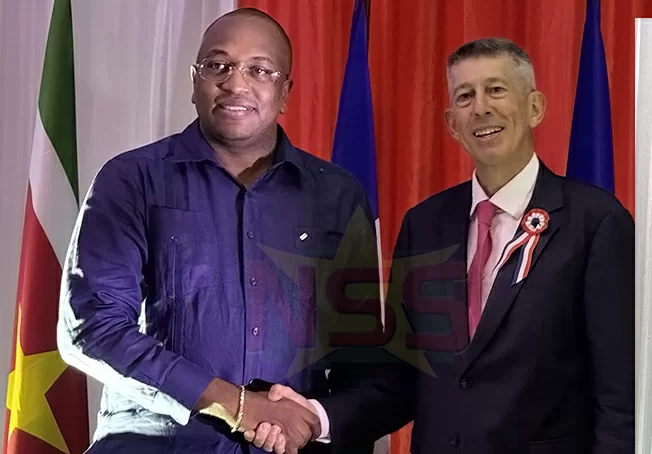
As France prepares to bid farewell to its long-serving ambassador to Suriname Nicolas de Lacoste, diplomatic leaders from both nations have laid out an ambitious vision for a new chapter of partnership between the neighboring countries, coinciding with the upcoming 50th anniversary of formal diplomatic relations.
Speaking at a joint event Tuesday evening marking both Bastille Day (Le Quatorze Juillet) and his upcoming departure from the South American nation, de Lacoste expressed both nostalgia for his posting and firm confidence in the future of bilateral relations. “Suriname and France are neighboring countries bound by centuries-old ties as sister nations, built through generations of shared history,” the outgoing ambassador told attendees.
De Lacoste outlined that the new phase of cooperation will span four key areas: economic development, cross-border security, cultural exchange, and regional integration. He pointed to Suriname’s strong growth potential over the coming years, highlighting the active involvement of French energy giant TotalEnergies in the nation’s offshore energy sector as tangible proof of the mutual trust that underpins current relations. He also noted that the French community residing in Suriname has seen explosive growth in recent years, a sign of deepening people-to-people connections.
Suriname’s Minister of Foreign Affairs Melvin Bouva echoed de Lacoste’s optimism, noting that France, as a close neighbor, already delivers tangible opportunities for Suriname, even as untapped potential remains across trade, agriculture, infrastructure development, and tourism. This August 25, the two nations will mark a major diplomatic milestone: the 50th anniversary of the establishment of formal diplomatic ties. Bouva emphasized that the anniversary offers an ideal opportunity to deepen and strengthen the bilateral partnership.
A core priority for advancing cooperation is finalizing and implementing the bilateral border agreement. Bouva confirmed that Suriname is moving forward with the final ratification steps to conclude what he described as a long, intensive, but critically important process. The minister stressed that operational cross-border collaboration is essential to maintaining a secure frontier that facilitates legitimate travel and trade. “Neither country will serve as a safe haven for illegal activities,” Bouva affirmed, noting that transnational challenges demand coordinated joint action.
De Lacoste echoed this commitment, saying he is fully confident that the shared border between France and Suriname will be strengthened, adding that leaders on both sides share a common goal of improving quality of life for border communities that have consistently called for greater public safety. He added that joint cross-border patrols have already delivered tangible results, leading to the interception of criminal suspects wanted on both sides of the shared river border.
On the regional cooperation front, de Lacoste thanked Suriname for its support in securing associate member status for French Guiana and Martinique in the Caribbean Community (CARICOM), a step that he says will further boost regional integration for French Guiana and strengthen ties between Paris and Paramaribo. “Suriname can always count on France as a reliable, predictable partner within the European Union,” he added.
The ambassador emphasized that centuries of shared history remain the foundational bedrock of bilateral relations. The historical connections stretch back hundreds of years: when Suriname offered shelter to French exiles including Huguenots, and later French Guiana provided protection to Surinamese Maroons during the era of slavery, the country’s civil conflict, and in the aftermath of the 1986 Moiwana massacre, which marks its 40th anniversary this year. “Nothing will ever erase this part of our shared history,” de Lacoste said.
Looking back on his four-year tenure in Suriname, de Lacoste shared that he leaves with only minor regrets: wishing he had been able to explore more of the country’s interior and reach greater fluency in Dutch and Sranantongo. One of his most cherished memories is a walk through Paramaribo with celebrated Surinamese author Cynthia McLeod, who told him that French was once the most widely spoken language in the Surinamese capital. In line with this history, de Lacoste expressed hope that French will gain a greater foothold in Suriname’s education system, particularly in border regions along the Marowijne and Lawa rivers.
The ambassador also said he was deeply impressed by Suriname’s peaceful multicultural society, calling it a “truly admirable Surinamese secret.” He joked, “If there is any country where we will never hear racist comments about the French national football team, it is Suriname.” He also highlighted his fond memories of visits to remote interior communities including Tepu and Apoera, as well as trips to the country’s border regions.
Bouva praised de Lacoste for his “dedication, openness, professionalism, and sincere commitment” to advancing bilateral ties during his tenure. While not all of the ambassador’s planned initiatives have been completed, Bouva noted that a strong foundation for future progress has been laid. “Thanks to your efforts, ambassador, we are well on our way toward reaching the shared vision we have for our relationship,” Bouva said. Looking ahead, the minister outlined plans to invest in cross-border infrastructure and policy initiatives designed to bring communities closer together, rather than dividing them along the frontier.
At his farewell event, de Lacoste honored three long-serving members of the French embassy staff in Suriname with official French distinctions: Jolanda Solingen, the embassy head chef; Stanley N’Gadimin, the ambassador’s chauffeur; and Eric Champier, head chef of the ambassador’s official residence.