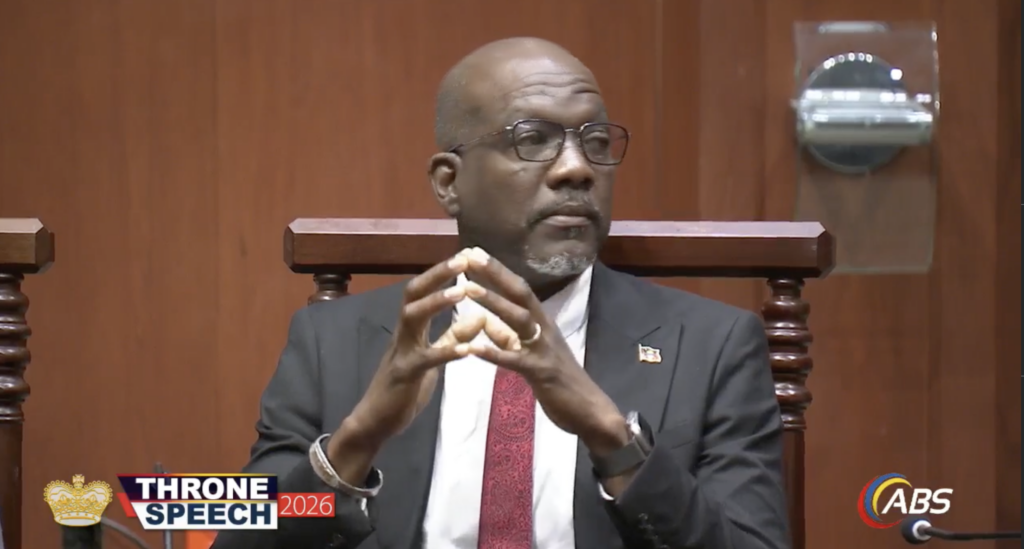
During a heated parliamentary debate on Tuesday, Antigua and Barbuda’s Education Minister Daryll Matthew pushed back against fierce opposition criticism of the government’s approach to ongoing negotiations with the United States focused on potential transfers of third-country nationals. Opponents of the governing administration have repeatedly claimed that the small Caribbean nation holds no meaningful leverage in talks with Washington, citing its geographic size and pre-existing U.S. visa restrictions as factors that leave Antigua and Barbuda negotiating from a position of extreme weakness. Matthew rejected this narrative outright, arguing that the country’s greatest strategic strength comes from staying at the negotiating table and advancing terms that prioritize the well-being of all Antiguan and Barbudan citizens.
Addressing the full legislative body during debate over a parliamentary resolution that establishes a formal framework for continued negotiations, Matthew reframed the opposition’s “no cards” argument. “We may have a small hand. We may have a small voice. However, we still have the responsibility to negotiate in the best interests of our people,” he told assembled lawmakers. “The only time you have no cards is when you get them from the table and walk away.” With both the Antiguan-Barbudan negotiating team and U.S. representatives remaining committed to ongoing discussions, he emphasized that the government will continue working toward a final outcome that delivers benefits to the country’s population.
Matthew stressed that responsible governance demands sustained engagement even when negotiating with a far larger global power, pushing back against opposition calls for a complete overhaul of the government’s negotiation approach. He also pushed for cross-party unity on this sensitive issue, noting that questions of national interest should never devolve into partisan political fighting, and calling for a broad national consensus around the government’s negotiating priorities. “There must be some things that, as a nation, we can collectively agree on,” he said. “This is one of them.”
The minister commended Prime Minister Gaston Browne, Ambassador Sir Ronald Sanders, and the full government negotiating team for publicly releasing a White Paper on the talks and bringing the framework resolution before parliament, a move he said demonstrates the administration’s commitment to transparency and keeps the general public fully informed about ongoing discussions. “I want to commend the Prime Minister… and the entire team that has been working diligently on this over the past six, eight months for putting everything here on the table,” Matthew stated.
He also categorically denied opposition claims that the government had already struck a secret deal to accept third-country nationals, clarifying that the current resolution before parliament does not ask lawmakers to approve a finalized agreement or bind Antigua and Barbuda to accepting any transfers at all. “This resolution is not committing the government to accept anyone,” he explained. “We are not approving the operating procedures. We’re not committing to receive. What we’re doing is simply saying that we want certain issues satisfied.”
Matthew laid out clear non-negotiable conditions that any final agreement must meet to gain approval, starting with a hard cap of just 10 total transfers in 2026. After the initial pilot period, he said, the country can reassess whether the arrangement delivers tangible benefits to national development. Additional key requirements include a total ban on accepting any individuals with criminal convictions, no additional financial burden placed on Antiguan and Barbudan taxpayers, and permanent retention of the government’s right to reject any individual proposed for transfer.
Warned that allowing convicted criminals to be transferred to the small island nation would carry catastrophic risks for public safety, Matthew highlighted the severe harm that even one high-risk offender could cause. “Can you imagine if one convicted pedophile was deported to Antigua and Barbuda and just ran havoc in this country? Can you imagine if a serial killer was transferred from the United States to Antigua and Barbuda? … Can you imagine if a sophisticated gang leader came to Antigua and Barbuda?” he asked. These risks, he argued, fully justify the government’s insistence on maintaining the final say over which individuals may be transferred. “There must be an opportunity for us as a nation to say, ‘This person, no,’” he said. “We have to have a framework in place that protects our national interests.”
Matthew also noted that Antigua and Barbuda’s limited public infrastructure cannot support unregulated transfers, adding that the country cannot afford additional strain on already constrained housing, healthcare, and other core public services. “I cannot, with a good conscience, tell my constituents that we had no cards, we had to take all of them, we had to put it on the taxpayers’ purse, we had to give them a job, we had to give them a house,” he said.
Despite the strict conditions the government has laid out, Matthew struck an optimistic tone about the progress of talks, saying that the two sides are closer to a mutually acceptable agreement than critics have claimed. After reviewing the negotiated White Paper and all draft documents exchanged between the two parties, he concluded that “We’re not so far apart.”
Closing his remarks, Matthew once again praised the governing team for bringing the issue to parliament for open debate, reinforcing the government’s commitment to transparency and public accountability. “I want to commend the Prime Minister and his team for bringing this resolution to Parliament so that we can speak with clarity, so that the public understands exactly what it is we’re doing,” he said.