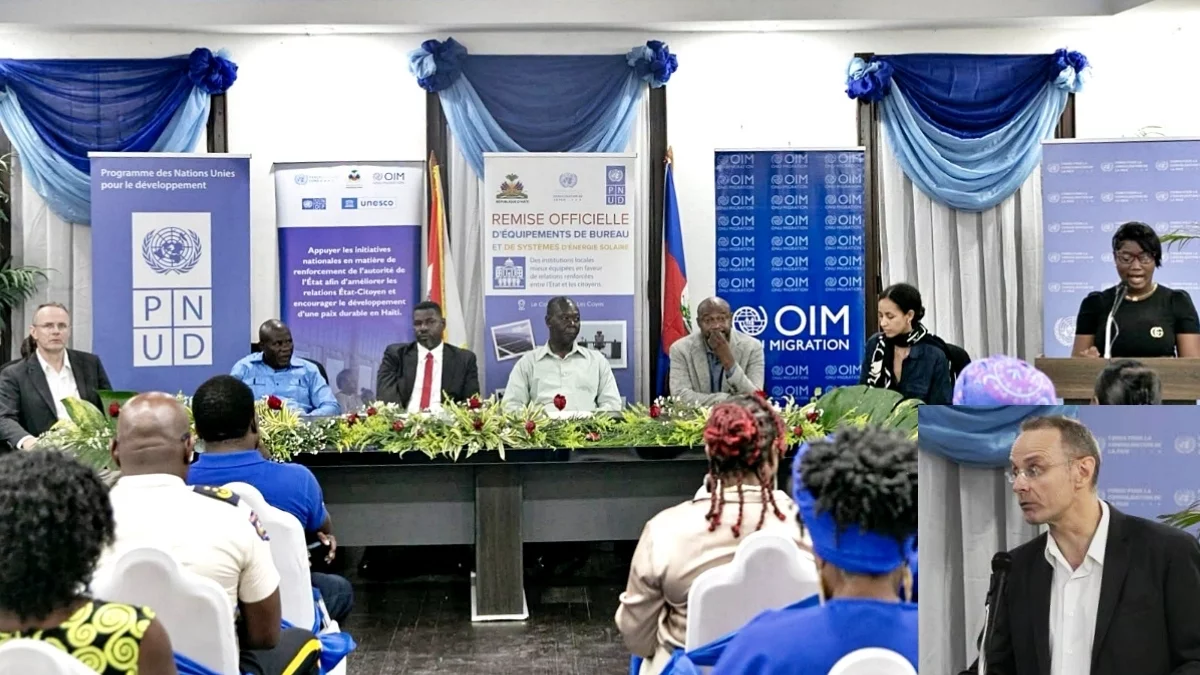
Haiti has long grappled with overlapping security, political, and humanitarian emergencies that have stretched state infrastructure and strained connections between national authorities and local communities. In this fragile context, fully functional local public institutions stand as a critical lifeline, keeping channels of communication and service delivery open between the state and the populations it serves. On July 10, 2026, UNDP Haiti, backed by funding from the United Nations Peacebuilding Fund, hosted an official handover ceremony at Cap-Haïtien City Hall to transfer a package of essential office equipment and off-grid solar power systems to 12 local public institutions across Cap-Haïtien and Les Cayes. The donation forms a core component of the UN-backed State-Citizen Relations (SCR) Project, an initiative designed to rebuild trust and strengthen governance at the local level.
The ceremony drew a wide cross-section of national, local, and international stakeholders, including Michel Saint-Croix, Mayor of Cap-Haïtien; Nora Nadja Naji and Deborah Gribaudo, representatives of the UN Peacebuilding Support Office based in New York; and Sylvain Merlen, Deputy Resident Representative of UNDP in Haiti. Senior departmental and local authorities from both regions also attended, alongside leadership from the 12 beneficiary institutions. Attendees included Jean Pierre Raynaud Phildor, Vice-Delegate of the Les Cayes district; Jean Renaud Joseph, representative of Les Cayes’ Association of Community Action Committees (CASECs); Jean Renel Ferdinand, a representative for Cap-Haïtien’s CASECs; and Serge Phanord, Departmental Director of the Office of Citizen Protection (OPC) for Haiti’s North department.
The donation package covers a wide range of critical supplies tailored to the day-to-day operations of local public offices. It includes 12 laptops, 12 all-in-one multifunction printers, 180 visitor chairs, 15 metal work desks, 15 dedicated office chairs, 15 large work tables, secure filing cabinets, wall and standing fans, bottled water coolers, and 12 fully integrated solar power systems. The entire package is designed to address longstanding gaps in working conditions for local public employees, ensure consistent delivery of administrative services even amid frequent power outages, and remove barriers that prevent ordinary citizens from accessing the support they need.
Twelve institutions across Haiti’s northern and southern regions will directly benefit from the donation: eight Communal Section Administrative Council (CASEC) offices, the vice-delegations of both the Les Cayes and Cap-Haïtien districts, and the OPC departmental offices for the North and South departments. These decentralized bodies serve as the first and often only point of contact between local populations and the Haitian state, with responsibilities ranging from processing public service requests to facilitating local conflict mediation and creating space for citizen participation in local governance. For the beneficiary institutions, the new resources address immediate, unmet needs that have severely limited their ability to carry out their core daily missions for years.
Beyond the tangible donation of equipment and energy infrastructure, the SCR Project pursues a far broader, long-term goal: to sustainably strengthen the institutional capacity of Haiti’s local governance bodies and repair the fractured relationship between state institutions and Haitian citizens. To advance this mission, the project has already rolled out a series of complementary initiatives, including skills-building workshops focused on government transparency and accountability, participatory needs assessments to identify gaps in local institutional performance, targeted training for territorial authorities, and the formal establishment of the Joint Committee on Transparency and Accountability (CMSTR). The project has also supported the creation of a community-led monitoring and evaluation mechanism to track institutional performance, and public outreach initiatives designed to make local institutions more accessible to ordinary citizens, such as a popular open house week hosted by Les Cayes city hall earlier this year.