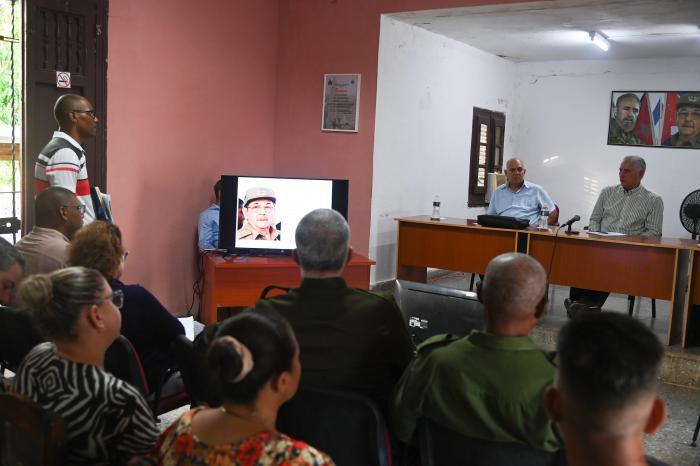
Against a backdrop of ongoing economic and social adversity across Cuba, national leadership has placed a renewed focus on granular, on-the-ground engagement with municipal-level governance to address citizen needs and solve pressing daily challenges. This approach centers on close examination of local conditions, direct engagement with community concerns, and persistent pursuit of targeted solutions – a philosophy that turns municipal-level work into a critical space for addressing problems at a manageable scale and centering the lived experiences of residents behind broad national statistics.
It is this commitment that brought Cuba’s highest leadership, headed by Miguel Díaz-Canel Bermúdez, President of the National Defense Council, to a series of municipal visits across Havana in recent days. On the afternoon of Monday, July 15, 2026, Díaz-Canel was joined by Roberto Morales Ojeda, Political Bureau member and Organizational Secretary of the Central Committee of the Communist Party of Cuba, for a working meeting with the Boyeros Municipal Defense Council.
Boyeros ranks among the capital Havana’s largest municipalities, home to seven People’s Councils and a population of more than 176,400 residents. During the meeting, Díaz-Canel, Morales Ojeda and other accompanying national leaders held in-depth dialogue with local authorities, receiving detailed updates from Yucleidis Ramírez Ramírez, president of the Boyeros Municipal Defense Council.
Ramírez Ramírez outlined updates on the municipality’s most critical daily infrastructure and livelihood issues, including electricity supply, water access, and food security. He emphasized that the Defense Zone holds strategic importance for the territory in the current context, noting that updating the municipality’s comprehensive “energy map” stands as one of the most urgent ongoing tasks for local governance.
Discussions spanned every core dimension of residents’ daily lives. Beyond infrastructure, Ramírez Ramírez presented details on the municipality’s citizen services system, support programs for vulnerable populations, and the coordinated role of local economic actors in aiding at-risk community members. For example, the municipality’s Family Support System (known locally by its Spanish acronym SAF) currently receives active support from 38 local economic entities. New participating economic actors have also been assigned to manage consistent pension distribution across the territory, while both state and non-state entities have been tasked with expanding production and distribution of staple food products, prioritizing underserved areas with the highest need.
Solid waste collection, a longstanding challenge across Havana that has spurred local governments to test innovative solutions, was a key focus of Monday’s meeting. Boyeros authorities reported that they are currently testing low-cost alternative collection methods including horse-drawn carts, and are exploring other context-appropriate solutions. Meeting participants agreed that any locally successful approach to waste collection should be scaled up across other municipalities facing similar challenges.
The meeting also covered Boyeros’ ongoing agenda to revitalize public spaces for community sports, cultural activities, and general recreation, a initiative designed to boost overall quality of life for the municipality’s residents.
During the session, President Díaz-Canel asked specific questions about the operation of the SAF and progress on expanding local food production. The gathering also served as an opportunity to reinforce core governance priorities: timely identification of emerging local problems, early planning for the upcoming academic school year, and ongoing work to optimize both the structural and functional performance of the local Defense Zone.
Closing the meeting, Díaz-Canel reaffirmed the value of systematic planning and consistent follow-up on issues that directly impact residents. Stressing that sustained attention to detail is the most effective way to deliver meaningful progress, he told local counterparts that another follow-up meeting will be held in the near future to continue monitoring progress and addressing emerging challenges in Boyeros.