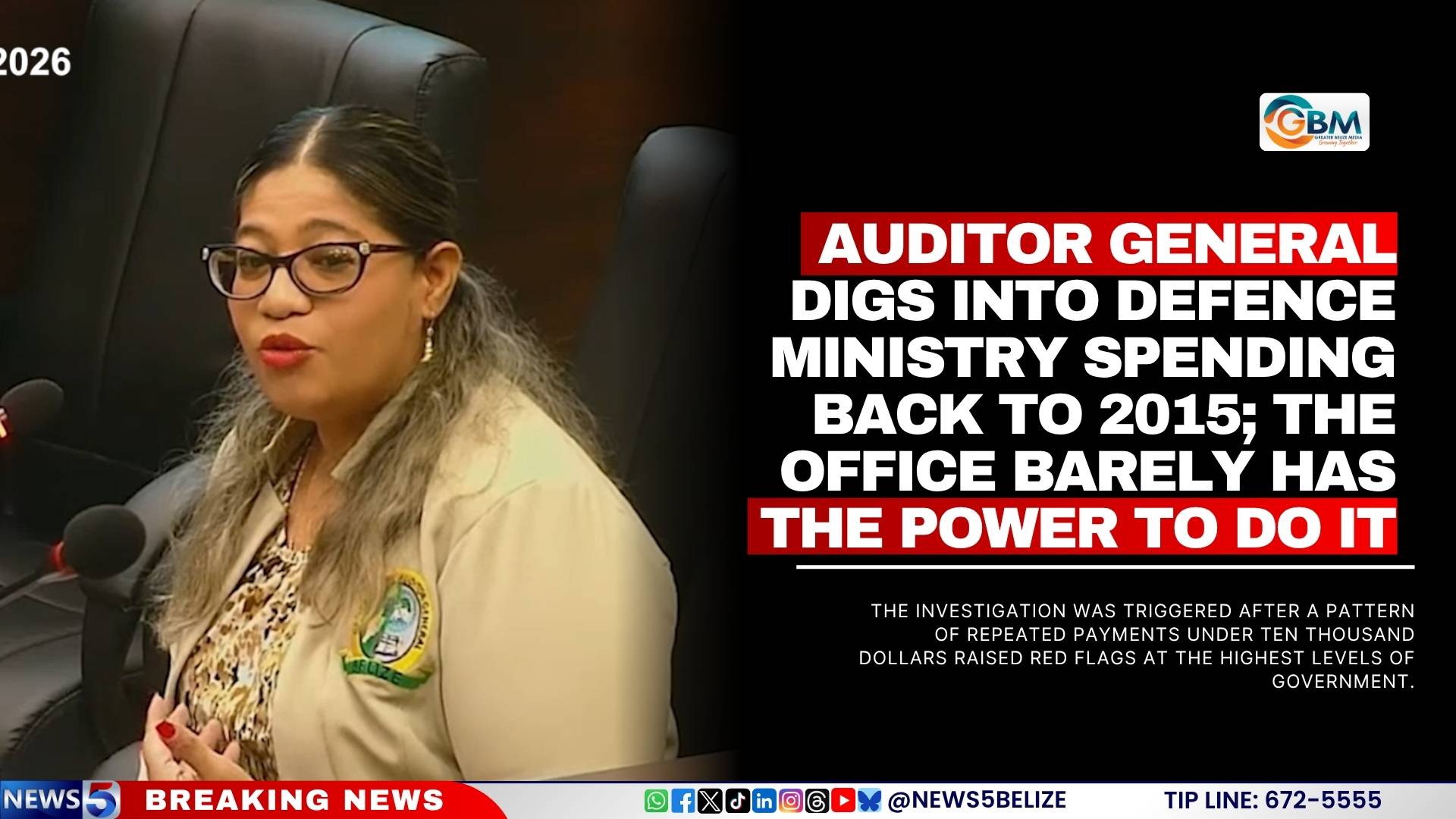
In one of the most high-stakes inquiries in its institutional history, Belize’s Office of the Auditor General has launched a sweeping audit of the Ministry of Defence, driven by growing public and official claims of corruption. The probe, which will trace spending decisions all the way back to 2015, has already sparked intense debate over the office’s limited resources, questioned independence, and ability to enforce accountability for public funds.
The investigation was set in motion after senior government officials noticed a suspicious pattern: hundreds of repeated transactions, all valued just below the ten-thousand-dollar threshold that triggers enhanced financial oversight. Belize Prime Minister John Briceno confirmed that the red flags prompted him to reach out to the financial secretary and order the Auditor General to examine the irregular activity.
In a surprise announcement two weekends prior to the report, Briceno expanded the scope of the audit far beyond the transactions of his current administration, ordering investigators to include spending from 2015 onward to uncover any potential misconduct linked to previous officeholders, including former politician John Saldivar.
This extension of the timeline has cast doubt on whether the office can complete the full investigation within the initial three-month deadline. Opposition Leader Tracy Panton has joined growing calls for a far more extensive, independent review, arguing that the problems plaguing public spending are not isolated to the defence portfolio. Panton contends that the issues are systemic across government agencies, requiring a full forensic audit rather than a limited probe.
Established under Belize’s constitution, the Auditor General’s role is appointed by the governor general, and the Finance and Audit Reform Act is supposed to protect the office from political interference. In practice, however, the institution’s independence has faced widespread public criticism. Dean Flowers, president of Belize’s Public Service Union, recently claimed that all oversight bodies, including the Auditor General’s office, are influenced by political interests. Flowers alleged that appointees to these roles prioritize personal and partisan gain over the national good, collecting salaries while upholding a corrupt status quo.
On paper, the Finance and Audit Reform Act grants the Auditor General broad investigative powers: the right to summon public officials for questioning, search any government-held documents or records, and access financial data with almost no restrictions. In reality, the office has consistently faced obstruction from the executive branch. Auditor General Maria Rodriguez outlined these challenges in a May 13 interview, explaining that executive branch officials often refuse to meet with her staff or respond to requests, and the office has no formal avenue to compel compliance. Rodriguez emphasized that executive branch representatives must be required to cooperate with the office’s inquiries, separate from parliamentary oversight processes.
Compounding these structural challenges is the office’s severely constrained budget. Despite being tasked with scrutinizing billions of dollars in annual public expenditure, the Auditor General’s office operates on an annual budget of just over three million dollars, ranking it among the smallest and lowest-funded government entities in Belize’s national budget.
Prime Minister Briceno has pushed back against concerns about stalled progress, insisting that the current administration is fully cooperating with the probe. Briceno confirmed that auditors have begun compiling requested documentation, and that Ministry of Defence CEO Usher has given assurances of full cooperation. The Prime Minister added that the investigation will proceed without exemptions, and any public official or politician found to have engaged in misconduct will be held accountable for their actions.