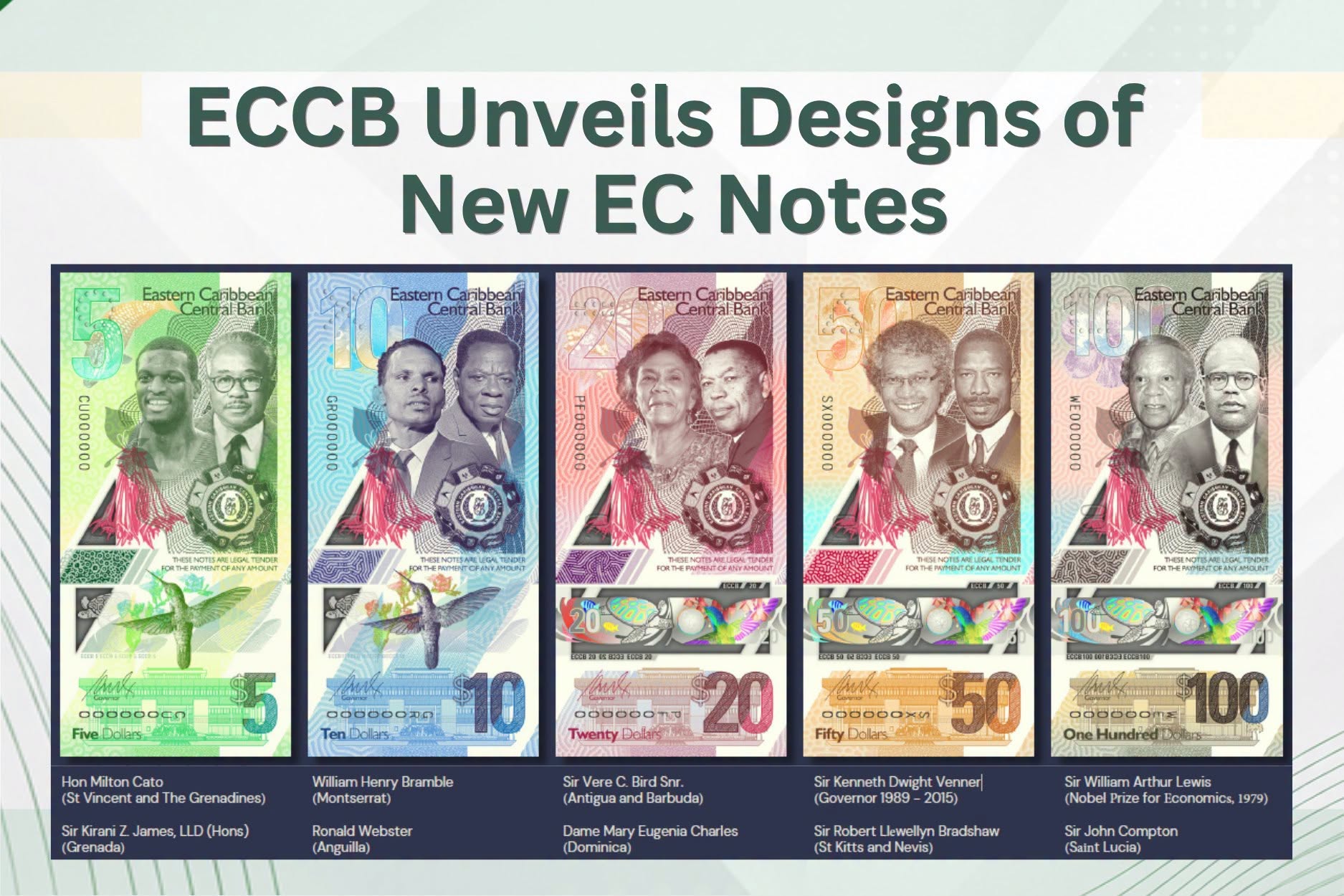
For months, anticipation has built across the Eastern Caribbean around the Eastern Caribbean Central Bank’s (ECCB) landmark decision to remove Queen Elizabeth II’s image from regional banknotes — a move widely celebrated as a key step toward asserting post-colonial identity and regional self-determination. But as details of the new currency designs have emerged, one concerned regional citizen is pushing back against what they call a critical failure to capture the full scope of Eastern Caribbean history.
In an open letter to the editor, the writer argues that while removing the British monarchy’s image was a long-overdue and praiseworthy change, the ECCB’s new lineup of portraits leaves out the foundational figures who shaped the region long before modern independent governments took shape. Instead of highlighting a diverse range of contributors to Eastern Caribbean society, the new banknotes are almost entirely dominated by sitting and former prime ministers, political leaders, and other government officeholders.
While the writer acknowledges that many of these political figures made meaningful contributions to their nations, they question whether holding public office should be the sole or primary benchmark for national recognition. The backbone of modern Eastern Caribbean society, they stress, was built generations before independence by enslaved Africans who resisted brutal oppression, organized uprisings against their enslavers, and fought and died for the liberty that current generations enjoy today.
Across every island in the Eastern Caribbean bloc, from St. John’s 1733 slave revolt to Fedon’s Rebellion in Grenada, and countless lesser-documented uprisings in St. Kitts and Nevis, Antigua and Barbuda, Dominica, Saint Lucia, and St. Vincent and the Grenadines, these unsung freedom fighters altered the trajectory of regional history. Many have been lost to historical record, but the writer argues their sacrifices still deserve national commemoration — a space they have been entirely denied on the new banknotes.
Currency, the writer points out, is far more than a practical tool for financial exchange. It is a pervasive, accessible educational medium that passes through the hands of millions of people, including children, every single year. The figures featured on banknotes send a powerful message about which contributions matter, shaping how entire regions remember and interpret their past. By prioritizing sitting political leaders exclusively, the ECCB risks cementing a harmful narrative that true leadership originates in government office, rather than in the grassroots struggle for justice, freedom, and human dignity that laid the groundwork for independent Eastern Caribbean nations.
Beyond the overlooked freedom fighters of the anti-slavery movement, the writer notes that the Eastern Caribbean is home to generations of accomplished trailblazers across every sector: renowned scientists, award-winning artists, champion athletes, transformative educators, influential labor leaders, celebrated writers, iconic musicians, and cultural pioneers whose contributions extend far beyond the realm of party politics. A truly representative set of banknotes, they argue, would celebrate the full diversity of Eastern Caribbean achievement, rather than concentrating recognition on a single professional group.
The writer does praise the ECCB for its commitment to public consultation during the redesign process, a step that represents meaningful engagement with regional citizens. But they argue that consultation should not end with the launch of the new banknotes, and should instead spark ongoing reflection on how the region tells its collective story. Future redesign efforts, they urge, should strive for far greater historical and sectoral balance, prioritizing recognition for the women and men whose courage, sacrifice, and creativity built Eastern Caribbean society centuries before the creation of modern parliaments, cabinets, and elected governments.
“If our money is to truly tell our story as a region, then it must tell all of it,” the writer concludes.