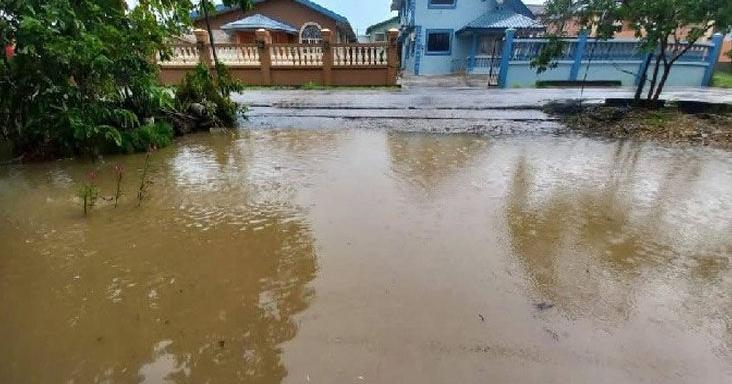
Intense overnight rainfall across southern Trinidad has sparked dangerous flash flooding, forcing an elderly pensioner to evacuate her flood-swamped residence in Barrackpore as local authorities move forward with long-planned infrastructure and drainage upgrades to address recurring flooding in the region.
The resident, who lives alone on Cumuto South Trace, has dealt with repeated flooding episodes for years: even 10 to 15 minutes of steady rainfall is enough to send water surging into her property, according to local councillor Joseph Lorant. When floodwaters rose rapidly this week, knee-high levels inundated the ground floor of her home. Though the property has an upper level she could retreat to, mobility impairments that make climbing stairs difficult left her with no option but to flee the premises entirely for safety.
Lorant confirmed that the pensioner was the only resident displaced by flooding in her immediate neighborhood during this latest rain event, though the heavy downpour triggered flash flood events across multiple communities in Moruga and other districts of Barrackpore.
For years, local crews have repeatedly cleared the waterway near the pensioner’s home to reduce flooding, but persistent blockages in key drainage sections have kept the problem unresolved. Now, after gaining the resident’s approval to conduct private land remedial works, officials are preparing targeted interventions to fix the issue long-term. Lorant explained that immediate steps will include targeted dredging of the local waterway to improve drainage flow, which will serve as a temporary solution until permanent infrastructure upgrades—including the construction of new box drains—can be completed.
Across the wider Penal/Debe region, this week’s flooding has also offered a real-world test of a groundbreaking new drain and waterway maintenance initiative launched two months ago. The VAC master cleaning programme, which uses specialized high-pressure machinery and vacuum extraction to clear blockages from underground culverts, has already delivered measurable improvements, according to Penal/Debe Regional Corporation chairman Gowtam Maharaj.
Unlike traditional maintenance that only cleared surface blockages, the new programme reaches deep into closed underground culverts—the primary source of most urban street flash flooding, Maharaj explained. Crews have already serviced high-risk areas including town centers and major road junctions, pulling out a surprising array of discarded debris that had clogged drainage systems for years: plywood sheets, fallen logs, discarded mattresses, and hundreds of plastic bottles, among other waste.
Maharaj noted that while flash flooding did occur this week, water levels receded far faster than in past events, a improvement he directly attributes to the new maintenance programme. He added that coordinated work between the regional corporation, which uses smaller excavators for local drainage clearing, and the Ministry of Works, which handles large-scale river maintenance, also supported faster water run-off after the downpour. Following this week’s flood events, crews will expand the VAC programme to new areas including the front of a Barrackpore secondary school and other sites where minor flooding was reported. In addition to drainage work, the corporation’s disaster management unit quickly responded to a separate incident, clearing a fallen tree that blocked a local road after the heavy rain.
Officials say they remain optimistic that the combination of targeted remedial works for high-risk private properties and expanded systematic drainage maintenance will reduce future flood risk for vulnerable residents across the region.