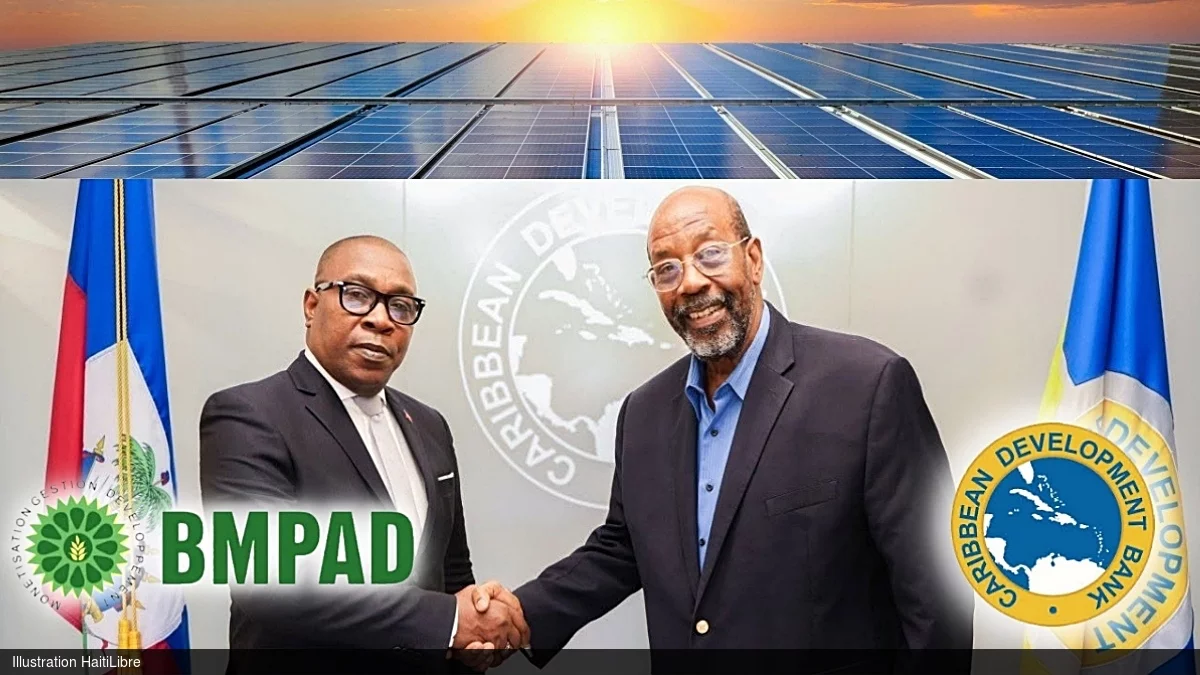
Haiti is poised to deliver a long-overdue energy transformation to its underserved rural communities, as the country’s Office for Monetization of Development Assistance Programs (BMPAD) has launched formal partnership discussions with the Caribbean Development Bank (CDB) to advance a ground-breaking solar electrification project.
In a landmark first working session, BMPAD Director General Me Stevenson Jacques Thimoléon laid out the details of the Solar Electrification Program for Essential Public Services (PESPE), an initiative designed to expand sustainable, reliable electricity access to Haiti’s most energy-poor rural regions. This meeting marks a critical milestone in BMPAD’s strategy to build international collaboration around renewable energy projects that strengthen core public services for rural Haitians.
At the core of PESPE is a plan to install stand-alone photovoltaic solar systems at three types of key public facilities located in communes and communal sections with the least consistent access to grid electricity: public primary and secondary schools, community health centers, and local sub-stations of the Haitian National Police (PNH). The overarching goal of the project is not only to expand energy access, but also to reduce stark territorial disparities between urban and rural areas by delivering higher-quality public services to populations that have long been overlooked.
To ensure efficient, coordinated delivery, PESPE will be led by BMPAD with active participation from a cross-sector coalition of Haitian government institutions, including the Ministry of Planning and External Cooperation (MPCE), the Ministry of National Education and Professional Training (MENFP), the Ministry of Public Health and Population (MSPP), the National Institute of Professional Training (INFP), and the Haitian National Police itself. BMPAD is also actively seeking additional technical and financial partners to support full implementation of the initiative, with the inter-agency governance structure designed to deliver coordinated, efficient, and long-lasting outcomes.
The initiative aligns directly with the Haitian government’s national sustainable development priorities. If all required co-financing from national and international partners is secured, PESPE will draw on a total investment pool of $45 million USD over a 36-month implementation period. As a critical first step to test the model, BMPAD is prioritizing launching a 12-month pilot project that will validate the technical, social, and financial viability of the program before it is scaled up nationwide.
Beyond just installing solar panels on public buildings, the program includes holistic capacity-building components to ensure long-term sustainability. Local technicians will receive specialized training to maintain the solar installations, community-level management committees will be established to oversee ongoing operations, and the project will position renewable energy as a core driver of inclusive local economic development.
When fully deployed, PESPE is projected to deliver electricity to 500 rural schools, 300 rural health centers, and 200 PNH rural sub-stations. The far-reaching impacts of this access will include improved learning environments for hundreds of thousands of Haitian students, stronger quality of primary health care for rural communities, reliable cold chain storage to preserve life-saving vaccines at local clinics and dispensaries, and increased operational capacity for law enforcement working to keep rural communities safe.
Through this initial engagement with the Caribbean Development Bank, BMPAD has reaffirmed its commitment to diversifying its network of technical and financial partners to deliver high-impact economic and social projects. By centering renewable energy as a lever for sustainable development, the initiative seeks to strengthen public services and close the persistent equity gap between Haiti’s urban and rural areas.
This first formal contact between the two institutions has opened promising pathways for long-term collaboration, with the immediate goal of mobilizing the resources needed to launch the pilot project. That pilot will serve as a foundation for a national program that has the potential to permanently transform access to essential public services and accelerate inclusive development for Haiti’s rural communities.