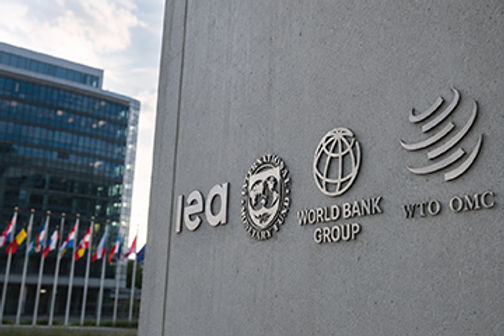
Four of the world’s most influential multilateral institutions covering energy, finance, development and global trade have issued a rare joint assessment, noting that the immediate market turbulence triggered by the ongoing Middle East conflict has softened, but ongoing vulnerabilities across the global economy demand that national governments stay vigilant against potential new disruptions.
Following a high-level coordination gathering held July 7, the chief executives of the International Energy Agency (IEA), International Monetary Fund (IMF), World Bank Group and World Trade Organization (WTO) released a public statement highlighting that the global economy has so far displayed unexpected resilience in the face of the conflict. Still, the leaders emphasized that macroeconomic uncertainty remains elevated, and ripple effects from the hostilities are likely to persist for the foreseeable future.
This working group was first convened in April, created specifically to align a unified institutional response to the war’s spillover effects on global energy markets, cross-border trade flows and overall economic stability. In their latest update, the group confirmed that while global prices for fuel and agricultural fertilizer have pulled back from peaks recorded ahead of their June coordination meeting, the underlying crisis sparked by the conflict has not been fully resolved.
The institutions added that the conflict’s economic impacts have been deeply uneven across different national economies. It has disrupted critical energy supply chains, threatened global food security, roiled commodity markets and dampened overall economic activity, dragging down growth projections and pushing up inflation rates in many vulnerable economies around the world.
In the statement, the four bodies called for sustained international diplomatic efforts to end the conflict and reopen unimpeded access to the Strait of Hormuz, the world’s most strategically critical maritime chokepoint, through which roughly a fifth of global oil supplies and large volumes of other traded goods pass every day. They also urged national governments to uphold the principle of freedom of navigation, invest in strengthening collective energy and food security, upgrade port infrastructure and streamline trade facilitation processes, and build broader systemic resilience to absorb future economic shocks.
This joint statement makes clear that the world’s leading multilateral economic and energy institutions still view the Middle East conflict as a major persistent threat to global economic stability, even as near-term market conditions have improved in recent weeks.
For small import-dependent economies like Belize, prolonged regional instability could continue to put upward pressure on fuel costs, international shipping rates, fertilizer prices and broader inflation, even as the recent pullback in global energy prices has delivered some temporary relief to vulnerable households and businesses.
The four institutions concluded by confirming they will maintain close, continuous monitoring of global developments tied to the conflict. They also reaffirmed their commitment to expanding targeted support to member nations if economic conditions worsen again, standing ready to adjust their assistance programs to meet evolving needs.