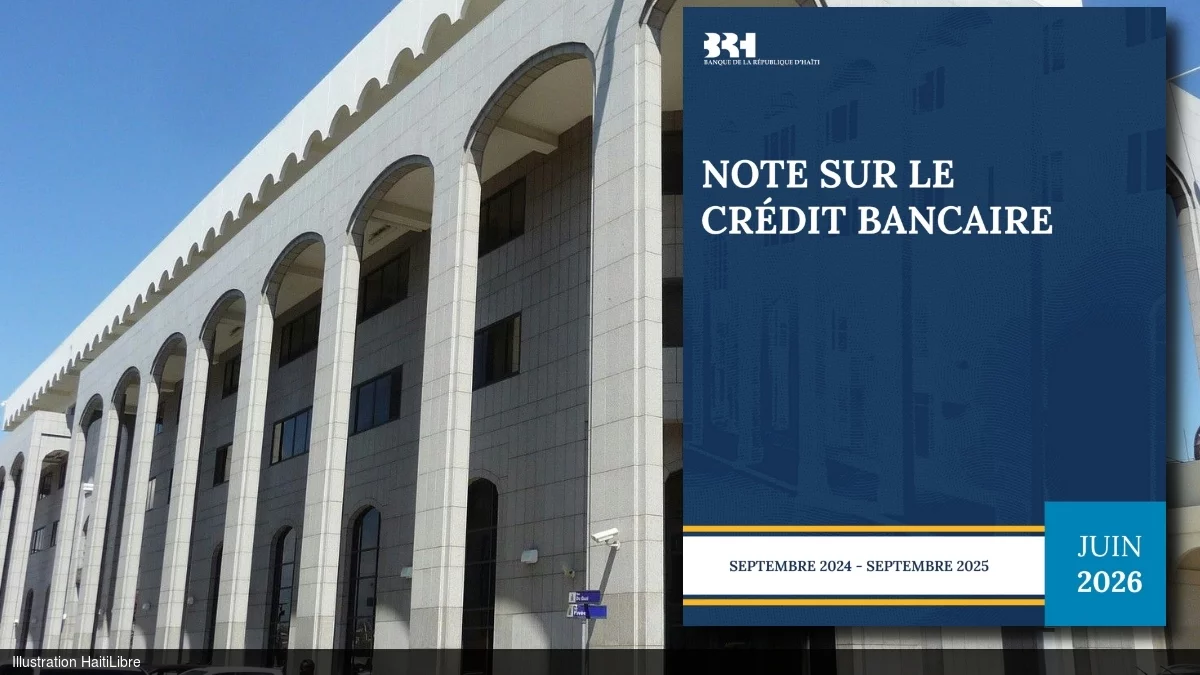
After two consecutive years of sharp decline, Haiti’s bank lending to the private sector has finally edged into positive territory, new data from the Bank of the Republic of Haiti (BRH) confirms. The central bank’s latest annual report, which tracks credit trends between September 2024 and September 2025, shows a modest 0.3% expansion in the country’s net loan portfolio, ending a downturn that saw credit contract by 15.2% in 2024 and 9.6% in 2023. This fragile growth unfolds against a backdrop of deep systemic challenges that have kept Haitian financial institutions deeply cautious about extending new capital.
Over the 12-month analysis period, Haiti’s commercial banks maintained a risk-averse lending posture amid ongoing deterioration of the national business climate and a five-year-long worsening security crisis that has disrupted nearly all segments of economic activity. The report documents that the average rate of non-performing loans (NPLs) across the sector climbed to 13% during the period, up from 10.36% in the 2023-2024 fiscal year, a jump that has further incentivized conservative lending strategies.
Beyond overall growth trends, the BRH analysis highlights significant structural inequalities in Haiti’s credit market. Lending remains heavily concentrated in a small set of sectors and geographic regions, with persistent gender-based gaps in access to financing for small business owners and entrepreneurs. To mitigate ongoing strain on the market, the central bank has already rolled out targeted interventions to support struggling borrowers and prioritize lending to high-impact productive sectors, though the report notes these measures have had limited impact amid broader instability.
Breaking down credit allocation by sector, the report shows the housing sector and industrial free zones are the largest recipients of bank lending, holding 5.269 billion gourdes and 5.082 billion gourdes in outstanding credit respectively. Together, these two segments account for more than half of all allocated private sector credit, at 26.6% and 25.7% of the total portfolio. Export-focused enterprises follow as the third-largest group, receiving 3.212 billion gourdes in financing equal to 16.2% of total disbursements, while the tourism and hotel sectors hold 2.440 billion gourdes, or 12.3% of total allocated credit.
The agricultural sector, which benefits from special provisions outlined in BRH’s Circular 113, received 11.9% of total disbursements, and the government’s Real Estate Development Promotion Program (PPDI) accounts for an additional 5.3% of lending. Leasing-focused financial institutions round out the allocation, receiving 400 million gourdes, equal to 2% of total private sector credit.
In its policy analysis, the BRH emphasizes that sustained growth in private sector lending will depend first on reversing the country’s security crisis. The report notes that improving public safety is a non-negotiable prerequisite to rebuild investor confidence, restart stalled productive activities, and revitalize traditional credit distribution channels. Restoring national stability, the central bank argues, would also lay the groundwork for a more supportive environment for financial innovation that could expand access to underserved groups. Beyond security, the report identifies the development of a robust, comprehensive financial risk management ecosystem as a critical priority to strengthen long-term resilience in Haiti’s banking sector.
The full 18-page BRH report, published in French, is available for public download via the HaitiLibre official website.