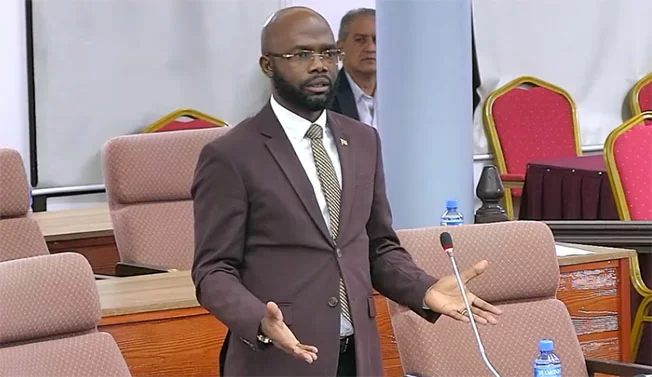
A heated political clash has erupted in Suriname’s National Assembly (DNA) over plans to discuss the high-profile disappearance of more than 300 kilograms of mercury from the Geyersvlijt police station compound behind closed doors, with cross-faction lawmakers pushing back against the government’s push for a confidential committee general discussion. The controversy centers on a major theft case that has already sparked widespread public concern, with critics arguing the public has a right to full transparency, especially given the case touches on the integrity of the national police force itself.
Multiple sitting members of the legislature have rejected the proposal to hold proceedings in secret, arguing that the seriousness of the theft and questions around police institutional integrity demand an open, public debate that allows Suriname’s society to follow the proceedings and hold officials accountable. Ebu Jones, a faction member of the NDP opposition, flatly rejected closed-door handling of the case. Jerrel Pawiroredjo, faction leader of the NPS, added that confidential committee general meetings should remain an exceptional procedure, not a default for common criminal cases.
Pawiroredjo warned that treating a run-of-the-mill mercury theft with mandatory secrecy would push the National Assembly directly into covering up the issue, eroding public trust in the legislative body.
Government representatives, including Justice and Police Minister Harish Monorath and government coordinator in the DNA André Misiekaba, defended the call for confidentiality, noting that an active criminal investigation into the disappearance is still ongoing under the leadership of the Public Prosecutor’s Office. According to the government, sensitive investigatory details cannot be released in an open plenary session, as public disclosure could jeopardize ongoing investigative work. The government offered to share full sensitive details with lawmakers in a closed committee general meeting if legislators desired more information, but this proposal drew sharp criticism from both ruling coalition and opposition blocs.
Jones reiterated that the public already has broad awareness of the case and significant concerns, giving Surinamese citizens a legal and moral right to clear, public information. He emphasized that parliament has a fundamental obligation to uphold transparency when addressing missing materials and integrity failures within the police service.
Krishna Mathoera, a legislator from the ruling VHP party, contextualized the mercury disappearance as part of a longer pattern of problematic incidents within the police apparatus, including other missing seized goods, allegations of extortion, and repeated integrity breaches. Mathoera stressed the issue extends beyond the active criminal probe, touching on core governmental accountability: “What measures is the Minister of Justice and Police taking to stop this kind of incident from happening again?” she asked.
The government maintained its position that active investigatory work means names and operational details cannot be named publicly, while acknowledging that parliament has a legitimate right to receive accountability updates, noting the relevant minister has already outlined planned policy changes to address gaps. VHP faction leader Asis Gajadien and fellow legislator Rabin Parmessar underlined that the National Assembly retains the sovereign right to vote to make information public if it determines a closed confidential meeting is unnecessary, a precedent that has been set in previous parliamentary cases.
DNA Speaker Ashwin Adhin outlined a compromise path forward, announcing that after consultations with the government, a new meeting has been scheduled for Thursday at 9:00 a.m. If the government determines all relevant details can be released publicly, the full meeting will be open to the public and media. If sensitive information is deemed necessary to withhold initially, the meeting will open in closed committee general session, after which the full National Assembly will vote on whether to transition the remainder of the debate to an open public session.
A confidential preliminary meeting has already been convened, with the full parliamentary debate scheduled in the coming days. Multiple legislators have stressed that confidential committee general meetings must not become a routine tool to keep matters of public interest hidden from general view. They reminded fellow members that DNA Standing Order Article 100 mandates secrecy for all members for matters discussed in closed session, unless the full National Assembly votes to lift the confidentiality requirement. The government is set to discuss the matter at a cabinet meeting this week to finalize its position on what information can be released publicly ahead of Thursday’s scheduled parliamentary debate.