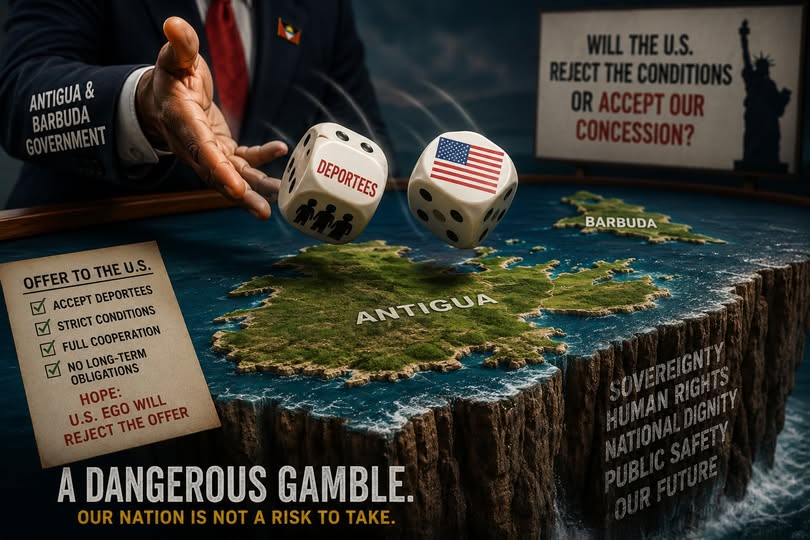
After processing the initial shock of the Antigua and Barbuda government’s proposal to accept up to 10 deportees from the United States, independent analyst Yves R. Ephraim has published a nuanced breakdown of the Caribbean nation’s negotiating strategy, outlining two starkly contrasting potential outcomes: a masterclass in small-state diplomacy, or a reckless gamble that could threaten national sovereignty and security.
At the core of Ephraim’s criticism is the excessive secrecy surrounding the drafting and signing of the memorandum of understanding (MOU) between the two governments. To date, the full text of the agreement has not been released to the Antiguan and Barbudan public, a lack of transparency that Ephraim argues was only broken when a third country leaked details of the negotiations. He suspects the signed MOU includes provisions that bar the government from publicly sharing the full agreement, a restriction that leaves citizens unable to form their own informed opinions on a matter of critical national importance. The government’s failure to disclose the document has already eroded what little public trust remained in its handling of the issue, he says.
Ephraim also poses a fundamental unanswered question: why did Antigua and Barbuda agree to enter negotiations with the U.S. over this proposal in the first place? While he acknowledges that high-level diplomatic talks often require a degree of confidentiality to avoid derailing discussions, he argues that the government’s approach to public disclosure has been mishandled from the start, leaving the public rightly angered over what many see as unnecessary concessions on core national interests including sovereignty and border security.
To provide context for his analysis, Ephraim outlines the official position the Antigua and Barbuda government has laid out for the negotiations: first, the country is open to engaging with the U.S. in a spirit of bilateral friendship and cooperation; second, it rejects any permanent, ongoing monthly program of deportee transfers; third, it will only review potential cases on an individual basis, exercising full sovereign discretion over each decision; fourth, it has capped the total number of deportees considered for acceptance in 2026 at no more than 10, and will only move forward if all of the government’s conditions are met in writing; fifth, no deportee will be accepted until all requirements for eligibility, documentation, funding, settlement responsibility, legal status and return arrangements are finalized in advance; sixth, the government retains the full right to reject any candidate, turn away improperly documented arrivals, or suspend the entire arrangement at its own discretion; seventh, no third party or international organization will be involved in the process on Antigua and Barbuda’s behalf until all core terms are agreed to the government’s satisfaction; and eighth, all terms stand unless Antigua and Barbuda’s parliament votes to amend them.
Based on these terms, Ephraim lays out his theory of the government’s underlying strategy: Antigua and Barbuda is aiming to avoid openly antagonizing its powerful bilateral partner the U.S., while intentionally creating a negotiating deadlock that will ultimately kill the proposal. By appearing cooperative on the surface and offering a limited concession of accepting 10 deportees, the government insulates itself from U.S. claims that it is refusing to cooperate. At the same time, the strict conditions it has attached place heavy demands on the U.S. that Ephraim argues align with a core assumption: the current U.S. administration’s ego will never allow it to acquiesce to terms set by a small Caribbean nation, nor accept that every deportation decision must be vetted and approved by Antigua and Barbuda’s government.
Ephraim notes that this strategy, if it holds, would be a brilliant win for small-state diplomacy: the U.S. cannot accuse Antigua and Barbuda of being uncooperative, and the impasse will persist until there is a change in the U.S. administration, a timeline that fits what is publicly known about the current administration’s approach to international negotiations. But if the gamble fails, Ephraim warns, Antigua and Barbuda will have no way to back out of its public commitment to accept the 10 deportees, opening the door to further concessions down the line.
His deepest criticism is reserved for the government’s choice to unilaterally gamble with national interests without full public consultation or transparency. “Whether this strategy is deliberate or just a lucky accident remains to be seen,” Ephraim concludes. “If the stalemate holds, the government will have pulled off a success under difficult circumstances. But if the government miscalculates, the outcome will be no different than a compulsive gambler mortgaging the family home and losing, leaving his wife and children with nowhere to go.” For now, he says, the public can only wait to see how the gamble plays out.