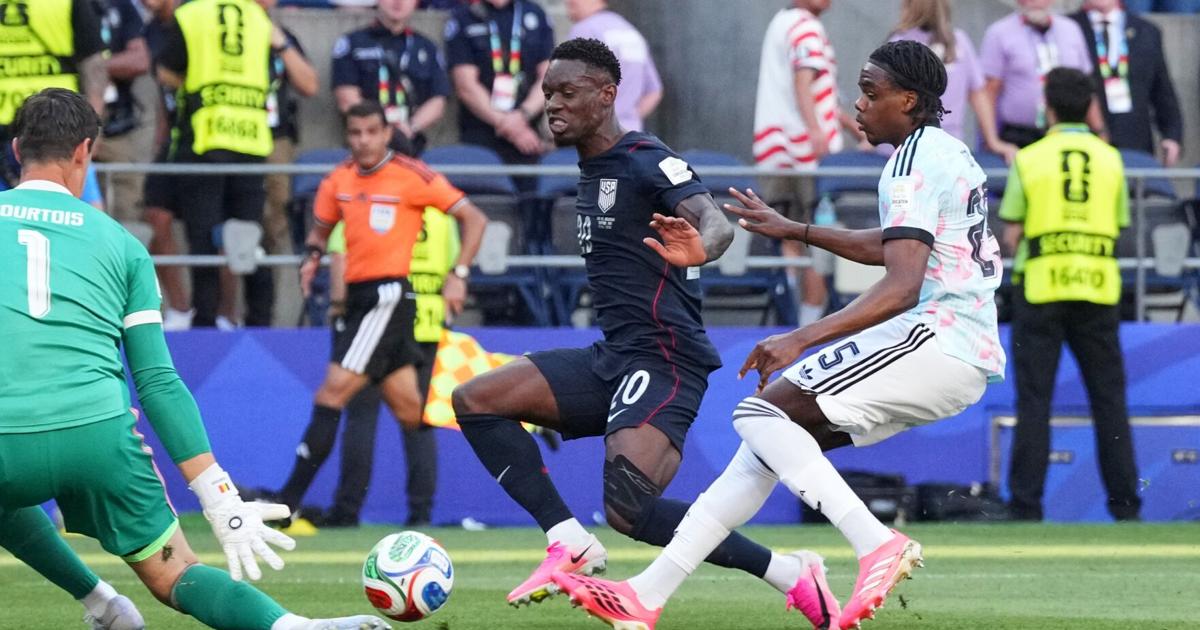
A firestorm of global debate has erupted in men’s World Cup soccer after a high-profile political intervention resulted in star United States forward Folarin Balogun being cleared to play in a critical Round of 16 matchup against Belgium. The controversy traces back to a red card issued to Balogun during the U.S.’s 2-0 group stage victory over Bosnia-Herzegovina in Santa Clara, California, which carried an automatic one-game suspension that would have sidelined the tournament’s leading American goalscorer.
Speaking to reporters at an unrelated Oval Office event, former U.S. President Donald Trump confirmed he personally placed a call to FIFA President Gianni Infantino to request a formal review of the red card decision. Trump clarified that he did not demand a specific outcome, saying, “All I did was ask for a review. I didn’t say, ‘You have to do this.’” The president framed the initial red card as a “horrible” call, arguing that it would have created an unfair competitive disadvantage for the U.S. and left a permanent blemish on the tournament.
Trump, who described himself as having a sharp understanding of sports, admitted he was not initially familiar with the specific rules around red cards and their penalties. Once he learned the call would force Balogun out of the Belgium match, he said he chose to intervene. He also pushed back on the use of slow-motion video replay to issue the red card, noting that slowed-down footage can exaggerate the intensity of accidental on-field collisions. “I didn’t think it was a foul,” he said. “I thought it was two great athletes that crashed into each other and got entangled.” He added that both teams should be allowed to field their strongest rosters regardless of the final result: “If we win or we lose, it’s fair.”
Following Trump’s call, FIFA ultimately overturned the suspension, clearing Balogun to start against Belgium in Seattle. The decision sparked celebration among U.S. soccer fans and officials, including U.S. Secretary of State Marco Rubio, who called the ruling correct. “Why would Belgium want to win a match if everyone will argue you didn’t really win it because their best, or their leading, scorer was not on the pitch?” Rubio asked during a public appearance ahead of a diplomatic meeting with Chile’s foreign minister, joking that the dispute was on track to become a full “international incident” ahead of this week’s NATO summit in Turkey.
But the reversal has drawn sharp condemnation from across the global soccer community, with many decrying the move as an unacceptable case of political interference in the sport. The Belgian Football Association formally challenged Balogun’s eligibility for the Round of 16 match, and European governing body UEFA issued a scathing rebuke, calling FIFA’s decision “incomprehensible and unjustifiable.”
Infantino later released a public statement on the social platform X defending the independence of FIFA’s internal judicial process, seeking to distance the governing body from claims of political coercion. “During our conversation, I explained that there was an ongoing legal process involving FIFA’s independent judicial bodies and that the case would be decided in due course by the competent bodies,” Infantino wrote. “That is how FIFA’s system works, and it is a principle that I will always uphold.”
The controversy also extended to Brazilian referee Raphael Claus, who issued the original red card. Trump launched an unsubstantiated attack on Claus’s integrity, claiming the official was “a little bit suspect if you check his past,” but offered no evidence to back up the claim. Claus, who has been ranked among Brazil’s top referees for several years and was selected to officiate the 2024 Copa America final, has never been formally accused of misconduct. A 2024 Brazilian Senate investigation into match-fixing scrutinized general referee assignment practices but did not name Claus as a subject of wrongdoing.
Both the Brazilian Football Confederation and the Sao Paulo Football Federation issued statements defending Claus in the wake of Trump’s comments. “There is nothing in his record that calls his integrity into question or supports any suspicion of wrongdoing,” the Brazilian confederation said, while the Sao Paulo federation offered “unwavering support” for Claus against what it called “regrettable insinuations that attempt, without any basis, to cast doubt on his integrity and professional career.”