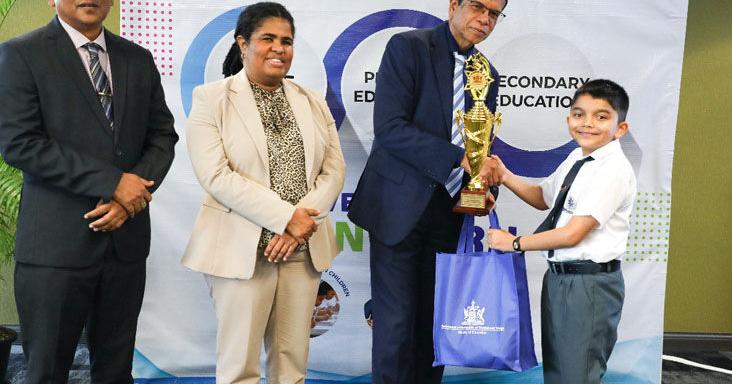
A landmark achievement for Trinidad and Tobago’s primary education system was celebrated this week, as nine top-performing students from across the country were honored at an awards ceremony hosted by the Ministry of Education at its Port of Spain headquarters.
Among the standout cohort, three students achieved a rare perfect 100% score on the 2026 Secondary Entrance Assessment (SEA), the national examination that determines placement for secondary school. While Ministry officials opted not to publicly rank the top nine awardees to avoid singling out individual students, Education Minister Dr. Michael Dowlath confirmed the three-way tie for first place, adding that the highest overall Composite Weighted Standard Score hit an exceptional 253.423. One of the perfect scorers, Shazana Mohammed of Debe Hindu School, publicly shared her full-mark achievement during her acceptance speech at the event.
Senior education officials including Acting Permanent Secretaries Simone Williams and Keshore Lutchman, Chief Education Officer Dr. Peter Smith, and National Parent-Teachers Association (NPTA) president Walter Stewart joined the ceremony to congratulate the cohort. The nine honorees, called to the stage in alphabetical order to deliver remarks and collect their awards, are Katherine Ajodha (St Peter’s Private School), Amara Batan (Curepe Presbyterian), Shivan Khan (Caroni Hindu), Shazana Mohammed (Debe Hindu), Adam Ng Tang (Montrose Government), Liam Rajnauth (Trinidad Renaissance Preparatory), Ethan Ramlackhansingh (San Fernando TML), David Ramlakhan (Montrose Government), and Vivek Supersad-Maharaj (Munroe Road Hindu).
Beyond the top individual performances, the 2026 SEA results reflect broad, encouraging gains across the entire national student body, Dowlath announced. A total of 17,509 students sat the examination this year, and across all subject areas, national mean scores improved from 2025 results. In Mathematics, the average score rose from 52.10 to 53.84; English Language Arts saw an increase from 66.70 to 68.66; and the writing component of the exam edged up from 11.25 to 11.57 out of a possible 20 points.
These improvements extended across all performance tiers, the minister noted. This year, 70.73% of all test-takers (12,384 students) scored above the 50% benchmark, up from 66.18% (11,827 students) in 2025, meaning 557 more students crossed this key achievement threshold. Gains at the highest end of performance were even more striking: 670 students scored above 90% in 2026, compared to just 421 in 2025, a jump of 249 exceptional performers.
“These results demonstrate that our collective efforts to strengthen teaching and learning are beginning to bear fruit, and it signals what I believe is a meaningful return to excellence across our education system,” Dowlath said. “The data tells us a clear story: more students are reaching higher levels of achievement, and more students are proving that with the right support, academic success is within reach.”
NPTA president Stewart opened his remarks saying he felt ecstatic and proud of the cohort, highlighting a particularly notable trend: six of the nine top awardees are boys. For years, education stakeholders in Trinidad and Tobago have flagged persistent underperformance among male primary students, making this outcome especially welcome. “When I see boys excelling in this way, I’m doubly proud and doubly pleased,” Stewart said.
He also praised the resilience of this year’s entire SEA cohort, noting that these students entered primary school just as the COVID-19 pandemic hit, and spent their first two years of primary education learning remotely through digital devices. “That speaks volumes about their resilience and perseverance. Apart from their incredible achievement, I really want to applaud that determination that gave us the kind of results we are seeing today,” Stewart added. He also thanked principals and teachers for their tireless work to lift student outcomes, and expressed optimism for even stronger results in coming years as the education system transitions to integrate a new Continuous Assessment Component into student evaluations.