Paramaribo, Suriname – July 4, 2025 – Suriname’s Ministry of Public Health, Welfare and Labor kicked off a nationwide public health initiative this Monday, launching the WHO-endorsed STEPS survey to identify key risk factors for chronic non-communicable diseases (NCDs) across the country’s adult population.
The STEPS methodology, developed specifically by the World Health Organization to standardize NCD risk factor surveillance, will run through the end of September 2025. Its core mission is to build an accurate, up-to-date profile of public health outcomes across Suriname, highlighting modifiable and population-wide risk factors for widespread chronic conditions including diabetes, hypertension, and cardiovascular disease. The de-identified, aggregated data collected through the survey will directly inform the development of evidence-based national health policy, targeted prevention programs, and future public health interventions, according to ministry officials.
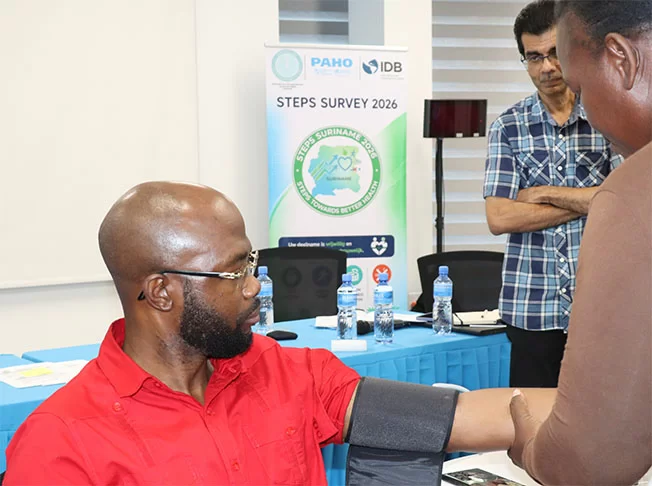
Leading the launch of the project’s training period for field staff, Public Health Minister André Misiekaba emphasized the foundational role that reliable, comprehensive health data plays in advancing Suriname’s national public health strategy. He called on all selected community members to participate voluntarily to support the project’s success. To demonstrate the research process firsthand, Minister Misiekaba stepped into the role of a study participant during a practical simulation exercise held to wrap up the intensive field training program for data collectors.
Prior to the launch of fieldwork, dozens of aspiring data collectors completed a rigorous, multi-week training program to prepare for on-the-ground survey activities. The training culminated in a full role-play simulation held at the ministry’s headquarters, where practicing data collectors walked through every step of the research protocol: conducting structured lifestyle and health interviews, performing standardized physical measurements, and communicating clearly and respectfully with voluntary participants. Minister Misiekaba joined the simulation, volunteering to have his own blood pressure measured as part of the exercise.
Fieldwork is scheduled to begin immediately following the completion of training. Data collectors will travel to randomly selected households across all regions of Suriname, with participants chosen via a statistically robust random sampling method designed to ensure the survey’s results are representative of the entire adult population. Participation is entirely voluntary and restricted to adults. During the approximately one-hour in-home visit, participants will complete a structured questionnaire covering personal health history and lifestyle habits, undergo simple physical measurements including blood pressure screening, and provide a small blood sample via a routine finger prick for testing.
To help residents verify the identity of official survey staff, the ministry has noted that all authorized data collectors will wear branded STEPS study apparel and carry official government-issued photo identification badges. Officials strongly advise residents to only admit staff that can provide this official identification to avoid safety risks.
Ministry representatives stressed that high population participation is critical to producing a reliable, accurate snapshot of Suriname’s current public health landscape. All personal information collected during the survey will be treated as strictly confidential, used exclusively for approved research purposes, and never released publicly. Final study results will only be published in aggregated, anonymized form that protects the privacy of individual participants.