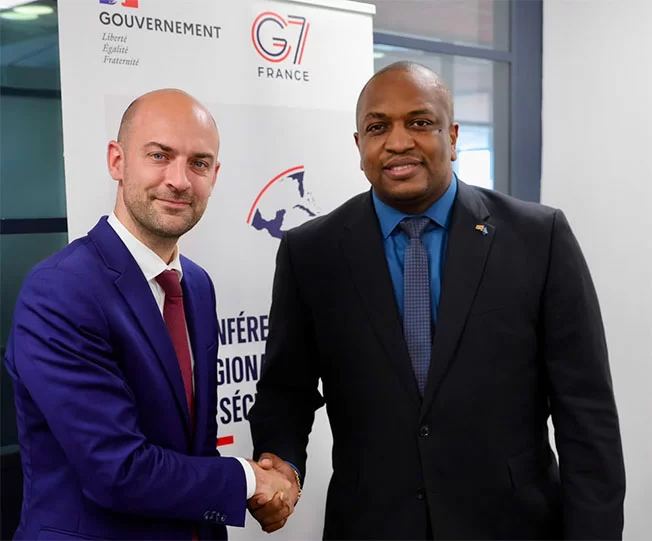
Diplomatic relations between Suriname and France are poised for deepening collaboration across multiple key sectors, after top foreign policy officials from both nations reached a series of preliminary agreements during a high-stakes bilateral meeting held this week in Fort-de-France, Martinique.
The gathering brought together Suriname’s Minister of Foreign Affairs, International Trade and Cooperation Melvin Bouva, and his French counterpart, Minister for Europe and Foreign Affairs Jean-Noël Barrot, to advance long-standing bilateral and regional cooperation goals. Both ministers underlined that their shared commitment to good neighborly relations and a forward-looking strategic partnership is aimed at delivering tangible, mutually beneficial outcomes for the populations of both countries.
Central to the discussions was work on a cross-border cooperation protocol, which the two leaders say will inject new momentum into the development of shared border regions and strengthen both economic and social collaboration along the boundary. Bouva highlighted the untapped potential for expanding trade and investment ties between Suriname, France, and France’s overseas department of French Guiana. According to official statements from Suriname’s foreign ministry, the recent growth of Suriname’s oil and gas sector opens new, promising avenues for joint economic development and collaborative projects.
Infrastructure and connectivity were another core focus of the talks. Both sides agreed to advance upgrades to cross-border connections across land, air, and river routes. Bouva reiterated Suriname’s priority of restoring the critical ferry link between the Surinamese border town of Albina and Saint-Laurent, the French Guiana town located across the Maroni River. The Surinamese minister also pushed for more streamlined rules for cross-border person movement, including simplified visa procedures, as part of a more robust shared border and neighborhood policy framework.
The talks also covered cooperation across a wide range of additional sectors, including education, public healthcare, culture, tourism, and public safety. The two ministers prioritized expanding joint action to combat transnational organized crime, a shared priority for neighboring territories. Suriname formally expressed its full support for the Martinique Declaration, a regional framework focused on strengthening collective cross-border cooperation on security and crime reduction.
Beyond bilateral engagement, the two nations also committed to closer collaboration in multilateral forums. The agreement includes a pledge to mutually support each other’s candidatures for international positions and to coordinate shared policy positions within global multilateral organizations. All of the preliminary strategic agreements reached during the Martinique meeting are scheduled to be formally ratified this coming September.