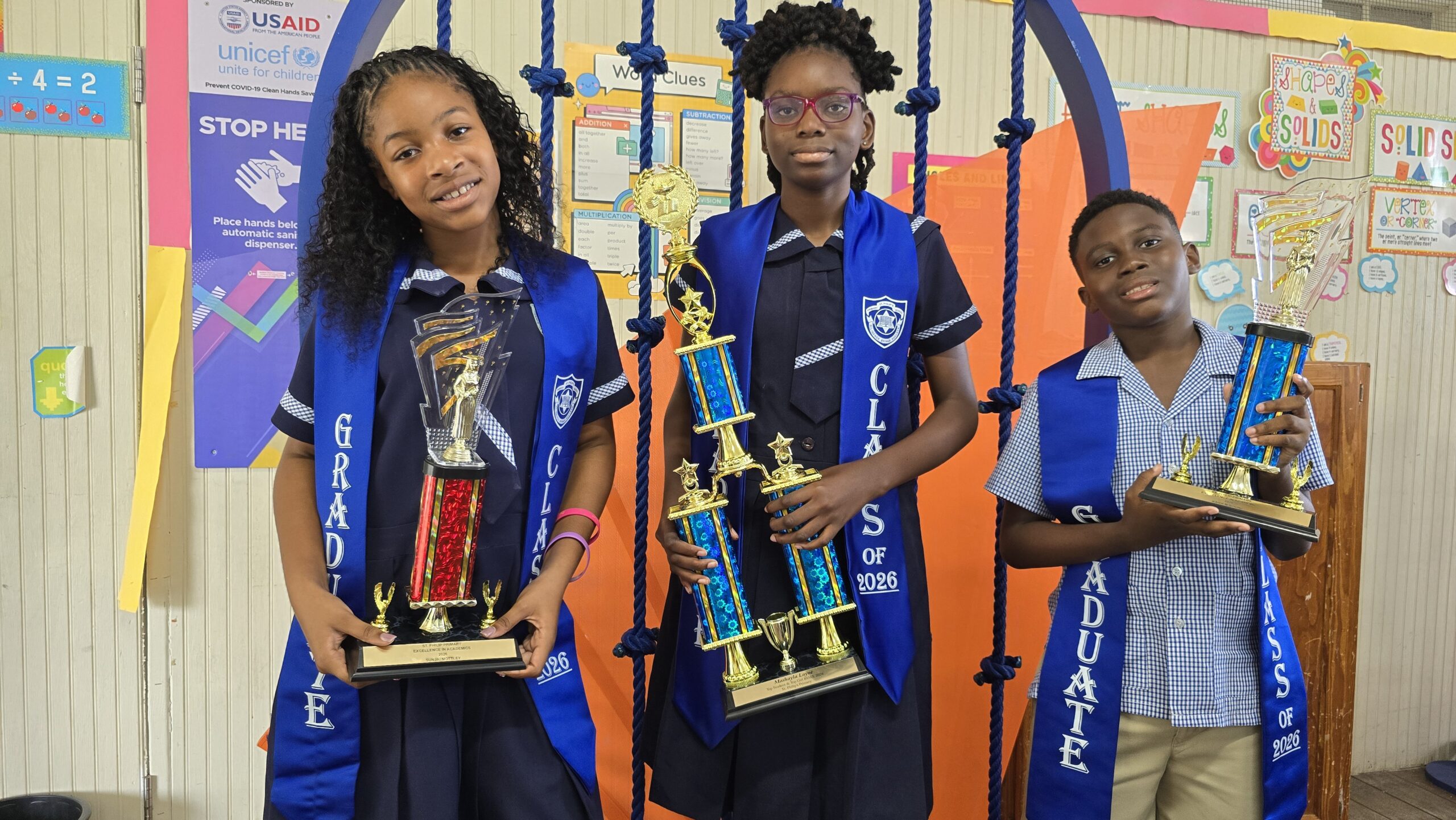
On the eastern side of Barbados, a small rural primary school has defied widespread preconceptions about underperforming rural education after three of its students delivered extraordinary scores on the 2024 Barbados Secondary School Entrance Examination, capping months of disciplined, intentional preparation by students and staff alike.
Eleven-year-old Mashayla Layne, St Philip Primary School’s top performer and top female scorer, earned a 95 in Mathematics and an 85 in English, securing her a spot at the prestigious Queen’s College for the upcoming September term. The aspiring future lawyer shared that her success came from intentional sacrifice, supported by both her educators and family. Speaking to Barbados TODAY, Layne highlighted the extra preparation led by her Class Four teacher Sonia Marshall-Bushell, noting “Our teacher made us skip breaks to prepare us.” She also credited her parents for consistent encouragement through the months of studying.
For Marshall-Bushell, the exceptional results are the product of shared commitment between educators and students, with every member of the class giving up personal time to hit their academic goals. The experienced educator adapted her teaching strategy to meet each student’s individual needs, relying on differentiated instruction that acknowledged the unique learning pace and style of every child. She introduced a wide range of problem-solving frameworks and incorporated hands-on practical activities to reinforce core concepts, rejecting the idea that exam preparation requires cutting all creative and recreational time. “I believe in the whole child so I did not deprive them of games, lunch time and so on, but I must admit they did give up some of their vacations,” she explained.
The teacher emphasized that the strong performance carries extra meaning because St Philip Primary, located in Church Village, is often overlooked by families choosing schools in the St Philip district. “It is seen as a no-brand-name school, we find that lot of people bypass this school and head to other schools in St Philip, but this was an opportunity to show that great things can come from St Philip,” she said. Beyond the three standout students, every one of the 16 students in Marshall-Bushell’s class exceeded performance expectations, even those who had struggled with core content earlier in the year. All students earned scores above 50 percent, a result that left Marshall-Bushell overjoyed.
Two 10-year-old early entry candidates also delivered strong results that earned them places at the island’s top secondary schools. Kaiden Young, who hopes to pursue a career in medicine, scored a 91 in Mathematics and will join Layne at Queen’s College. Despite his impressive score, Young said he believed he could have performed even better, noting he had given up holiday time to attend extra preparation sessions. Fellow early sitter Sunjay Mottley, who will attend Harrison College, earned an 89 in mathematics and an 81 in grammar. Mottley, who has career goals in law, veterinary medicine and cosmetology, said she felt pleased with her outcome but also saw room for improvement. She shared that she felt nervous going into the exam even after thorough preparation, and encouraged next year’s candidates to prioritize consistent, early studying.
St Philip Primary Principal Pamaletta Bhamjee praised Marshall-Bushell’s extraordinary dedication to her students, noting the teacher gave up personal breaks, holiday time and weekends to ensure the class was fully prepared. Bhamjee highlighted that the school’s average scores outpaced national averages across both core subjects: the national mean for English this year is 64.2, while St Philip Primary achieved a 67 percent average; the national mean for Mathematics is 58, compared to the school’s 66.6 average. “So you can see Mrs Marshall-Bushell did an excellent job,” the principal said.
Bhamjee also credited several external and government initiatives for supporting the school’s rising academic performance, particularly the Payce Digital reading programme based at Haggatt Hall. The programme offers after-school reading sessions for both infant and junior students, and has helped build a stronger culture of recreational reading among the student body. “The ladies at Payce Digital are very creative, so on the final meet, one of them actually wrote a story that she read to the children, which they thoroughly enjoyed,” Bhamjee noted. The Level Up Reading Club also provided critical support, funding new books for the school and backing its athletic programme.
The principal additionally acknowledged the Barbados Ministry of Education’s ongoing education transformation initiatives, which have provided valuable teacher training and literacy resources including Snappy Sounds and Jolly Phonics, materials that educators have called invaluable for building foundational skills. This year, the school also received its first dedicated reading teacher for the Junior Department to support students struggling with literacy. “I find that has done a lot to raise the self-esteem of the children, and once they have that help and they realise they actually can read, it will make a difference to how they approach their work overall because [you need reading skills] to make a success of your life,” Bhamjee explained.
For Bhamjee, who will retire later this year after more than four decades in the education sector, these exceptional exam results mark a fitting capstone to her career. The outcome proves that when paired with dedicated teaching staff, supportive community partners and motivated students, small rural schools like St Philip Primary can compete and outperform many of the island’s most well-known institutions.