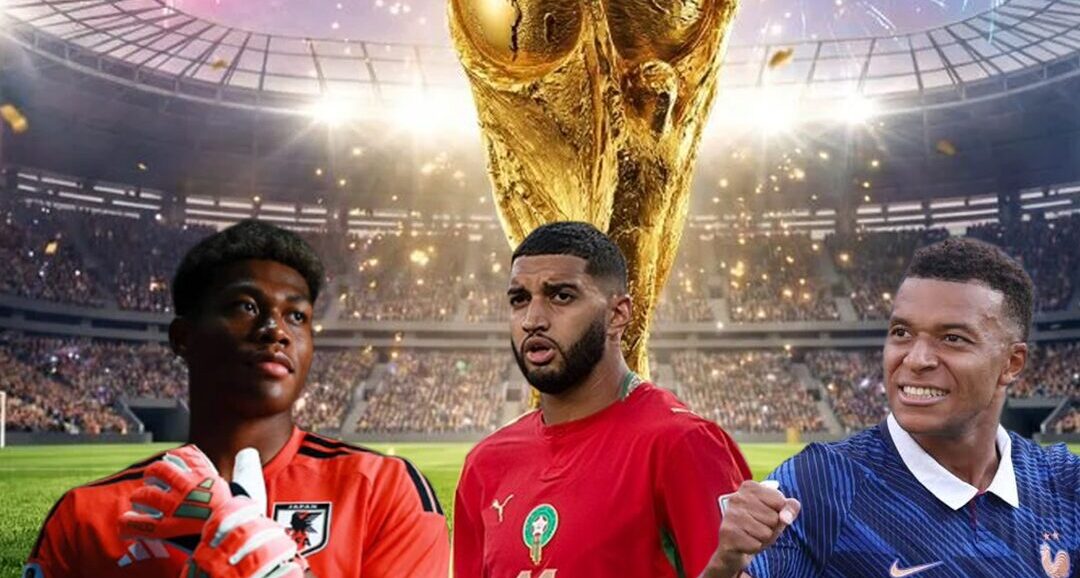
The 2026 FIFA World Cup, currently underway across host venues in the United States, is far more than a global sporting spectacle: it is a living, breathing portrait of the 21st century’s new global order, one that stands in sharp contradiction to the exclusionary politics of the tournament’s host nation.
Long before political leaders and policy analysts have fully acknowledged the shift toward a multiracial, multipolar global system, the grass of the World Cup pitch has already laid that truth bare for billions of viewers to see. If the football field is the most honest map of modern global life, its first defining feature is the undeniable mixing of national identities that dismantles centuries-old myths of ethnically pure nation-states.
Consider Japan’s starting goalkeeper, Zion Suzuki: born in Newark, New Jersey, to a Ghanaian father and Japanese mother, and raised in Saitama, he is a product of multiple global heritages – yet he has faced repeated racial abuse for his skin tone, from observers who insist on forcing his identity into narrow, outdated boxes. Suzuki is no outlier; he is the defining norm of this 2026 tournament. France’s captain Kylian Mbappé traces his roots to Cameroon and Algeria. Two of Spain’s most electrifying young stars, Lamine Yamal and Nico Williams, carry heritage from Morocco, Equatorial Guinea and Ghana. Breel Embolo, one of Switzerland’s key attacking threats, was born in Cameroon. Germany, England, the Netherlands, and Portugal all field rosters shaped by generations of migration, empire, and labor movement. With every pass, every goal, the old fiction of the “pure-blood” nation fades a little more.
The second truth the pitch reveals cuts even deeper: the global balance of footballing power no longer aligns with the 20th century’s hierarchical order of wealthy Western nations. Football’s elite is not the G7. Brazil, a multiracial powerhouse from the Global South, has long sat at the top of the sport, while Argentina enters the tournament as defending champions. Morocco, the first African and Arab nation to reach a World Cup semifinal, now competes as a full equal to traditional giants: in their opening group match in New Jersey, Morocco took the lead against five-time champion Brazil, only for the South American side to scrape a 1–1 draw late through Vinícius Júnior, with both sides advancing separated only by goal difference.
Teams from across Africa are not token additions to the bracket – they are contenders that demand respect. Côte d’Ivoire reached the tournament’s knockout stage for the first time in its history. Even more striking is the performance of Cabo Verde, a tiny island nation of just 500,000 people making its World Cup debut: it held reigning European champion Spain to a scoreless draw, then came from behind to secure a 2–2 draw against two-time world champion Uruguay. These results alone reveal more about the trajectory of the coming century than hundreds of academic policy papers.
In football’s genuinely global arena, the conventional metrics of great power status – population, economic wealth, military might – guarantee nothing. The United States, the 2026 host, successfully won its group and fills massive stadiums, but it remains outside the sport’s top tier: it can host the spectacle, but it cannot command the game. China has only qualified for one World Cup, in 2002, leaving without scoring a single goal. India, the world’s most populous nation, has never qualified at all. Football has been a multipolar sport for a full generation, and it has been signaling the direction of global history long before diplomats and political leaders caught up to the shift.
That reality creates a stark paradox for the United States: on its own soil, in front of the largest global audience in sports history, it is hosting a vivid showcase of the very multiracial, multipolar world that its current politics is actively trying to keep out. This contradiction is not just abstract. As the tournament kicked off, the U.S. reinstated and expanded country-specific entry restrictions. Full entry bans apply to two participating nations, Haiti and Iran, while Senegal and Côte d’Ivoire face partial restrictions. The official framing relies on language of screening, vetting, and national security, but the outcome is clear: while star players are granted exceptions to compete, the communities that raised them, and the fans who would have packed the stands to cheer them on, are locked outside the gate. Iran’s squad was forced to set up a pre-tournament base in Mexico, with multiple coaching staff denied visas, and players only allowed entry into the U.S. to compete before being required to leave immediately. Journalists from restricted nations face strict single-entry limits that make it nearly impossible to follow their national team across three different host countries.
One high-profile example underscores these barriers: Omar Artan, one of Africa’s top referees and the only Somali on FIFA’s elite international list, was denied entry at Miami International Airport after an 11-hour interview, despite holding a valid visa and diplomatic passport. U.S. officials offered no public evidence to support the decision, only claiming anonymously that he had “association with suspected members of terror organizations.” Because Somalia is on the U.S. restricted entry list, the language of national security did the work that an explicit nationality ban would have. FIFA has since responded that host governments retain full authority over immigration decisions, leaving no mechanism to challenge the ruling.
It is true that nations have a legitimate right to screen entrants and address genuine security concerns. But when the pattern of restrictions falls so precisely on the very nations whose participation makes this tournament a reflection of the new global order, it is reasonable to question whether security is the full story, or just a convenient language that established power has learned to use. The host nation sells the World Cup as a global festival of shared belonging, all while reminding much of the world that such belonging remains conditional. The wall of visa paperwork, the border checks and restrictions, the welcome extended to elite talent but doubt cast on entire communities: this is not a display of strength. It is the behavior of a power that can feel the ground shifting beneath its feet. A power that still controls the global order does not slam the door on the new world. It slams the door because it can already feel that control slipping away.
For Caribbean nations, the oldest global region shaped by centuries of forced racial mixing, these realities come as no surprise. Multiracial mixing does not automatically deliver racial justice on its own. Brazil, for example, is a multiracial giant whose national identity is tied to footballing glory built on Black genius, yet it remains structured by deep racial hierarchy off the pitch, clinging to the outdated myth of “racial democracy” while Black citizens continue to fight for full equal dignity. Similarly, multipolarity is not a automatic salvation for the global order. A world with multiple centers of power is not inherently kinder or more free; it may simply mean more powers to negotiate with, more competing interests to navigate. Old empires do not disappear – they adapt and learn new languages of influence. New powers do not enter the global order free of their own ambitions. For small nations, a multipolar world still requires deliberate work to organize, define, and sustain their own interests.
That is what makes this 2026 World Cup meaningful far beyond the boundaries of sport. It is not mere entertainment; it is revelation. It shows the world as it actually is, not as nostalgic traditionalists imagine it: irreversibly mixed, irrevocably plural, and fully competitive beyond the outdated rankings of the last century. For 90 minutes at a time, the truth that border walls and entry restrictions try to hide becomes impossible to deny. A mixed-heritage goalkeeper named Suzuki claims a cross for Japan. A player with Cameroonian and Algerian roots is the most dangerous striker in the world for France. Spain’s future runs through the children of immigrants. Morocco pushes five-time champion Brazil to the brink in New Jersey. Cabo Verde holds two global powerhouses to draws. The map of the world is redrawn on the pitch, in cleat studs and sweat.
The visa lines and entry restrictions represent the world that a frightened established power wishes still existed: ranked, filtered, suspicious, obedient to old hierarchies. The pitch represents the world the global people are already building: mixed, multipolar, and increasingly indifferent to who used to run it.