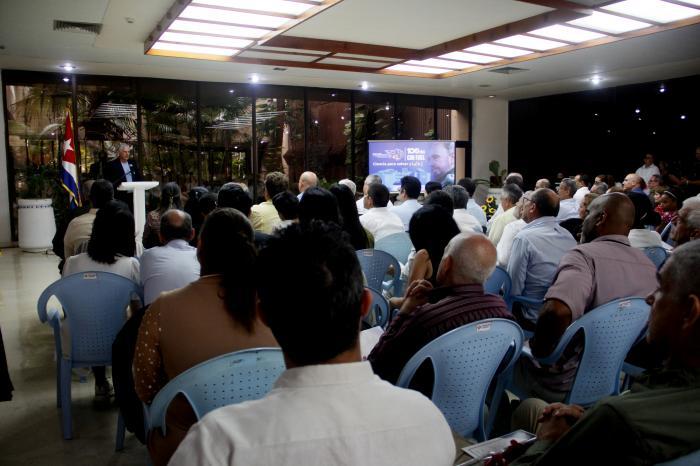
Havana, Cuba – In a celebratory ceremony marking four decades since the founding of the nation’s landmark Center for Genetic Engineering and Biotechnology (CIGB), Cuban leaders and scientific stakeholders gathered to honor the revolutionary vision that built the country’s world-renowned biotech sector against long-standing geopolitical and economic challenges.
The event opened with a moment of recognition for Army General Raúl Castro Ruz, leader of the Cuban Revolution, whose decades of contributions to advancing Cuban biotechnology were honored with a special institutional award from CIGB workers. Political Bureau member and CIGB Director General Marta Ayala Ávila presented the honor on behalf of the center’s staff, with Cuban President Miguel Díaz-Canel Bermúdez — who also serves as First Secretary of the Central Committee of the Communist Party of Cuba — accepting the award on Castro’s behalf.
In his keynote address to CIGB workers, Díaz-Canel emphasized that the institution stands as a defining example of the resilience that has shaped Cuban national identity. Joined at the ceremony by Political Bureau member and Prime Minister Manuel Marrero Cruz, the president traced CIGB’s origins to the forward-thinking vision of revolutionary leader Fidel Castro, who prioritized scientific investment long before biotechnology became a global priority.
Díaz-Canel recalled that as early as 1960, when nearly a quarter of Cuba’s population remained illiterate, Fidel Castro articulated a national vision centered on developing a generation of scientists and thinkers. That foundational commitment led to CIGB’s official founding in 1986, at a time when cutting-edge biotech research was limited almost exclusively to the world’s most industrialized nations. Díaz-Canel framed that founding decision as far more than a scientific investment: it was a politically transformative act rooted in humanist values that secured Cuba’s scientific, health and technological sovereignty, he said.
Against a decades-long economic blockade and resource scarcity, Cuba’s revolutionary leadership chose not to wait for outside powers to solve the nation’s challenges, instead betting on domestic talent and collective effort to build an indigenous biotech sector, Díaz-Canel added.
Forty years on, the results of that gamble are impossible to ignore. The president outlined a legacy of breakthrough milestones that have improved lives across Cuba and dozens of other countries, ranging from the interferon developed to curb Cuba’s 1981 dengue epidemic to the Abdala COVID-19 vaccine, which was developed and produced entirely at CIGB. He highlighted Heberprot-P, a one-of-a-kind treatment that reduces lower leg amputations from diabetic foot disease by up to 75 percent, alongside life-saving vaccines for hepatitis B and pentavalent Haemophilus influenzae type b, and widely recognized therapeutic products including streptokinase, Hebermin, Jusvinza and a range of interferons that have improved health outcomes globally.
Beyond human health, CIGB’s research has advanced Cuba’s goal of food sovereignty, Díaz-Canel noted. The institution’s Gavac and Porvac vaccines protect the nation’s cattle and swine herds, while new high-yield soybean and corn seed varieties are already being rolled out across national planting programs, with growing demand from Cuban farmers.
Today, CIGB continues to expand its research pipeline, with more than 40 active innovation projects in development, including candidate products HEBERSaVax, CIGB 300, CIGB 845 and CIGB 552. Díaz-Canel emphasized that CIGB is far more than a research hub: it is proof of what the Cuban Revolution can deliver when science is centered on public good, and a testament that Cuban scientists trained in the nation’s public education system can compete with the very best talent in the world.
He acknowledged that the sector has faced persistent headwinds, from the long-standing U.S. economic blockade to chronic resource shortages and technological barriers, but noted that every obstacle has served to accelerate Cuban biotech’s progress — a hallmark of Fidel Castro’s enduring legacy. Díaz-Canel expressed confidence that CIGB will continue to drive national progress as Cuba implements targeted economic transformations aimed at unlocking productive capacity, generating shared prosperity and advancing social justice.
Calling on the center’s workers to build on the revolutionary legacy, Díaz-Canel tied the next era of progress to the upcoming centennial of Fidel Castro’s birth, saying the milestone should serve as a catalyst for a new wave of innovation and achievement. “Fidel’s legacy calls upon you to continue being that beacon of innovation and progress that he envisioned,” he said. “Continue to be great.”
For her part, CIGB Director General Marta Ayala Ávila reaffirmed the institution’s commitment to advancing public health through science amid growing external aggression, saying the center’s staff is more dedicated than ever to improving the quality of life for the Cuban people.
The 40th anniversary ceremony included additional recognitions for the pioneering team that first produced leukocyte interferon in Cuba in May 1981, for long-serving CIGB staff who have contributed to the center’s work across four decades, and for domestic institutions that have partnered with CIGB to advance its mission over the years. The Cuban Workers’ Federation (CTC) also awarded CIGB its 85th Anniversary Seal, presented by CTC General Secretary Osnay Miguel Colina Rodríguez.
Four decades after its founding, CIGB has solidified its standing as a leading high-tech institution focused on the research, development, production and commercialization of vaccines and biotechnological innovations, with far-reaching impacts on human, animal and plant health, and across key sectors of the Cuban economy.