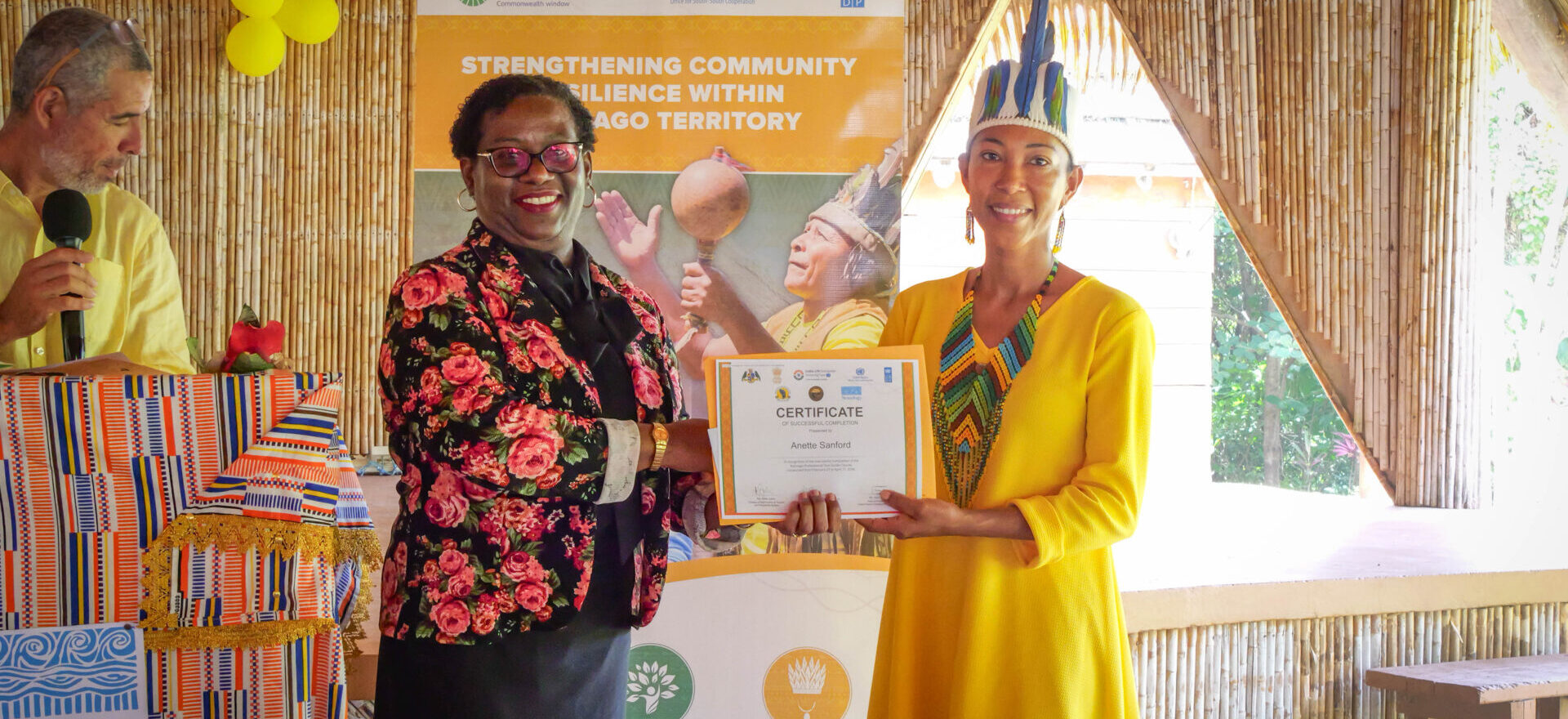
Sixteen Kalinago Territory community members have officially become certified professional tour guides, marking a major milestone in efforts to grow inclusive, community-led indigenous tourism and expand local economic opportunity across the region.
The graduating cohort, made up of 10 women and six men, completed a rigorous, months-long training initiative before receiving their certification during a formal ceremony hosted at Barana Autê. The event drew a cross-section of attendees, including senior Dominican government officials, Kalinago community leadership, representatives from international development partners, local institutional stakeholders, and family members of the graduates, who gathered to honor the participants’ hard work and reaffirm shared commitments to sustainable, community-centered tourism development in the territory.
Among the distinguished guests in attendance were Cozier Frederick, Dominica’s Minister for Environment, Rural Modernisation, Kalinago Upliftment and Constituency Empowerment; Annette Sanford, Chief of the Kalinago people; Duane Silverstein, Executive Director of conservation non-profit SeaCology; delegates from Dominica State College; members of the Kalinago Council; UNDP representatives; and other invited stakeholders.
The training programme was organized through a collaborative partnership between the Kalinago Council, Dominica State College, and the Dominica Hotel and Tourism Association. Joint funding for the initiative was provided by the Strengthening Community Resilience in the Kalinago Territory (SCR-K) Project and SeaCology. The SCR-K Project itself is financed by the Government of India and implemented by the United Nations Development Programme (UNDP) in coordination with the Government of Dominica through the Ministry of Environment, Rural Modernisation, Kalinago Upliftment and Constituency Empowerment. The broader initiative works alongside the Kalinago Council and other local and national partners to build resilient local livelihoods through a range of focus areas: climate-smart agriculture, sustainable forest management, eco-indigenous tourism, and community capacity building.
UNDP officials note that the tour guide training perfectly embodies the collaborative, community-centered approach at the core of the SCR-K Project. The Kalinago Council had already prioritized tour guide capacity building as a key step to grow tourism within the territory, and the initiative aligns directly with one of the SCR-K Project’s core objectives: expanding access to training for micro, small, and medium-sized enterprises (MSMEs) and tourism stakeholders in the eco-indigenous tourism sector. By aligning with the council’s existing priorities and partnering with local and organizational stakeholders, the project avoided redundant efforts and maximized long-term development impact for the community.
Run from February 21 to April 4, 2026, the curriculum blended structured classroom instruction with hands-on fieldwork and practical exercises to equip participants with the full range of knowledge and skills needed to deliver authentic, high-quality visitor experiences. Instruction was led by faculty from Dominica State College, with additional technical support provided by the Dominica Hotel and Tourism Association. The curriculum covered a diverse set of core competencies: tourism industry fundamentals, Kalinago Territory history, cultural and heritage interpretation for Kalinago traditions, local flora and fauna identification, birdwatching and natural heritage interpretation, customer service, professional ethics, emergency first aid, and practical on-the-ground tour management techniques. To earn their certification, graduates were required to pass both comprehensive written examinations and hands-on practical assessments.
Addressing the gathering of graduates and guests, Minister Cozier Frederick emphasized that the training represents far more than just learning tour leadership skills. “Guide training is far more than learning how to lead a tour. It is about becoming ambassadors of our people, our culture, and our environment. Through proper training, we preserve and share our history with accuracy and pride. We provide visitors with meaningful and memorable experiences that reflect the true identity of our community. We also develop the knowledge and skills to ensure the safety and well-being of those in our care. Guide training creates valuable employment opportunities and strengthens our tourism industry by promoting professionalism and excellence. Most importantly, it inspires us to protect our natural environment and cultural heritage so that future generations can continue to benefit from them,” Frederick said.
Kalinago Chief Annette Sanford also commended the graduates for their dedication throughout the programme, and reminded them of their unique responsibility to share the authentic history and identity of the Kalinago people with the world. “As tour guides, you now hold a very special responsibility. You have the privilege of telling the Kalinago story the way it deserves to be told. For many years, textbooks and outside narratives have misrepresented who we are. We have often said that these stories need correcting. Well, we are part of that correction. Every visitor we guide gives you an opportunity to tell the truth. Tell them our story with confidence. Tell it with pride. Tell it with authenticity,” Sanford stated.
Speaking on behalf of UNDP, Project Analyst Sawana Fabien noted that the graduation ceremony marks far more than the successful completion of a single training course. “Today is a celebration of commitment, perseverance, and your willingness to invest in yourselves, your families, and your community. When the Kalinago Council identified this training as one of its priorities, the SCR-K Project responded because we believe development should be driven by the aspirations of communities themselves – not by what a project thinks a community needs. That is the essence of partnership, and I believe the relationship between UNDP, the Government of Dominica, the Kalinago Council, and our implementing partners is one that should be celebrated. Our commitment does not end today. We remain committed to working alongside the Kalinago people, listening to your priorities, strengthening local capacity, and building partnerships that create opportunities for today and for future generations,” Fabien said. She added that the SCR-K Project centers its work on building community resilience by investing in people, local institutions, and collaborative partnerships, so communities have the skills, confidence, and access to opportunity needed to lead their own sustainable development trajectories.
SeaCology Executive Director Duane Silverstein also reaffirmed his organization’s longstanding commitment to supporting conservation and community-led development initiatives that protect the Kalinago Territory’s one-of-a-kind natural and cultural heritage.
Looking ahead, the newly certified guides are expected to play a transformative role in advancing the Kalinago Territory’s long-term vision for indigenous tourism, while opening new pathways for local employment, community entrepreneurship, and grassroots leadership. As Dominica prepares for a projected increase in international visitor arrivals, driven in part by the expansion of the country’s tourism infrastructure including the opening of a new international airport, the training programme ensures the Kalinago Territory is well-positioned to welcome guests with authentic, high-quality cultural and nature-based tourism experiences.
Beyond equipping individual participants with marketable professional skills, the initiative is also expected to strengthen the Kalinago community’s ability to manage tourism growth sustainably, safeguard irreplaceable cultural heritage, and ensure that the full economic benefits of tourism development remain within the local territory. UNDP confirms that the SCR-K Project will continue its work alongside the Kalinago Council and its partner organizations to support additional initiatives that build resilient local livelihoods, empower indigenous communities, and preserve the Kalinago Territory’s distinctive cultural and environmental heritage for future generations.