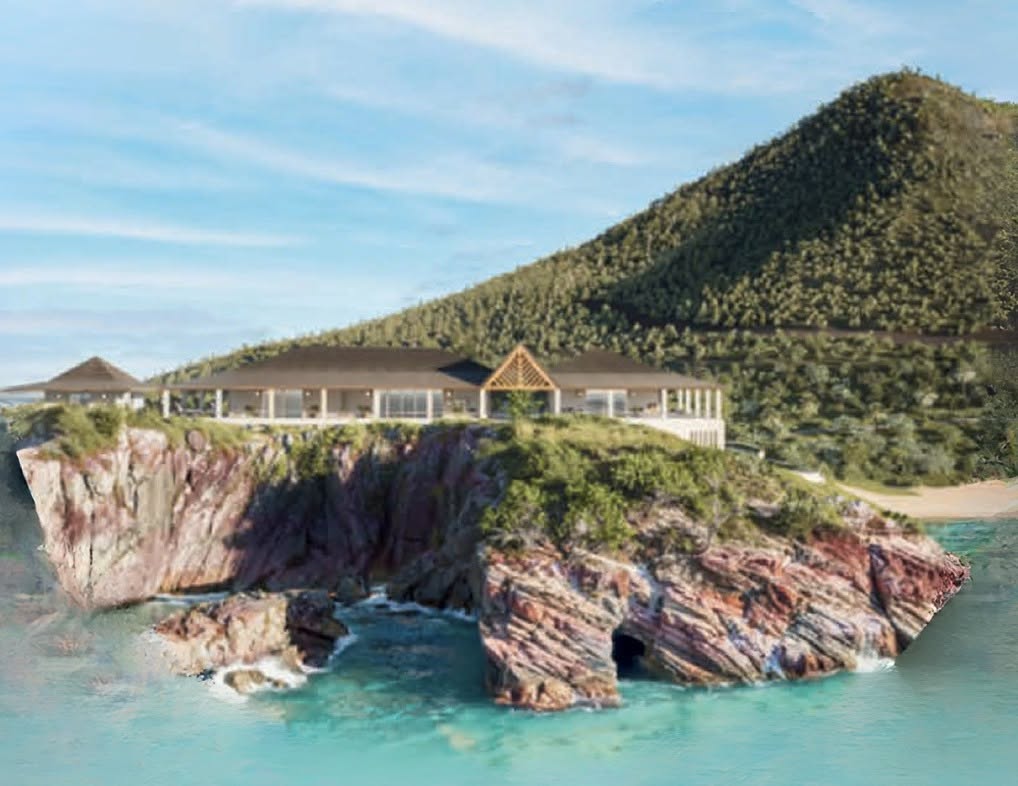
A newly finalized Environmental Impact Assessment (EIA) has determined that a proposed multi-million-dollar luxury private villa project at Antigua and Barbuda’s Pearns Point can move forward without causing major long-term damage to local ecosystems or community interests, provided developers adhere to a robust set of engineering and environmental protection requirements.
The 538-page study, commissioned by project owner Ariadine Ltd. and conducted by independent environmental consultancy EcoUrban Planning Ltd., evaluates the feasibility of constructing a three-storey private residence across two parcels of land, Lots 32 and 33, on a 6.69-acre rocky headland overlooking the Caribbean Sea. The approved in-principle project may later add complementary amenities including a spa, separate guest suite, and dedicated pool house. Water supply for the property will draw from local groundwater reserves, supplemented by an on-site reverse osmosis desalination plant, while all wastewater will be treated in an on-site facility and reused for landscape irrigation where regulatory approval is granted.
While the Development Control Authority has already granted preliminary approval for the development, the island’s Department of Environment mandated a full EIA due to the site’s sensitive coastal position, as well as plans for on-site water treatment and desalination infrastructure. The assessment addressed a wide range of stakeholder concerns, from required coastal building setbacks and long-term geological stability to drainage management and ongoing environmental stewardship.
The EIA notes that the headland’s dramatic coastal position is both the project’s primary selling point and its most significant engineering challenge. Geological surveys confirmed that the headland’s underlying volcanic bedrock is generally structurally sound for construction, with no major underground voids detected beneath the proposed villa footprint. However, investigators did find localized weathering, fractured rock formations, and natural cave systems along the site’s cliff edges that require careful excavation practices and mandatory setbacks from the cliff face to prevent instability.
Coastal hazard resilience was a core focus of the assessment. Pearns Point is exposed to high-energy Atlantic and Caribbean wave systems, and recent tropical storms have already accelerated beach erosion and caused periodic flooding on the narrow tombolo that connects the development headland to the Antiguan mainland. Computer climate modeling shows that extreme hurricane-driven storm surges and large wave events could temporarily submerge this low-lying access route, cutting off access to the property even though the villa itself is sited at a sufficiently high elevation to avoid inundation.
Consultants concluded that these natural risks can be mitigated to acceptable levels through targeted climate-resilient design. Key requirements include maintaining mandatory cliff-edge setbacks of 8 to 10 meters, elevating all habitable living spaces to at least 3 meters above mean sea level, building drainage infrastructure engineered to handle 100-year rainfall events, and integrating permeable surfaces, vegetated drainage swales, and natural water management features across the property. The EIA also recommends annual structural inspections of cliff faces, drainage systems, and shoreline conditions, with full updated hazard assessments conducted every 5 to 10 years to account for accelerating climate change and sea-level rise.
Stormwater management emerged as a critical design priority, as natural surface topography on the headland directs runoff toward the tombolo and access road. Without properly designed drainage infrastructure, construction activity could worsen existing localized flooding, accelerate erosion, and increase sediment runoff into adjacent nearshore marine habitats. The assessment requires developers to implement a comprehensive Drainage Master Plan, regrade low-lying areas where necessary, and install engineered drainage networks to safely divert runoff during heavy rain events.
Baseline marine surveys found that nearshore habitats around Pearns Point are currently in generally healthy condition, with extensive seagrass beds dominated by turtle grass, manatee grass, and Halophila stipulacea growing on sandy nearshore substrates. Since the project includes no in-water construction and all treated wastewater will be recycled for irrigation, consultants confirmed that impacts to marine ecosystems will remain negligible as long as erosion controls, wastewater management protocols, and runoff protection measures are strictly maintained throughout construction and operation.
On land, ecological sensitivity within the proposed development footprint was found to be relatively low. The site supports native coastal vegetation, including three isolated button mangrove trees, with observed wildlife consisting primarily of native seabirds and invasive mongooses. To reduce on-site ecological harm, the EIA recommends minimizing unnecessary vegetation clearing, installing preemptive erosion controls, securing all construction waste to prevent it from reaching coastal areas, and using turtle-friendly exterior lighting to avoid disrupting nesting sea turtle behavior.
Temporary construction-related impacts are expected, including increased dust, noise, local traffic, and minor disruptions to neighboring properties and adjacent coastal areas. However, the assessment frames these impacts as localized, short-term, and fully manageable through standard best construction practices, including active dust suppression, phased vegetation clearing, preemptive erosion controls, proper drainage design, and routine third-party environmental inspections.
Long-term operational impacts are projected to be minimal, with the primary ongoing risks tied to regular maintenance of the wastewater treatment system, desalination plant, and drainage infrastructure. The EIA notes these risks can be effectively managed through consistent scheduled maintenance and ongoing compliance with local environmental regulations.
The assessment also addressed public concerns around beach access at Pearns Point. While all beaches in Antigua and Barbuda are legally public, the report acknowledges that historic informal access routes currently cross privately held land within the development area. It clarifies that the Development Control Authority holds formal responsibility for establishing permanent public beach access routes in the area, and any official pathway should balance public access rights with the legal interests of private property owners.
In its final conclusion, the EIA confirms the Ariadine Villa project is compatible with the surrounding coastal environment and can proceed without significant long-term environmental or social harm, provided all recommended protection and resilience measures are fully implemented. In addition to setback and drainage requirements, core recommendations include protecting existing marine habitats, retaining natural vegetation buffers, avoiding coastal engineering works that disrupt natural sediment movement, and integrating climate-resilient design that can withstand increasingly severe storm activity driven by climate change.