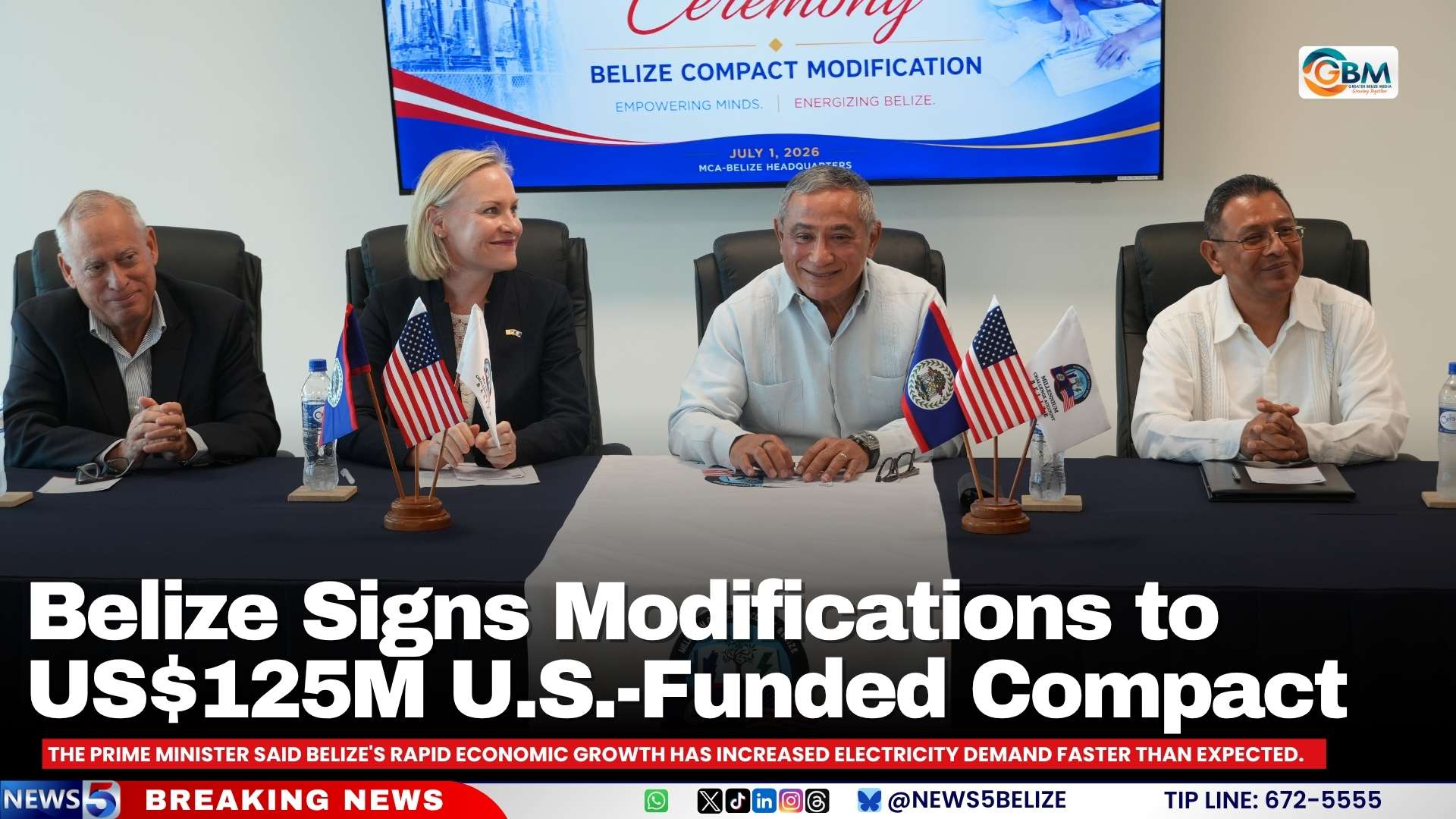
On July 1, 2026, Belizean government officials formalized key amendments to a landmark $125 million grant compact with the United States’ Millennium Challenge Corporation (MCC), a major U.S. foreign assistance agency, in a signing ceremony attended by Prime Minister John Briceño and senior diplomatic representatives from both nations. The revised agreement, one of the largest grant-based development investments in Belize’s modern history, reallocates $20 million originally earmarked for education to the compact’s energy sector initiative, following a comprehensive review of foreign assistance priorities by the U.S. government. The document was officially signed by Carlos Pol, Chief Executive Officer of Belize’s Ministry of Economic Transformation, on behalf of the Belizean government.
The redirected funding will directly address unanticipated surges in energy demand driven by Belize’s faster-than-projected economic expansion over the past four years. According to Prime Minister Briceño, the country’s current energy consumption has already hit levels forecasters did not expect to see until 2028 or 2029, a shift he described as a “victory of our own success” that required urgent adjustments to the original compact’s funding allocations. The additional capital will support critical upgrades to Belize’s national electricity grid, highlighted by the construction of a new 69-kilovolt submarine transmission cable connecting the mainland to Ambergris Caye, a popular tourist and residential hub whose growing population has strained existing energy infrastructure.
Beyond physical infrastructure improvements, the expanded Energy Project will also back targeted policy and regulatory reforms to modernize Belize’s energy governance, including structural updates to the national Belize Energy Act. Briceño noted that the upgraded investment will not only strengthen the reliability of the country’s power supply but also advance the government’s core goal of reducing overall energy costs for consumers and businesses. The Belizean government is already pursuing parallel renewable energy development—including utility-scale battery storage and solar energy projects—with financial backing from the World Bank, and the additional MCC funding will complement these ongoing efforts.
Despite the $20 million reallocation, the compact’s remaining education investment will retain its original core mandates: improving access and quality at the secondary education level, expanding technical and vocational training programs aligned with labor market needs, and boosting overall workforce readiness to support long-term economic competitiveness. To offset the funding shift, the Government of Belize has committed to increasing its own domestic contributions to both the energy and education initiatives, including sustaining public funding for digital learning devices for secondary school students across the country.
Briceño emphasized that education and energy have remained Belize’s top two development priorities since compact negotiations first launched with the MCC in late 2021, and years of cross-stakeholder consultations have shaped the revised agreement to reflect on-the-ground changes in the country’s economic context. The amended compact is scheduled to enter into force later in 2026, with the overarching goal of advancing both human capital development through education and more affordable, reliable energy to support inclusive, long-term economic growth across Belize.