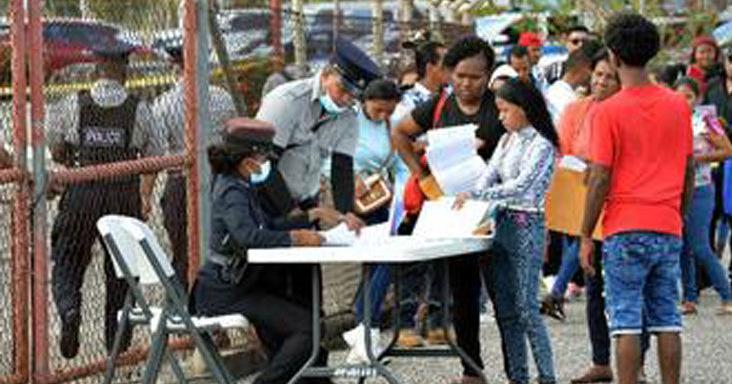
Migration and human rights activists in Trinidad and Tobago are pushing back against the government’s official justification for widespread delays in processing migration and residency applications, arguing that the policy punishes law-abiding migrants who have followed all regulatory requirements to gain legal status. The criticism comes in direct response to recent remarks from Minister of Homeland Security Roger Alexander, who blamed the backlog on undocumented migrants crossing the country’s porous borders to sneak into the ongoing registration exercise, falsely claiming long-term residency in the nation.
Speaking via telephone with the Express on Thursday, leading migrant rights advocate Sofia Figueroa-Leon rejected Alexander’s explanation as logically inconsistent and fundamentally unfair. She emphasized that there is no connection between the alleged illegal entry of new arrivals and the thousands of migrants who already completed all pre-requisite steps for registration, including submitting online applications and attending mandatory in-person appointments.
Figueroa-Leon argued that if the government is facing operational challenges in securing its borders or managing the registration process, those issues should be addressed directly rather than shifting the burden onto compliant applicants. “If they lack sufficient staffing or the capacity to manage the process, that is an administrative failure on the government’s part, not a problem that migrants should have to bear,” she noted. “Migrants came forward voluntarily to complete the registration process because they want to live legally in this country. They fulfilled their end of the agreement, so it is the government’s responsibility to hold up its end. Putting all applications on hold because of border control failures is unprofessional and not a serious policy response. The ball is now firmly in the government’s court to move forward with processing.”
Her criticism was echoed by other migrant support leaders and registered applicants, who echoed the call for the government to separate border enforcement from the processing of lawfully completed applications. Angie Ramnarine, coordinator of the Romaine Migrant Support Group, noted that it was predictable that registered migrants would encourage family members to join them after the government launched the regularization exercise, adding that securing national borders has always been the government’s core responsibility. “Rather than punishing people who already followed all the rules, the government should focus on doing its job to stop unauthorized new arrivals,” Ramnarine said.
Gabriela Alvarado, a 40-year-old migrant who completed her registration years ago and has lived in the country with her family for more than a decade, also called Alexander’s comments unfair. “I stood in long lines, filled out all the required paperwork, paid my $700 fee, and did everything by the book, and we are still waiting for approval,” Alvarado said. “It’s unjust that we have to pay for the government’s failures.”
The controversy comes as the country’s first-ever Migrant Registration Framework wraps its initial phase, which has already drawn nearly 30,000 applications from people representing more than 60 nationalities. Venezuelan nationals make up the overwhelming majority of applicants, with children accounting for more than half of the total registered population. The regularization program grants approved applicants temporary legal status to live and work in Trinidad and Tobago through September 2026.
Even before the latest delay controversy, the program has faced widespread criticism from civil society groups. After the initial online registration portal closed earlier this year, hundreds of undocumented migrants who missed the deadline due to system glitches or a lack of clear public outreach pleaded with authorities for a final extension to sign up. Civil society organizations have also raised ongoing concerns about a lack of transparency from national security officials, documenting multiple cases where migrants who visited immigration offices to ask for application updates were instead served deportation orders.