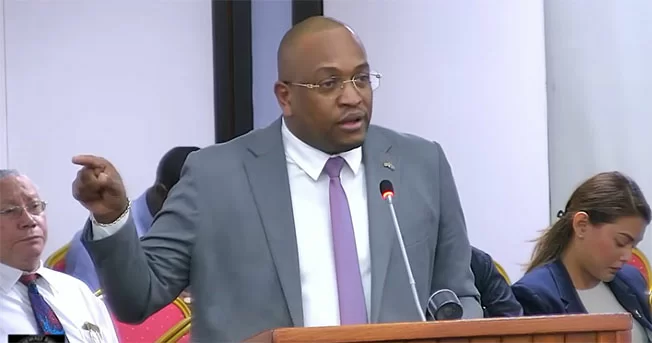
A long-running territorial dispute over the Tigri region between Suriname and neighboring Guyana has entered a new diplomatic phase, with Suriname’s top foreign affairs official pushing for immediate action to move negotiations forward. Speaking during budget deliberations in Suriname’s National Assembly on Monday, Minister Melvin Bouva—who oversees Foreign Affairs, International Trade and Cooperation (BIS)—announced plans to convene the long-idle joint Suriname-Guyana Border Commission at the earliest possible date to advance talks on the contentious issue. The latest controversy flared after Guyana issued a formal protest note over a map displayed during a presentation by Suriname’s state-owned oil company Staatsolie, which labeled the Tigri region as Surinamese sovereign territory. Multiple members of parliament raised questions about the government’s response to Guyana’s protest, putting the ruling administration’s diplomatic strategy for the border dispute under public scrutiny. VHP parliamentarian Mahinder Jogi pressed Bouva to outline concrete steps to advance Suriname’s claims in the dispute, noting that Guyana has increasingly taken aggressive unilateral actions to advance its position along the shared border. Minister Bouva reaffirmed Suriname’s unwavering commitment to defending its territorial sovereignty in the Tigri region, emphasizing that the government’s core priority remains protecting Suriname’s national interests. “Our priority is unwavering: we will safeguard, advance, and stand firm in defense of Suriname’s territorial sovereignty,” Bouva stated. He explained that like Guyana, Suriname routinely files formal official protests whenever developments related to the disputed region contradict its territorial claims, pointing to a recent incident where the Surinamese government issued a formal objection within days after an incorrect map of the country was published and used in the Netherlands. However, Bouva stressed that diplomatic protest notes alone are insufficient to resolve the decades-long disagreement. “Protests stacked on top of protests will never resolve this dispute,” he said. According to the minister, the path forward hinges on resuming formal negotiations through the joint Border Commission. Suriname has already appointed its full delegation to the body and selected its commission chair, but the government remains waiting for Guyana to finalize its own representatives to enable the commission’s seventh plenary meeting. “Our commission chair is ready to convene at any time. We expect Guyana to confirm its delegation so the meeting can move forward, and we will continue to press for this step,” Bouva added. The minister also revealed that he held a personal one-on-one conversation with his Guyanese counterpart on the sidelines of a recent international summit shortly after the map controversy broke. The two foreign ministers agreed to schedule a follow-up meeting during the upcoming CARICOM heads of government summit to continue bilateral discussions on the Tigri issue and other outstanding cross-border matters. When pressed by lawmakers to share additional details on Suriname’s broader diplomatic strategy for the dispute, Bouva declined to disclose sensitive information in an open parliamentary session. Instead, he invited the National Assembly to continue the discussion in a closed committee-general session, a confidential format reserved for sharing sensitive information related to national security and diplomatic positioning. The call for a closed-door discussion drew immediate criticism from some lawmakers. Jogi questioned whether negotiation through the joint Border Commission alone is sufficient to resolve the dispute, noting that Guyana has previously turned to international legal procedures to advance its claims in other border conflicts. He warned that Suriname cannot afford to remain passive while Guyana actively strengthens its legal and diplomatic position to assert control over the Tigri region. Other members of parliament joined the debate with differing perspectives. Rabin Parmessar, leader of the NDP parliamentary faction, commended the current administration for taking proactive action on the Tigri issue, recalling that the dispute was raised during the very first meeting between Suriname President Jennifer Simons and her Guyanese counterpart. Parmessar, who previously raised repeated concerns about the Tigri region during the prior administration’s term, noted that little progress was made on the issue in previous years. VHP lawmaker Dew Sharman argued that Suriname must take an even more proactive stance, pointing out that Guyana has little incentive to prioritize convening the joint Border Commission. In contrast, NDP representative Ebu Jones asserted that for Suriname, the Tigri region is not a disputed territory at all. “Tigri belongs to Suriname,” Jones stated, adding that the joint Border Commission has a broader mandate that covers far more than just the Tigri dispute. As the regional summit approaches, all eyes are turning to whether the two South American nations can break the long-standing deadlock and move toward a peaceful, negotiated resolution of the territorial disagreement.