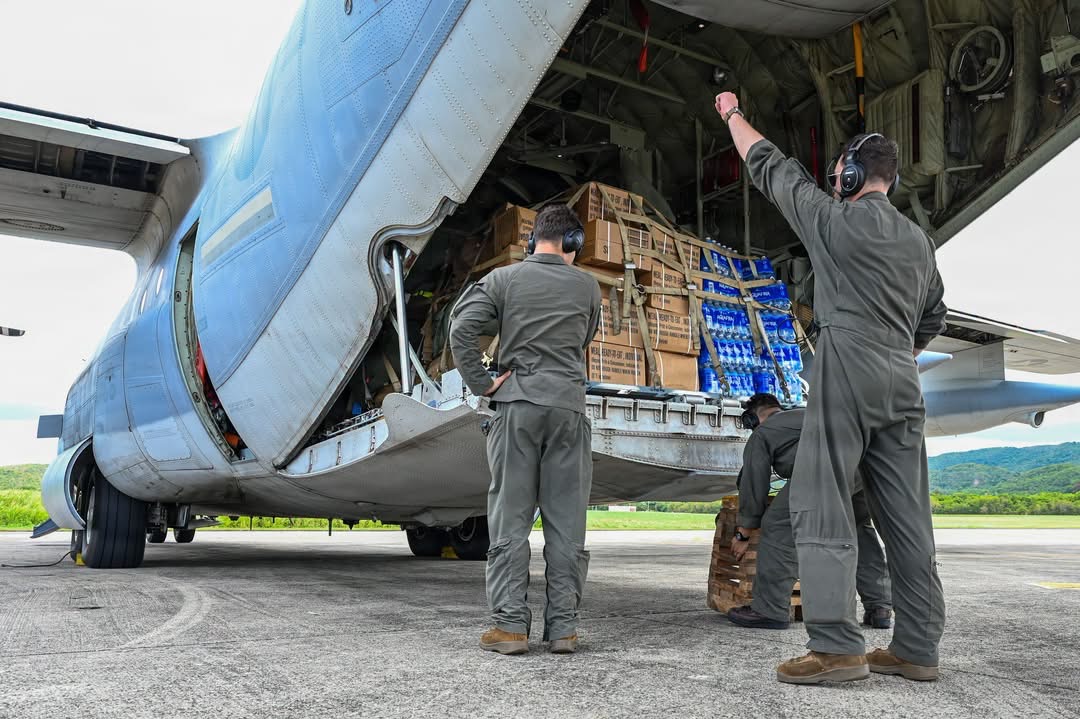
As international disaster response operations gain momentum in the wake of Venezuela’s catastrophic earthquake, the United States has significantly expanded its military-supported humanitarian aid mission, deploying extra aircraft, military personnel and purpose-built disaster response equipment to affected regions.
In an official statement released Monday, U.S. Southern Command (SOUTHCOM) announced that six U.S. Air Force C-17 Globemaster cargo planes are slated to land in Venezuela carrying a U.S. Marine Corps Combat Logistics Company deployed from Marine Corps Air Station Cherry Point, North Carolina. The arriving Marine unit is bringing critical heavy engineering machinery, portable water purification systems, and a range of additional resources to bolster ongoing relief work. The operation aligns with a direct request from the Venezuelan government and is being coordinated through the U.S. Department of State.
The expansion of the U.S. humanitarian mission does not end with this deployment: additional U.S. Air Force C-17 and C-130 Hercules airlift craft continue moving response personnel and emergency supplies into the country on an ongoing basis.
A roughly 100-member Contingency Response Element, paired with a specialized U.S. military Airfield Assessment Team, is already on the ground working alongside Venezuelan government officials, local aviation management teams, and U.S. civilian agencies to upgrade operational capacity at airports serving the earthquake zone. These upgrades are designed to speed the flow of incoming relief flights, cutting down on delays for life-saving supplies and personnel.
U.S. Marine Corps MV-22 Osprey tiltrotor aircraft maintain a steady shuttle route between a dedicated logistics hub in Curaçao and hard-hit regions of Venezuela, ferrying emergency responders, stockpiled supplies and heavy equipment to where they are needed most. The aircraft also conduct internal flights across Venezuela to support scattered relief operations across remote areas.
SOUTHCOM has also confirmed that the key Port of La Guaira, which suffered damage in the quake, has resumed full commercial and relief operations. This reopening has allowed the USS Fort Lauderdale to offload desperately needed humanitarian supplies and response equipment directly at the Venezuelan port, eliminating the need for complex multi-stage transshipment.
U.S. Marine Corps UH-1Y Venom utility helicopters are carrying out dual missions: they complete systematic aerial damage surveys of quake-ravaged communities, while also transporting U.S. State Department staff tasked with coordinating the overall U.S. relief effort.
Meanwhile, U.S. Army CH-47 Chinook heavy-lift helicopters and flight crews from Joint Task Force-Bravo, stationed at Soto Cano Air Base in Honduras, are providing on-the-ground airlift support for moving large cargo and personnel. Additional aircraft and crews are scheduled to arrive in the region within the next 48 hours to reinforce these operations.
Even the U.S. Space Force is contributing to the response effort, providing high-resolution satellite imagery of damaged communities and critical infrastructure that helps emergency response planners map out priority areas for immediate life-saving assistance.
SOUTHCOM notes that planning for further rounds of military support is still ongoing, carried out in close coordination with the U.S. State Department, Venezuelan government authorities, and international partner organizations involved in the disaster response. Additional deployments will be made public once they are finalized and confirmed.