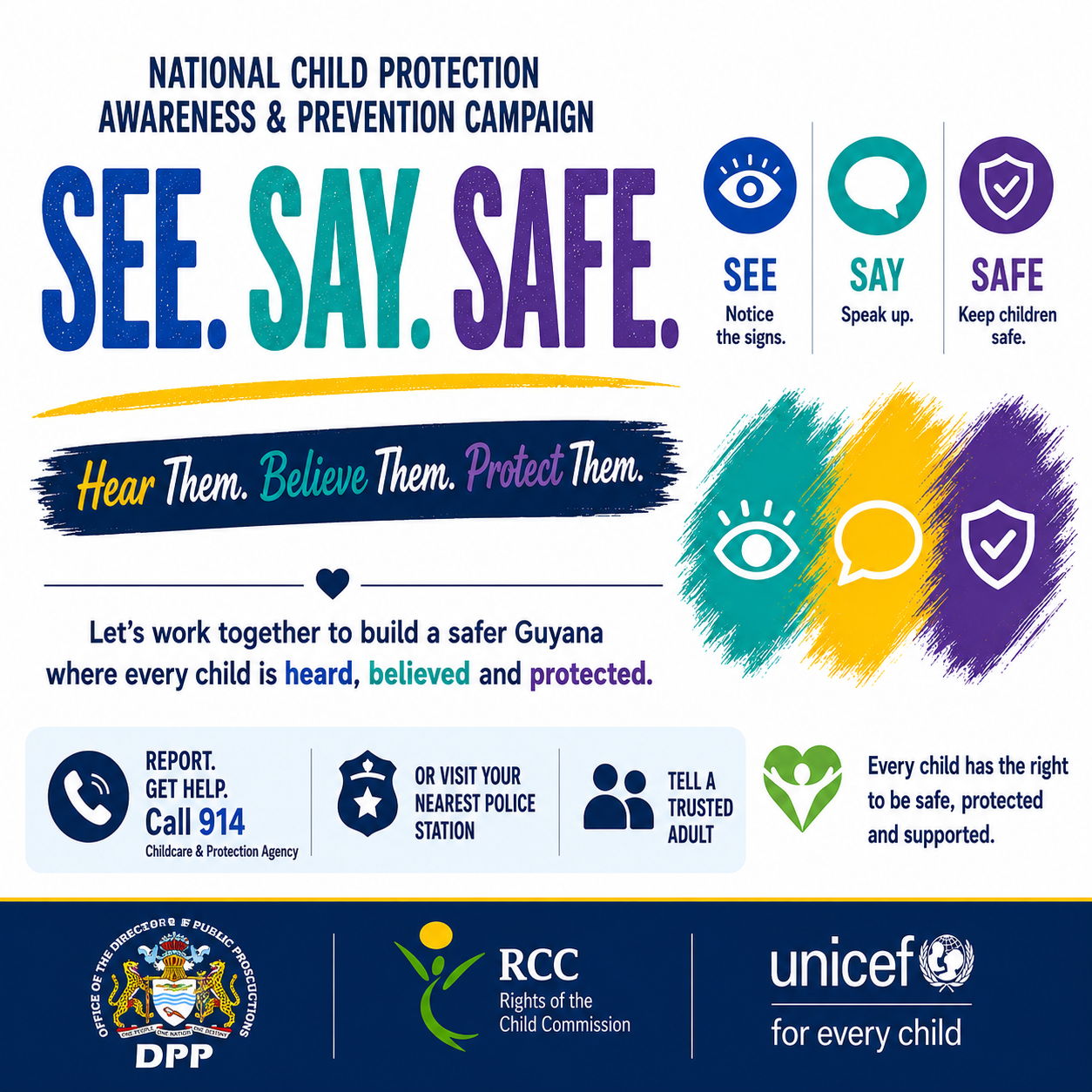
On June 28, 2026, UNICEF Guyana announced the launch of a groundbreaking public awareness initiative designed to combat child sexual abuse and boost early reporting of harm, in partnership with two leading Guyanese child protection bodies: the Rights of the Child Commission (RCC) and the Office of the Director of Public Prosecutions (DPP). Dubbed the ‘SEE. SAY. SAFE.’ campaign, the cross-sector effort aims to fill critical gaps in public knowledge that leave vulnerable children exposed to ongoing abuse.
Across its multi-month run, the campaign will deploy a multi-channel outreach strategy to reach every corner of Guyana, integrating messaging on national radio and television, across major social media platforms, in primary and secondary school programs, and through in-person community workshops. Unlike many targeted child protection efforts that focus solely on either adult action or child education, this initiative is designed to equip both groups with the tools they need to prevent harm.
Campaign organizers highlight a persistent barrier to child protection: far too many children who experience abuse never come forward to report their victimization. Most often, silence stems from deep-seated fear of retaliation, stigma, or uncertainty that their claims will be believed. RCC Chairperson Aleema Nasir emphasized that the campaign’s core mission is to dismantle these barriers by creating a culture where children feel secure disclosing harm, and adults are trained to respond with empathy and decisive action.
Over the coming months, the initiative will roll out targeted training modules for adults, teaching them to identify red flags that signal a child may be experiencing abuse, and guiding them to adopt consistent safeguarding practices in homes, schools, and community spaces. For children, the campaign will deliver age-appropriate education to help them distinguish between safe and unsafe interactions. It will also work to challenge social stigma that discourages survivors from coming forward, and clearly map accessible, official reporting pathways for anyone with concerns about a child’s safety.
A key, often overlooked message woven into the campaign is that child abuse can occur in trusted, familiar settings — including homes, schools, and community organizations — and that all children, regardless of gender, deserve protection, support, and to have their claims taken seriously. This explicit focus on including boys in protection conversations addresses a common gap in many global child safety efforts, where male survivors are often overlooked.
Dr. Loria-Mae Heywood, UNICEF’s Child Protection Specialist based in Guyana, explained that the initiative fills a critical need by connecting public awareness to tangible action. ‘When families and communities are informed and respond appropriately, children are safer,’ Dr. Heywood noted. ‘This campaign strengthens the link between awareness and action.’
Assistant Director of Public Prosecutions Teshana Lake stressed that early reporting is not just critical for a child’s immediate safety, but also for upholding justice for survivors. She urged anyone with concerns to report allegations promptly to the Guyana Police Force, noting that ‘Timely reporting in Sexual Offences helps to preserve evidence and it allows survivors to receive timely support.’
As an added component to improve future child protection work, the campaign is inviting all Guyanese residents to participate in a short, anonymous online survey. The data collected will help stakeholders measure current public awareness levels and refine child protection services to better meet community needs.
Organizers are calling on every member of the public to join the effort by learning to recognize warning signs of abuse, prioritizing open communication with children, and reporting any concerns to official authorities. Concerns can be directed to the Childcare and Protection Agency (CPA) via its dedicated 914 hotline, or to the nearest local police station.
Closing the campaign’s launch announcement, RCC Chairperson Nasir emphasized that child protection is a collective responsibility. ‘Protecting children is a shared responsibility. When we see, when we speak up, we help to keep children safe,’ she said.