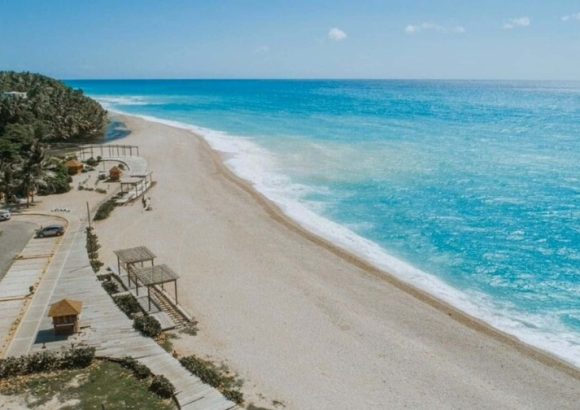
A groundbreaking new study led by researchers from the Technological Institute of Santo Domingo (INTEC) has upended long-held assumptions about the origin of sand on the Dominican Republic’s most popular tourist beaches, finding that nearly 90% of the sand is made up of fossilized remains of marine organisms rather than geologically derived sediment.
Conducted by INTEC’s Nanotechnology Laboratory under the leadership of chemical physics professor Dr. Melvin Arias, the research analyzed sand samples from eight of the country’s top coastal tourist destinations: El Morro, Dorada, El Portillo, Bibijagua, Isla Saona, Guayacanes, Punta Salinas, and Bahía de las Águilas. The team’s structural analysis confirmed that 88% of sand across these sites is produced by what researchers call natural marine “carbonate factories” — formations built from the accumulated skeletons of dead corals, red algae, and mollusks.
This discovery carries major implications for coastal conservation, as it confirms that the physical stability of the Dominican Republic’s coastlines and their ability to resist erosion depend entirely on the health of nearby coral reef ecosystems, not gradual geological processes. The study warns that any damage to these marine habitats, whether from pollution, excessive land runoff, or more frequent extreme weather events driven by climate change, would halt the natural production of new sand. Without this continuous natural replenishment, coastal erosion would accelerate dramatically, leading to permanent loss of coastal land that forms the foundation of the country’s $10 billion tourism industry.
Beyond erosion risk, the study explains the unique visual appeal that draws millions of visitors to Dominican beaches each year: the high concentration of biological carbonate material is what gives the sand its signature pale color and fine, soft texture — the key aesthetic and commercial selling point for the country’s coastal hotel zones. Researchers also noted that poor coastal management practices, such as the common practice of burying sargassum seaweed directly on beaches, already threaten this ecosystem by altering sand’s natural chemical composition and pH balance.
Over the long term, researchers explain, gradual changes to sand composition paired with ongoing coral reef degradation will break the natural cycle of marine sediment replenishment, undermining the geomorphological stability of entire coastlines. One of the most valuable contributions of the new research is the creation of the first comprehensive mineralogical baseline for Dominican beaches. This dataset will now allow the Dominican National Geological Survey and environmental management agencies to track the rate of coastal erosion over time by comparing modern sand chemical composition against future measurements.
The study also yielded reassuring findings for tourist and environmental health: rigorous physicochemical testing confirmed the complete absence of toxic heavy metals including lead, arsenic, chromium, nickel, and cobalt across all eight studied beach sites. At Bahía de las Águilas, where 87.8% of sand is made of coral-derived aragonite, researchers documented the presence of diatoms — a sensitive species of microalgae that acts as a natural bioindicator of water quality. Their presence confirms the beach remains entirely free of pollution, a major win for conservation efforts in the protected coastal area.
The research also highlighted rare exceptions to the biological sand origin rule, driven by geological processes. Punta Salinas in the Peravia province breaks the national trend: its sand is formed from volcanic rock fragments (quartz and magnetite) carried downstream from inland mountains by the Ocoa, Baní, and Nizao rivers. Similarly, the distinct reddish hue of sand at El Morro in Monte Cristi can be traced directly to erosion of the area’s iron-rich coastal cliffs.
The multi-institutional research project, which included contributions from researchers at the Autonomous University of Santo Domingo, the University of Calabria, and the University of Puerto Rico, has been published in the peer-reviewed *Journal of Coastal Research* to share its findings with coastal scientists and managers around the world.