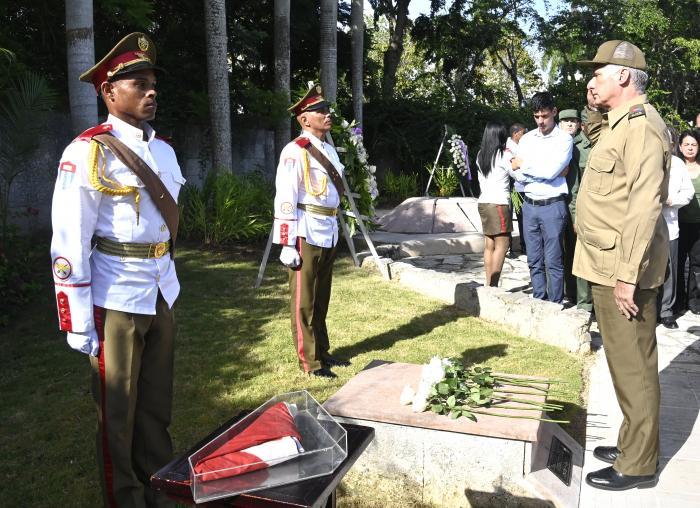
On Thursday, Cuba held a solemn state funeral to honor one of its most revered revolutionary leaders, Ramiro Valdés Menéndez, at the Ernesto Che Guevara Sculptural Complex in Santa Clara, drawing hundreds of Villa Clara residents who joined as representatives of the Cuban people to pay their final respects.
Floral tributes were placed at the ceremony on behalf of Army General Raúl Castro Ruz; Miguel Díaz-Canel Bermúdez, First Secretary of the Central Committee of the Communist Party of Cuba and President of the Republic; the Association of Cuban Combatants; the Cuban people; and Valdés’s immediate family.
In his keynote address at the memorial service, President Díaz-Canel highlighted the extraordinary legacy of a commander who dedicated more than seven decades of his life to the Cuban revolutionary cause, earning his status as an irreplaceable pillar of the nation’s revolutionary movement.
“Amid the deep sorrow of his passing, no matter how full a life he lived or how much he gave to our country, we still feel his absence acutely,” Díaz-Canel told the gathered crowd. “It is only right that we express our gratitude for the outpouring of solidarity from across all of Cuba as we bid him farewell, and for all the lessons we have drawn from his remarkable, exemplary life.”
The president walked attendees through key chapters of Valdés’s decades-long revolutionary career, recalling his participation in the 1953 Moncada Barracks attack, the historic Granma expedition that launched the revolutionary insurgency, and the years of guerrilla struggle in the Sierra Maestra mountains. He also underscored Valdés’s close ideological and personal bond with Ciro Redondo, second-in-command of Column No. 8, and with Ernesto “Che” Guevara — a bond that made Valdés a brother in arms to Guevara throughout the invasion of western Cuba and the decisive Las Villas campaign, which culminated in the landmark victory at the Battle of Santa Clara that sealed the revolution’s success.
Díaz-Canel further recalled that it was this long-standing loyalty and affinity that led Fidel Castro to task Valdés with leading the mission to locate and recover the remains of Che Guevara and his fallen comrades in Bolivia, before transferring their remains to their final resting place in Santa Clara — a assignment Valdés completed with the same meticulous, exemplary dedication that defined all his work for the revolution.
“Ramiro’s life was a lesson in history and moral purpose. He earned the title of hero through his every action, and he never wavered in his absolute faith and loyalty to Fidel and Raúl,” Díaz-Canel said. “His extraordinary life teaches us that the revolution is built on humility and unshakable conviction in ultimate victory.”
The formal burial proceedings opened with the playing of the Cuban National Anthem. Following the president’s address, Valdés’s funeral urn was transferred to a hearse bound for the Mausoleum of the Las Villas Front Combatants, where his mortal remains will be interred alongside fighters of the Reinforcement Detachment commanded by Che Guevara.
The procession carried the two stars marking Valdés’s status as a Hero of the Republic of Cuba and a Hero of Labor, alongside the many decorations and honors he earned for his decades of exceptional service. Resting closest to the urn was a folded Cuban flag, the same flag Valdés brought back from Bolivia along with Guevara’s remains, which he kept close to him for the rest of his life.
Members of the Ceremonial Unit of the Cuban Armed Forces and the Ministry of the Interior marched alongside the procession to the mausoleum, to the notes of “El Invasor” — the anthem that commemorates the epic history of Column 8 Ciro Redondo, where Valdés served as second-in-command under Guevara.
After Valdés’s ossuary was placed in its final resting place, the first niche of the first row of the Vanguard block, positioned to the right of the eternal flame that Valdés himself lit at the mausoleum’s inauguration on October 8, 2009, three rifle volleys were fired to honor the iconic revolutionary. Following the sounding of Taps, relatives of Valdés — who bore the legacy of being a hero of Moncada, the Granma expedition, and the Sierra Maestra struggle — alongside top revolutionary leaders, laid white roses at the gravesite. The moving moment concluded with a shared embrace between President Díaz-Canel and Valdés’s widow, Alicia Alonso Becerra.
In attendance alongside the national leadership were Esteban Lazo Hernández, President of the National Assembly of People’s Power and the Council of State; Bruno Rodríguez Parrilla, Cuba’s Minister of Foreign Affairs; Gladys Martínez Verdecia, First Secretary of the Provincial Committee of the Party in Artemisa; Rebel Army Commander José Ramón Machado Ventura; members of the Secretariat of the Central Committee; and other senior state and government leaders, joined by the highest provincial authorities of Villa Clara.
In a final reflection on Valdés’s legacy, the event reaffirmed that while the iconic revolutionary never sought the spotlight in the extraordinary project of the Cuban revolution, his place as a central protagonist of the nation’s liberation struggle is secure forever, and his example will continue to shape Cuba for generations to come.