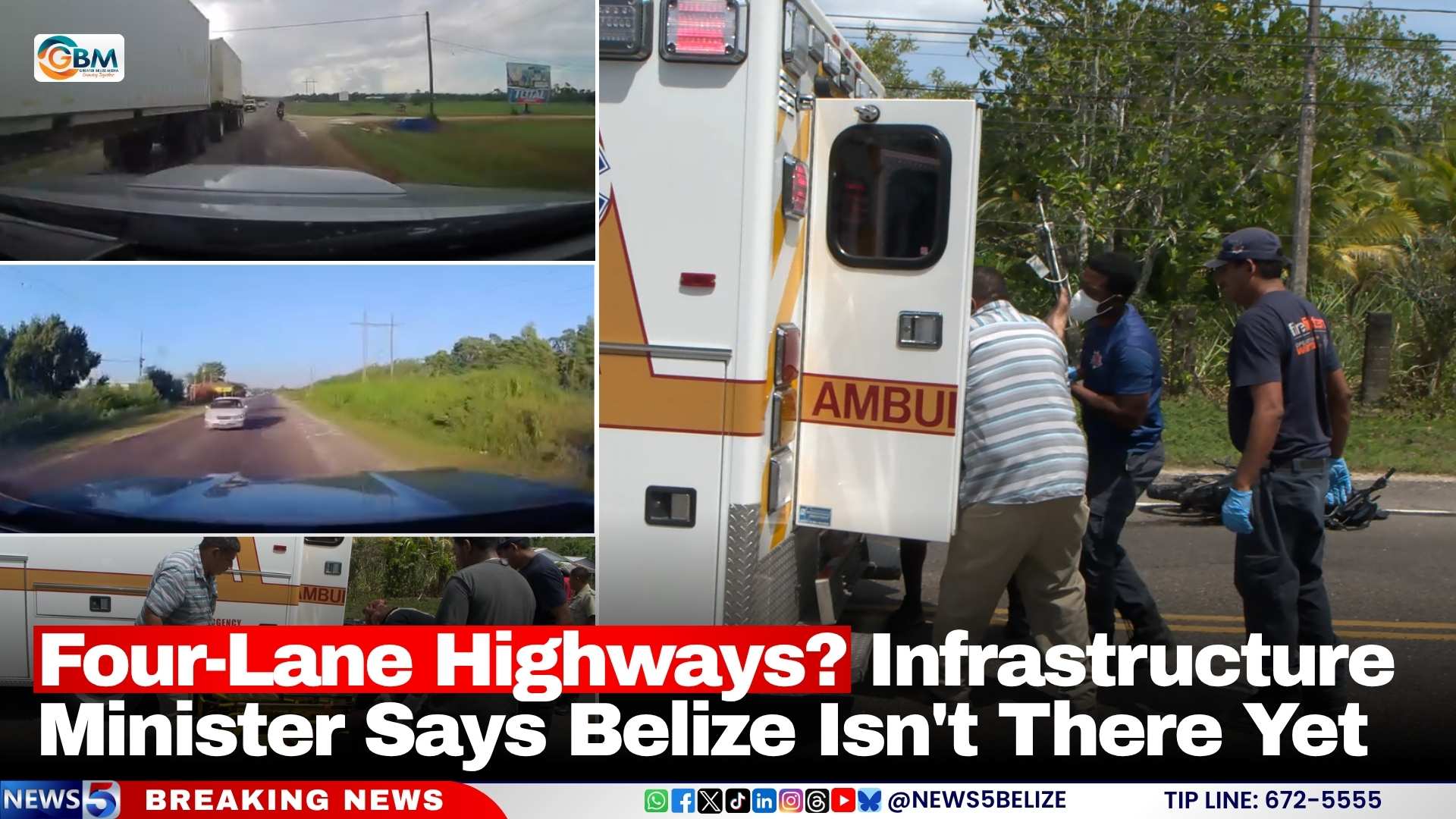
Amid growing public outcry over a sharp spike in deadly road accidents, Belize’s top infrastructure official has confirmed that a full conversion of the country’s busiest highways to four-lane divided roads is not on the immediate agenda, pointing to insurmountable financial constraints and low current traffic volume that fail to justify the massive project.
In 2025 alone, Belize recorded 3,300 road traffic collisions across the country, 94 of which were fatal. The devastating death toll has reignited fierce debate over the safety of Belize’s existing two-lane highway network, which is the primary intercity transit backbone for the small nation. Currently, the government is allocating millions of dollars to rehabilitation work on two of its most critical routes: the George Price Highway and the Phillip Goldson Highway. Road safety campaigners and everyday motorists have repeatedly questioned why these costly upgrade projects do not include a full shift to four-lane construction with a central median to separate opposing traffic streams, a design change that would eliminate the risk of deadly head-on crashes, the leading cause of fatal highway incidents worldwide.
In a recent public address addressing these demands, Minister of Infrastructure Development Julius Espat laid out the government’s rationale for the incremental approach, breaking the decision down into two core issues: population size and overall project cost. Espat explained that nearly all major infrastructure projects in Belize rely on funding from international financial institutions (IFIs), which have strict requirements for approving large-scale investments. Before greenlighting financing for highway expansion, these institutions dispatch independent technical and financial experts to conduct on-the-ground assessments of current and projected traffic flow to determine whether the scale of the requested project aligns with the country’s actual needs.
“When a highway is being designed, you cannot simply approach an IFI asking for a six-lane route and expect automatic approval,” Espat noted. “Their experts run detailed analyses to confirm whether the existing traffic volume, tied directly to our country’s population size, actually justifies a road of that massive magnitude.”
Beyond technical justifications, Espat emphasized the stark financial reality that the government faces, noting that even current two-lane rehabilitation projects already draw heavy public criticism for their high price tags. A full conversion to four lanes would send costs soaring to unsustainable levels for the small Central American nation. “If we are already complaining that the cost of current highway upgrades is too high, just imagine what four lanes would run us. The total cost would be tremendous, far beyond what our national budget can accommodate at this stage,” he said.
Instead of a full four-lane expansion, the government is rolling out a more modest, targeted upgrade: adding passing lanes to select high-traffic sections of the George Price Highway. This design allows drivers to safely overtake slower-moving vehicles without the massive land acquisition and construction costs of a full four-lane conversion. Unlike a continuous divided highway, these passing lanes are staggered across the route: one direction gets a second lane in one segment, while the opposite direction gets an extra passing lane in a different section, matching the most common problem areas where dangerous overtaking maneuvers regularly occur.
Espat emphasized that modernizing Belize’s road network is a long-term, incremental project rather than an overnight transformation. The current government is laying the groundwork for future expansions, he said, and subsequent administrations will be able to build on that progress as the country’s population and traffic volume grow to justify larger investments. “It’s a gradual process,” Espat explained. “By the end of our term in office, we will have delivered the upgrades we can afford right now. Hopefully, the next government will take what we’ve built and make it even better. That is how you steadily improve a country’s infrastructure over time.”
For road safety advocates, however, the slow, staged approach comes at a continuing cost of preventable deaths. While the government’s proposal addresses the risk of collisions during overtaking, it does not eliminate the threat of head-on crashes that make two-lane highways far more dangerous than divided alternatives. The debate over how to balance public safety and fiscal responsibility is expected to continue as the rehabilitation project moves forward and more data on accident rates becomes available.