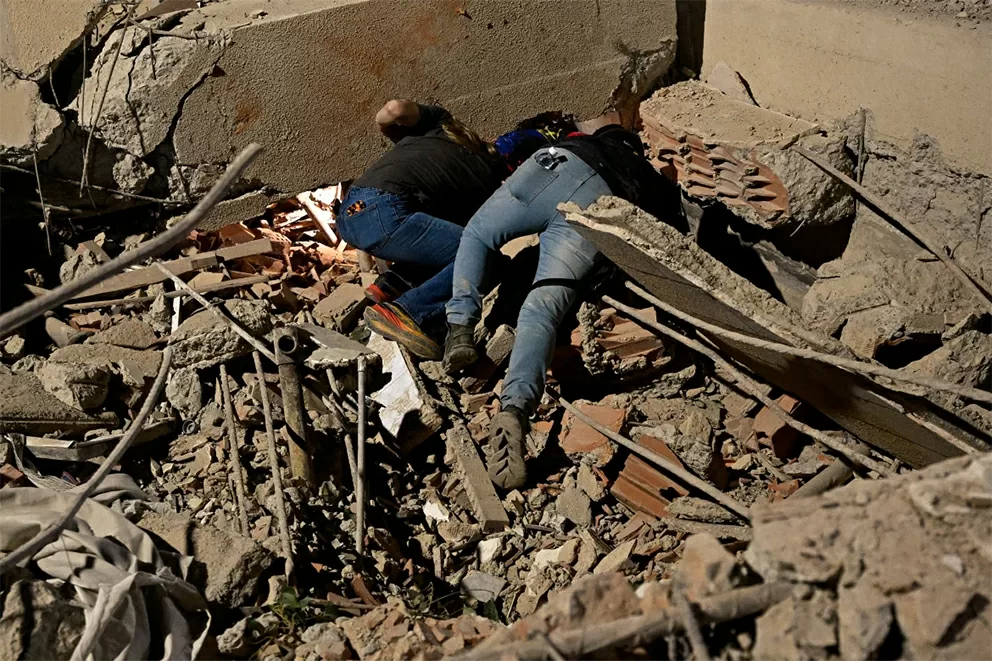
On Wednesday evening, a catastrophic pair of powerful back-to-back earthquakes struck western Venezuela, leaving a devastating trail of death, injury and widespread destruction that has triggered an urgent international response. According to data from the United States Geological Survey (USGS), the first tremor registered a magnitude of 7.2 and struck at a depth of 22 kilometers roughly 168 kilometers west of the capital Caracas, near the town of Morón. Less than a minute later, an even stronger 7.5 magnitude quake hit the same region at a depth of just 10 kilometers, with epicenters confirmed in Yaracuy state, per USGS mapping.
As of the latest official update from interim Venezuelan President Delcy Rodríguez, the disaster has claimed at least 164 lives and left more than 970 people injured. The worst damage has been concentrated in La Guaira, a coastal Caribbean state just north of Caracas, which Rodríguez has formally declared a disaster zone. Multiple multi-story apartment buildings have collapsed across the affected region, trapping residents under rubble, while widespread damage to critical infrastructure forced authorities to close Caracas’s main Simón Bolívar International Airport indefinitely. Thousands of residents who survived the tremors have fled their homes and gathered in open public spaces, too afraid to return to damaged standing structures even after initial shaking subsided. Many injured victims are currently receiving emergency care in hastily set up field hospitals, as local medical facilities are strained beyond capacity.
In response to the unprecedented scale of the disaster, the Venezuelan government has declared a national state of emergency, and rescue teams have been deployed across affected regions to pull survivors from collapsed structures. The USGS had pre-emptively warned of widespread casualties and catastrophic damage from the event, noting the disaster would require large-scale external support. Venezuela’s existing long-running economic and political instability has left critical infrastructure and emergency response services stretched thin, creating significant additional challenges for search and rescue operations that are already in their most critical window in the immediate aftermath of the quakes.
Within hours of the disaster, governments and leaders across the globe issued statements of solidarity and pledged tangible humanitarian assistance to support Venezuela’s response, transcending pre-existing political divides between nations.
Across neighboring South American countries, responses were immediate. Argentine President Javier Milei offered his deep solidarity with the Venezuelan people, noting that his country extended a hand of support regardless of existing political differences between the two governments. Guyana, another border nation, President Irfaan Ali confirmed his country stood ready to offer all possible assistance within its capacity, saying “As neighbors, we are deeply grieved by the destruction these powerful quakes have left behind.” Bolivian President Rodrigo Paz also confirmed Bolivia remained alert and prepared to deliver any necessary support, while Brazilian President Luiz Inácio Lula da Silva has ordered his foreign ministry and local diplomatic mission to assess what aid Brazil can provide. Colombia’s national disaster risk management agency activated its full emergency response team and reached out to Venezuelan authorities to coordinate technical and operational support, confirming no major damage was reported in the Colombian capital Bogotá, where the tremors were felt. Cuba already has health workers deployed in Venezuela, who have now been fully mobilized to provide emergency medical care to affected communities, per Cuban Foreign Minister Bruno Rodríguez. Ecuador President Daniel Noboa has confirmed his country is rushing emergency humanitarian aid to Caracas, noting that “humanity must always guide the actions of a leader” regardless of political differences. El Salvador President Nayib Bukele went a step further, announcing his country has a full team of 300 rescue workers and paramedics ready to deploy alongside 50 tons of equipment, medicine and essential supplies. Panama President Jose Raul Mulino also extended his country’s full solidarity and offered emergency humanitarian aid, while Uruguayan President Yamandu Orsi confirmed Uruguay stands ready to support Venezuela in any way the Venezuelan government requests.
Major nations beyond Latin America have also joined the response. U.S. President Donald Trump wrote on his Truth Social platform that the earthquakes were enormous in scale and had left a devastating death toll, confirming U.S. agencies had been ordered to prepare for rapid deployment of aid, while U.S. Secretary of State Marco Rubio confirmed the U.S. would immediately deploy search and rescue teams, medical supplies and humanitarian aid. Turkish President Recep Tayyip Erdoğan extended his sincere condolences to the Venezuelan people and government, sharing in the grief of families who lost loved ones and wishing a fast recovery for all injured victims. Italian Prime Minister Giorgia Meloni said she was following the situation with deep concern, and was working to activate all channels for humanitarian assistance as quickly as possible, as well as support for any Italian citizens in the region. Mexican President Claudia Sheinbaum confirmed the Mexican foreign ministry had already established contact with Venezuelan authorities, and she has ordered preparation of needed aid, with Venezuela requesting specialized rescue and medical personnel. Spanish Prime Minister Pedro Sánchez extended all of Spain’s support to the Venezuelan people, with Spanish foreign aid agency confirming it stands ready to deliver any required emergency assistance. Pakistani Prime Minister Shehbaz Sharif expressed deep sorrow for the loss of life and destruction, extending his country’s sincere condolences, while Indian Prime Minister Narendra Modi also expressed his grief and confirmed India stands ready to provide all possible assistance.
China, a long-time diplomatic partner of Venezuela, also issued a statement via foreign ministry spokesperson Guo Jiakun, extending condolences to the Venezuelan government and affected population, confirming there are no reports of Chinese citizens being killed or injured in the disaster. “We are confident that under the leadership of the Venezuelan government, the Venezuelan people will achieve a quick recovery and reconstruction,” Guo said, adding that China stands ready to provide all appropriate assistance in line with Venezuela’s urgent needs.
Venezuela sits in a highly seismically active zone along the boundary of the Caribbean and South American tectonic plates, meaning earthquakes are not an unusual occurrence, but the strength and close timing of this pair of tremors is considered exceptionally rare. Venezuelan authorities are currently working alongside international organizations to bring the situation under control, with aid shipments, medical teams and rescue personnel gradually arriving into the country. Crews are also conducting widespread damage assessments across the region, and setting up emergency shelter for thousands of displaced residents. Emergency response teams have warned the coming 72 hours will be the most critical window for finding surviving victims trapped under rubble, making the immediate delivery of international aid vital to saving lives.