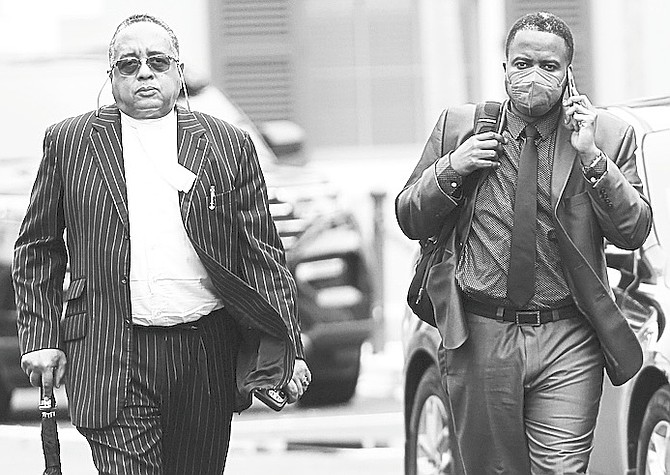
A high-stakes procedural battle in the Bahamian judicial system has concluded with the Court of Appeal upholding a lower court’s decision, rejecting an eleventh-hour attempt by five defendants — Adrian Gibson, Joan Knowles, Jerome Missick, Peaches Farquharson, and Elwood Donaldson — to bring their ongoing criminal trial to an early end. The appeal stemmed from the trial judge’s earlier refusal to grant the group’s requests for a mistrial, the dismissal of the seated jury, and the judge’s own recusal from the case, a ruling the five defendants argued had violated their constitutionally protected right to a fair trial.
The defendants put forward a series of grievances to back their challenge: they claimed procedural irregularities during the jury selection and empanelment process, that the official 2023 approved jury list had never been disclosed to the defense, that one juror held an undisclosed connection to the prosecutor’s office that created implicit bias, and that the trial judge herself had demonstrated apparent bias against their side.
In a unanimous ruling, a three-justice panel comprising Justices Evans, Charles, and Kokaram found that none of these claims rose to the level required to justify constitutional court intervention while the criminal trial was still in progress. The panel characterized the defendants’ constitutional motion as an impermissible collateral attack on active ongoing criminal proceedings, noting that all the issues raised could be addressed through standard trial procedures or, if the defendants are ultimately convicted, through a formal appeal after a verdict is reached.
Writing for the panel, Justice Kokaram clarified that the defendants’ complaints were not disputes over the existence of constitutional rights, but rather disagreements over the conduct of the trial — and that no extraordinary circumstances existed that warranted immediate constitutional review. The court specifically addressed the defendants’ key claim that seven of the nine seated jurors were not drawn from the official 2023 approved jury list, confirming that the assertion of fact was accurate but that the irregularity did not justify halting the trial. Justices emphasized the trial judge acted well within her authority to reject the request to dismiss the entire jury, and any challenge to the jury’s composition can be raised in a standard post-conviction appeal. The court also noted that no argument had been made that any individual juror selected was unqualified to serve.
The panel similarly dismissed the bias claim tied to the juror’s alleged connection to the Director of Public Prosecutions (DPP) office, pointing out that the defense never filed a formal application on this issue with the trial judge before launching their appeal. Claims that the trial judge had already formed a closed mind on the case and should have stepped down were also rejected, with the court finding the allegation had not been sufficiently proven, and could also be raised in a post-trial appeal if needed.
The defense’s complaint that the DPP had failed to disclose the approved jury list was dismissed outright as a non-starter. The court noted the full jury list is a matter of public record, and the defense never submitted a formal request to the DPP for a copy. Justices added that in constitutional claims challenging alleged state conduct, the Attorney General, not the DPP, is the proper responding party.
In its closing remarks, the court issued sharp criticism of the repeated procedural delays that have slowed the case, noting the trial has been pending since 2023 and this appeal has only added more unnecessary hold-up. The ruling reaffirmed a core principle of judicial procedure: constitutional motions cannot be used to interrupt ongoing criminal trials unless truly exceptional circumstances are present. “There has been no alleged constitutional breach that is so significant that will justify a departure from the well-worn investigation by an appellate court of any alleged miscarriage of justice,” the panel concluded.