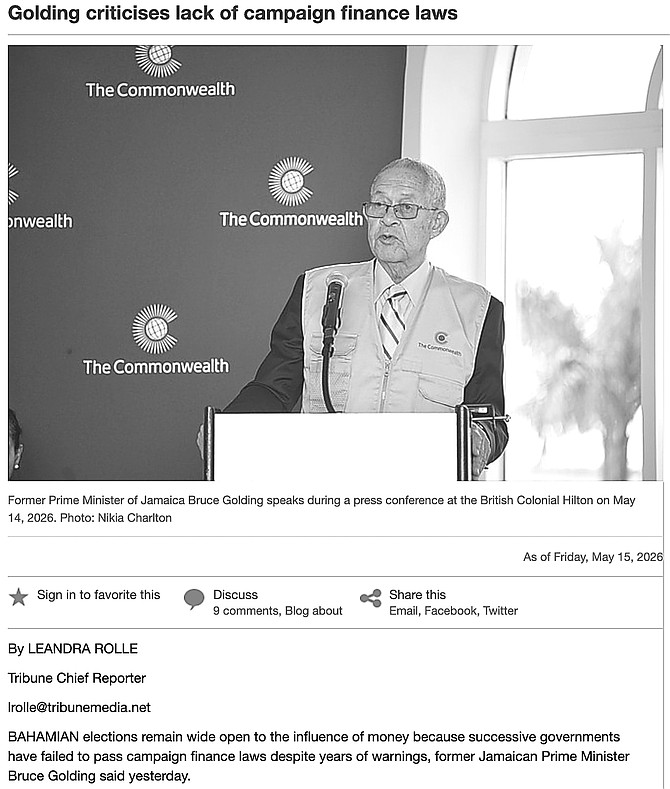
During recent legal proceedings connected to Jonathan Gardiner, attorney Susie Ribero-Ayala has brought forward new evidence that spotlights a long-running democratic gap in the Bahamas’ political system. To support her argument that the Caribbean nation lacks a rigorous, comprehensive campaign finance regulatory framework matching the standards of the United States, Ribero-Ayala submitted a 2024 report from The Tribune as court evidence, labeled Exhibit D. The report centers on critical commentary from Bruce Golding, former Jamaican Prime Minister and current chair of the Commonwealth Observer Group.
Golding’s remarks pull back the curtain on years of unfulfilled political promises and inaction on campaign finance regulation in the Bahamas. He explained that successive Bahamian governments have consistently failed to enact meaningful reform, despite repeated calls and formal recommendations from multiple international observer missions. In a sharp, candid rebuke of ongoing political intransigence, Golding joked that international organizations could send monitoring delegations to the Bahamas for another hundred years, and their repeated calls for change would still be ignored by national policymakers.
The former prime minister emphasized that democratic accountability on this issue ultimately rests with the Bahamian public. “It is their democracy. It is their future,” Golding stated, noting that while politicians can easily brush aside recommendations from the Commonwealth Secretariat and other international bodies, they cannot ignore the demands of their own electorate. Meaningful progress, he argued, depends largely on the level of public activism Bahamian citizens mobilize around the issue of campaign finance reform.
Compounding the urgency of Golding’s critique is the revelation that current Bahamian Prime Minister Philip ‘Brave’ Davis has explicitly deprioritized campaign finance reform proposals in 2024, breaking earlier campaign pledges to advance the legislation. Golding warned that the Bahamas’ lack of regulation creates uniquely high risks for democratic integrity, specifically because the country’s small size means individual electoral districts have relatively small voter pools. This dynamic makes the political system especially vulnerable to unregulated private money influence and outright vote buying. Wealthy candidates or well-funded political parties can easily calculate the exact number of votes needed to win an election, then deploy their financial resources to purchase the required support, effectively undermining free and fair democratic processes, Golding explained. “This is something that worries us,” he concluded.