A 2026 report compiled by the United Kingdom Home Office has laid bare the full scope of gang-related organized crime across Trinidad and Tobago, offering granular data on gang activity, violence trends, and systemic challenges facing the Caribbean nation’s law enforcement institutions.
Prepared as a reference for UK immigration and asylum decision-makers and published earlier in June 2026, the Country Policy and Information Note (CPIN) documents that at least 186 distinct gangs, with an approximate total membership of 1,750, currently operate across the twin-island nation. Data analyzed in the report links these criminal networks to 43.7 percent of all homicides recorded in 2024, with gang-related killings accounting for roughly one-third of all murders nationwide in 2025.
The report draws on conflict mapping data from the Armed Conflict Location and Event Data Project (ACLED) to show that a staggering 57 percent of Trinidad and Tobago’s total population lived within close proximity of gang-related violent incidents between January and September 2024. While gang activity is most heavily concentrated in the capital Port of Spain and the densely populated East-West Corridor, the assessment confirms criminal groups have established a presence in communities across both islands. High-risk areas explicitly named in the report include Laventille, Morvant, Sea Lots, Beetham, Tunapuna, Arima, Diego Martin, Chaguanas, and San Fernando, with the vast majority of gang-related homicides occurring in populated population centers in northwestern Trinidad.
Two large criminal networks – the Muslims gang and Rasta City gang – are identified as the dominant gang groupings in the country. Other notable active groups include Sixx, Seven, Resistance, Anybody Gets It (ABG), Tyson, and the Boombay Gang. The report notes that while most smaller gangs operate as affiliates of these larger, established organizations, security agencies have recorded a steady rise in independent splinter gangs and autonomous criminal networks across the region in recent years. Gangs in Trinidad and Tobago engage in a wide range of illicit activities, the report confirms, including drug trafficking, illegal firearms smuggling, contract killings, kidnappings for ransom, extortion, human trafficking, armed robbery, unregulated illegal quarrying, and financial fraud. The assessment also highlights that transnational Venezuelan criminal organizations, including the well-documented Tren de Aragua and Evander groups, operate in partnership with local gang networks across the nation.
On the topic of gang recruitment, the report outlines that criminal groups systematically target vulnerable young people between the ages of 12 and 16, with recruitment activity documented inside primary and secondary schools as well as within the country’s prison system. Contrary to common assumptions about gang demographics, the report notes that women hold full membership in many local gangs, and in some cases occupy senior leadership positions. In many marginalized communities, gangs maintain social control and public loyalty by providing informal financial support, mediating local disputes, and connecting residents to informal employment opportunities – a dynamic that has helped them embed themselves in community life. The assessment also echoes longstanding public concerns over allegations that state-funded public contracts have been awarded to individuals with proven ties to organized criminal groups.
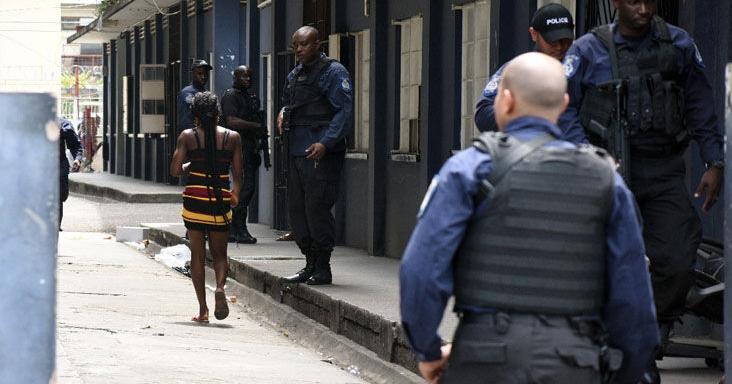
The CPIN assessment was published months after the government of Trinidad and Tobago declared a national state of emergency to address rising gang violence on December 30, 2024. Early outcomes from the emergency crackdown have shown measurable reductions in violence: the report records that more than 4,000 people were arrested and roughly 1,600 people were charged with criminal offenses during the emergency period. Clashes between rival gangs and targeted attacks on civilians dropped by 44 percent during the first eight months of 2025 compared to the same period in 2024, and the national overall homicide rate also declined sharply, falling from 45.7 homicides per 100,000 residents in 2024 to 27 per 100,000 in 2025. Even with this progress, however, gangs still remained responsible for approximately one out of every three murders recorded in 2025.
The report also documents rapid gang expansion on the smaller island of Tobago, where the total number of active gangs has grown from just 3 in 2009 to 28 as of 2022. Many Trinidad and Tobago-based gangs have also established cross-border connections with other criminal organizations across the Caribbean, enabling broader transnational criminal activity, the assessment adds.
In its concluding findings, the UK Home Office report acknowledges that state institutions in Trinidad and Tobago remain fully operational and are able to provide protection to citizens in most circumstances. However, it highlights persistent systemic challenges that continue to undermine efforts to curb gang activity: widespread witness intimidation, public sector corruption, chronic resource constraints for law enforcement, and eroded public confidence in policing and judicial institutions. The report identifies police officers, prison staff, prosecutors, judges, and private business owners as among the most common targets for gang intimidation and retaliatory violence.