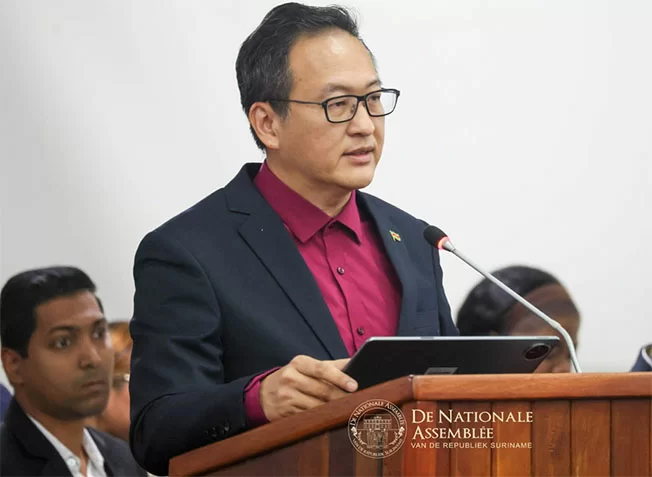
Suriname’s Ministry of Public Works and Spatial Planning (OWRO) has confirmed it requires an additional 1 billion Surinamese dollars (SRD) on top of its current 2026 allocation to deliver all planned infrastructure upgrades and maintenance projects across the country. Minister Stephen Tsang made the funding request public during ongoing budget deliberations in the National Assembly, noting that the current approved budget is insufficient to cover critical investments in roads, drainage systems, pumping stations, waste processing, and residential housing development.
Following last year’s government transition, Tsang told lawmakers his department inherited a massive accumulated backlog of deferred maintenance across nearly all core infrastructure assets, including roads, bridges, piers, drainage canals, water locks, and pumping stations. While targeted repair work has already been completed at multiple sites across the country, the minister stressed that far more resources are needed to deliver long-term, structural improvements to Suriname’s aging public infrastructure network.
Minister Tsang presented parliament with a detailed breakdown of how the requested additional funding would be allocated. The largest share, 440 million SRD, is earmarked for the rehabilitation of paved and unpaved roads across the districts of Paramaribo, Wanica, and Saramacca. Another 251.3 million SRD is allocated to cleaning primary and tertiary drainage canals, while 117 million SRD would go toward expanded drainage works and coastal protection projects. More than 107 million SRD is requested for the construction and rehabilitation of pumping stations, with remaining funds allocated to housing development, waste management upgrades, and new early warning flood systems.
The minister also outlined the alarming current state of Suriname’s national infrastructure, sharing ministry data showing more than 60 percent of the country’s entire road network is classified as being in poor or fair condition. OWRO’s analysis found secondary and tertiary rural roads in particular have suffered from decades of chronic underfunding for routine maintenance.
In total, Suriname maintains roughly 5,000 kilometers of public paved and unpaved roads. Ministry calculations show eliminating the full maintenance and rehabilitation backlog across the entire road network would require an estimated 116.28 billion SRD. By comparison, the 2026 national budget only allocates 1.75 billion SRD to road infrastructure. At current funding levels, OWRO estimates this annual allocation will only clear around 1.5 percent of the total accumulated backlog. When the cost of maintaining and repairing bridges and piers is added, that figure drops below 1 percent of the total backlog cleared per year.
During budget deliberations, Tsang clarified that the 2026 OWRO budget currently allocates 1.75 billion SRD to dry civil works, which include roads, bridges, and piers. Roughly 1.09 billion SRD is allocated to wet infrastructure projects, covering drainage systems, canals, water locks, and pumping stations.
Despite the severe financial constraints facing the department, Minister Tsang reaffirmed the ministry’s long-term ambitious development goals. The core strategic objective is to eventually pave all unpaved sand roads across Suriname. As a symbolic milestone tied to the 170th anniversary of the founding of the public works department, Tsang set a target to pave at least 170 roads in the coming period. The ministry is also progressing on work to build new pumping stations, strengthen national drainage networks, modernize aging water locks, and advance pre-construction planning for major long-term infrastructure projects, including a proposed cross-border bridge to Guyana and a potential second bridge crossing the Suriname River.
Tsang noted that if parliament cannot approve the full 1 billion SRD in additional funding, lawmakers will need to collaborate with the ministry to set clear priorities for which projects move forward. This signals that debate over the allocation of limited public resources to Suriname’s infrastructure sector will remain a central topic of budget negotiations in the coming months.