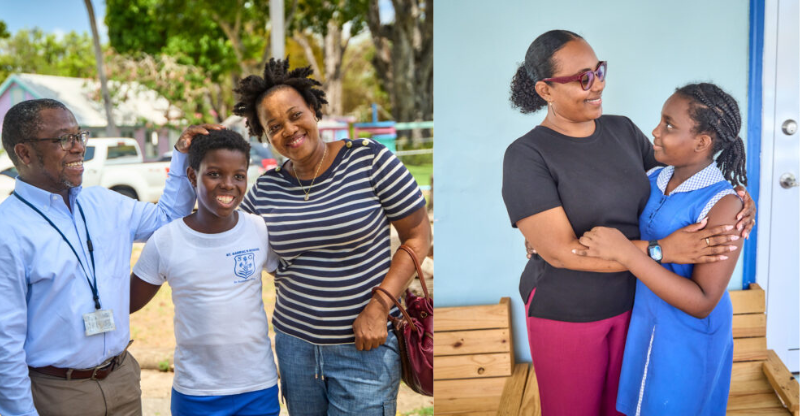
Barbados’ private St Gabriel’s School has made history this examination cycle, becoming the first institution in the island’s education system to claim both the top male and top female positions in the annual Common Entrance Examination. This unprecedented double triumph has cemented the school’s long-standing reputation for academic excellence, while opening new conversations around ongoing national education reform efforts.
Benjamin Enzo Luciene earned the title of the nation’s highest-scoring male candidate, and Xiomara Alexis Lascaris secured the top position for female students. In a further milestone for the two high achievers, both have already been accepted to study at Harrison College, one of the country’s most prestigious secondary institutions, where they will begin their post-primary education this coming September. At the time of the official results announcement, no public data was released on how government-funded public schools performed in terms of overall placement rates or distribution of top scores across institutions.
Chad Blackman, Barbados’ Minister of Education Transformation, officially announced the results and extended warm congratulations to all participating students across the country, highlighting the extraordinary achievement of Luciene and Lascaris in particular. Blackman reaffirmed the government’s unwavering commitment to advancing comprehensive systemic reform in the national education sector, while framing the current results within the context of a planned long-term shift away from the high-stakes standardized testing model that the Common Entrance Examination represents.
Blackman acknowledged that the examination has occupied a central role in the island’s education culture and national identity for decades. “This examination throughout the years has been an important part of our national psyche in terms of education,” he said. “That’s why I’m so excited about the future of that transition: it is going to be one that is based on equity and is one that is based on ensuring that we tap into the broad skill sets that our children have, and therefore not focused on a one-shot exam.”
Celebrations erupted across the St Gabriel’s campus immediately after the results were made public, with jubilant cheers from students, faculty and parents echoing through school corridors. St Gabriel’s Principal Alexina Chandler shared in an interview that the school placed a total of four students in the national top 10, an achievement she called deeply rewarding for the entire school community.
“We are so proud of them, over the moon,” Chandler said. “I mean, it’s not a total surprise because they’ve all worked very hard, but we’re very pleased, very pleased. We’ve had top students before, but not both. I’m not sure how many schools have had both, so that would be interesting to look into. I know they’ve worked extremely hard, and they’re focused children, lovely children. We also have two others in the top ten as well. I’m very proud of all of them.”
Chandler explained that the school’s consistent strong performance stems from a deliberate approach to building academic and personal foundations starting in early childhood education, rather than cramming focused preparation only in a student’s final primary year. She noted that the modern teaching frameworks the Ministry of Education Transformation currently promotes nationwide have already been core to St Gabriel’s curriculum for decades.
“The students work very hard, obviously the teachers as well, but it doesn’t just start in Class 4. It starts in the foundation years from nursery and reception onwards. We build that foundation. The ministry is talking about play-based learning; we already have that in place for many, many years, and then the children build on that,” she explained. “Even in Class 4, they continue with the other subject areas, so we will have well-rounded, confident students. So a lot of hard work from the students, the teachers, and the parents, their support as well.”
Addressing the ministry’s push for systemic education reform that prioritizes holistic development over rote testing, Chandler added that St Gabriel’s has long balanced targeted exam preparation with investment in soft skills and well-rounded growth. For example, the school introduces test-taking strategies, time management and problem-solving skills as early as Class 3, helping students build confidence without sacrificing broader learning. Project-based learning, another reform priority, is already a core component of the school’s infant department, with plans to expand the model further to align with the ministry’s new guidelines.
“It’s not just about mathematics and English for us; it is well-rounded students who, you know, [have] those soft skills … as well, project-based. We already have that going in our infant department. It’s now to extend more to the juniors in terms of what the ministry is looking at,” she said.
As Luciene and Lascaris prepare for their move to Harrison College, Chandler expressed full confidence that the foundational, holistic education they received at St Gabriel’s will support them through the next stage of their academic journeys. She emphasized that the historic double win is not a one-off anomaly, but a reflection of the school’s long-held institutional culture and educational philosophy.
“It sums up what we try to do at St Gabriel’s in a lovely way. It is not a surprise, as I said, everyone worked really hard and was focused. And so this is not an anomaly. This is not by accident. This is part of what we do at St Gabriel’s,” Chandler noted.
Founded in 1947 at the request of the then Anglican Bishop of Barbados, William James Hughes, St Gabriel’s originally opened with just 28 students between the ages of four and eight, and was initially run primarily by teaching sisters from the Convent of Jesus the Good Shepherd based in England. The school later expanded to offer primary through O-level secondary education, before closing its secondary section in 1975 to consolidate as an Anglican denominational primary school under the Diocese of Barbados. Today, it operates with a Christian foundational ethos while serving a multi-faith student body.