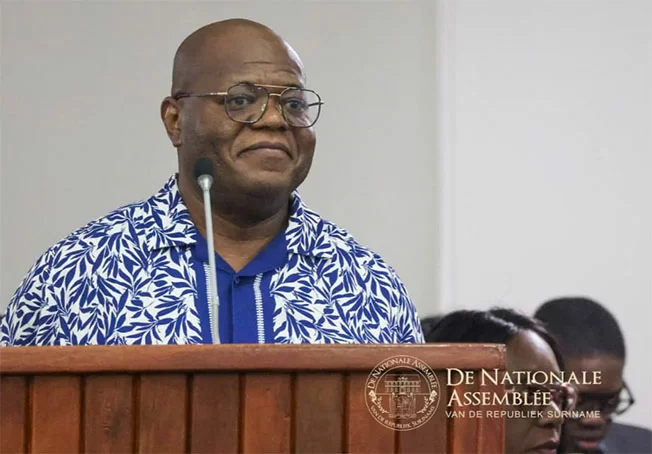
Suriname’s Minister of Internal Affairs, Marinus Bee, is launching an aggressive campaign to eliminate systemic waste in the country’s civil service, targeting so-called “ghost employees”, public workers who reside abroad while continuing to collect full government salaries, politically appointed unqualified staff, and idle civil servants who collect pay without reporting for work.
Addressing lawmakers during budget deliberations, Bee emphasized that the government cannot sustain unlimited public spending on workers who contribute no labor to state institutions. “Public funds are meant to support services that benefit all Surinamese, not to line the pockets of people who do not hold up their end of the agreement,” the minister stated.
The crackdown is already underway, leveraging the mandatory national civil servant registry to conduct rigorous cross-checks of all active public employees. Any worker who fails to verify their employment status after repeated official notifications will have their salaries immediately halted or frozen. Authorities are also conducting a full audit of national payrolls to root out duplicate payments and unauthorized compensation, with Bee confirming that multiple cases of individuals collecting two or even three simultaneous government salaries have already been uncovered.
In collaboration with the country’s Border Management System, authorities are also cross-referencing border exit data with active payroll records to identify public servants who have left Suriname permanently, failed to return from extended international stays, and remain on government payrolls. Bee estimates that roughly 2,000 civil servants currently fall into this category. Early progress has already been seen: a number of affected employees have voluntarily resigned after learning of the ministry’s ongoing investigation, the minister reported.
Going forward, enforcement will be significantly tightened, Bee confirmed. The government will no longer conduct prolonged searches for employees who cannot be located or have provided false residential addresses. Salaries for unresponsive workers will be blocked much faster, forcing employees to come forward to formalize their employment status to restore pay. The ministry is also considering the launch of an anonymous tip line, allowing ordinary citizens to submit information about public servants who have lived abroad for years while still collecting government salaries.
Bee framed the crackdown as a core part of a broader, long-overdue reform of Suriname’s entire civil service system. For decades, he explained, the public sector has been misused as a political tool, particularly during election cycles. Political parties have hired thousands of supporters to reward loyalty, with no actual vacant positions available and no requirement that hires meet basic job qualifications. After changes in government, ousted political appointees have often been sent home without work but continue to collect full salaries.
“Let’s be honest: we do not need 51,000 civil servants,” Bee said. The end goal of reforms is to build a smaller, more efficient, performance-focused public sector, where workers are hired and retained based on professional competence rather than political loyalty.
To ease the transition, the minister plans to reassign surplus public workers to other ministries and public entities that are facing staffing shortages where possible. He is also exploring the design of voluntary early retirement incentive packages to encourage workers to exit the public sector willingly. Most importantly, Bee noted that the savings generated by closing these costly payroll “leaks” will be redirected to raise compensation for active, hardworking civil servants – particularly underpaid strategic groups including teachers and healthcare workers.