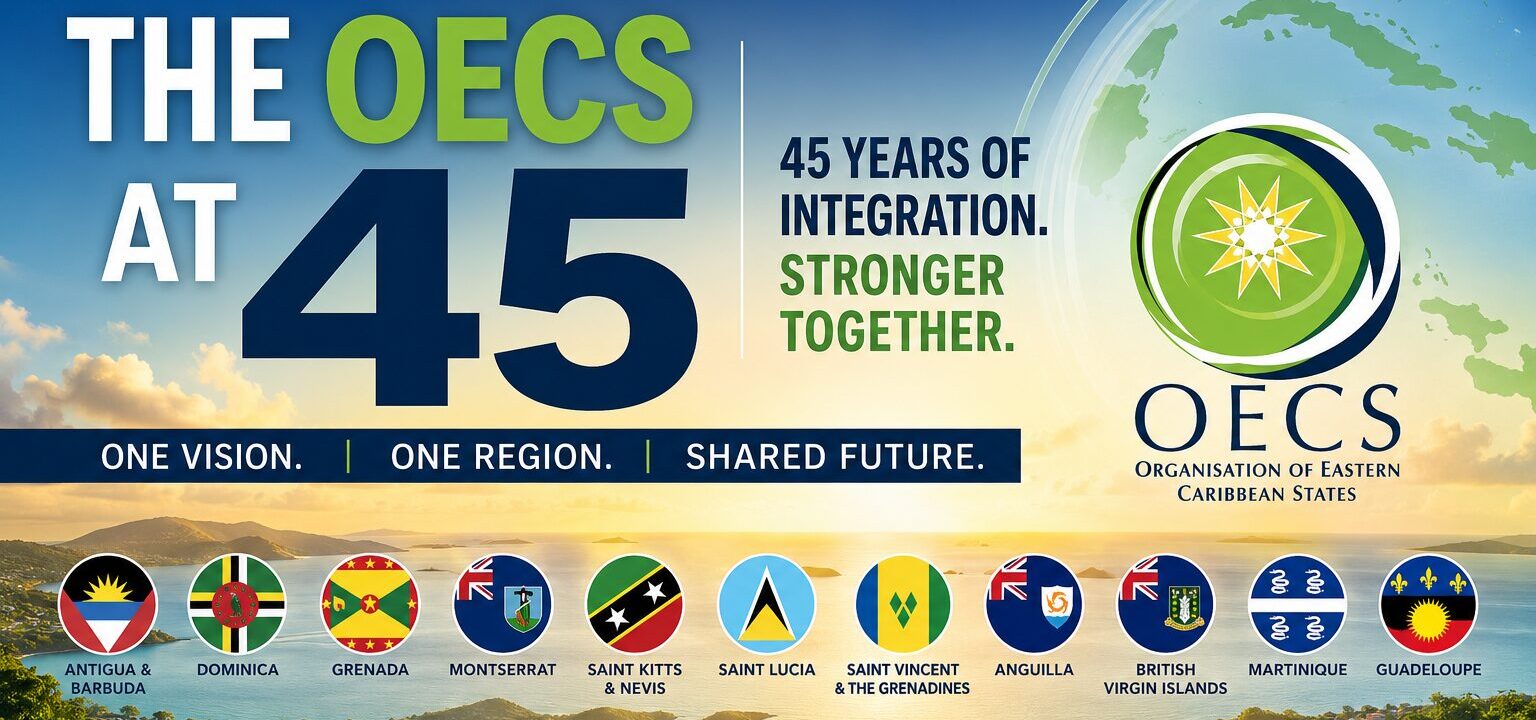
As the Organisation of Eastern Caribbean States (OECS) marks its 45th founding anniversary this year, it offers a timely opportunity to reflect on the real-world progress delivered by one of the Caribbean’s most ambitious regional integration projects. What started as a compact agreement between a handful of tiny Caribbean territories has grown into a powerful example of what small nations can achieve when they prioritize collective action over individual effort.
Founded officially on June 18, 1981, under the Treaty of Basseterre, the OECS was built on a deceptively simple core principle: that shared resources, coordinated policy, and unified action would produce far greater outcomes for residents than each territory could secure working alone. Four and a half decades later, that founding premise has been thoroughly proven correct.
Today, the OECS has expanded beyond its original membership to include 11 territories: Antigua and Barbuda, Dominica, Grenada, Montserrat, Saint Kitts and Nevis, Saint Lucia, Saint Vincent and the Grenadines, Anguilla, the British Virgin Islands, Martinique, and Guadeloupe. Together, this diverse grouping has built one of the most successful and functional models of regional integration in the entire developing world, outpacing many far larger regional blocs in delivering practical, on-the-ground results for ordinary citizens.
Among the OECS’s most transformative landmark achievements is the 2011 launch of the OECS Economic Union. This framework has unlocked unprecedented freedom for residents of member states: people can now move, live, work, and launch businesses across participating territories with far fewer barriers than existed before. In many key measures of functional integration, the OECS has made more progress than much larger regional bodies with far bigger budgets and broader mandates.
Another long-standing success story is the Eastern Caribbean Currency Union, overseen by the Eastern Caribbean Central Bank. Through decades of cascading crises — including devastating Atlantic hurricanes, the 2008 global financial collapse, and the widespread economic and social disruptions of the COVID-19 pandemic — the Eastern Caribbean dollar has maintained exceptional stability, protecting the purchasing power and economic security of millions of residents across the bloc.
Beyond economic and monetary integration, the OECS has also emerged as a leader in coordinated action on a range of cross-border priorities, from public health collaboration and bulk pharmaceutical procurement to systemic education reform and building collective climate resilience. Its coordinated response to shared global challenges has served as a powerful demonstration of the impact small states can deliver when they pool limited resources and specialized expertise.
The more recent addition of Martinique and Guadeloupe to the grouping has brought a valuable new dimension to regional cooperation, helping bridge long-standing linguistic and cultural divides that have split the Caribbean for centuries. This expanded, more inclusive vision of shared Caribbean identity may ultimately stand as one of the most significant long-term developments in the organization’s 45-year history.
That said, the OECS is not without unmet challenges and areas for improvement. Public awareness of the organization and its work remains stubbornly low across the bloc: millions of residents benefit from OECS programs and initiatives every day, but few recognize the organization as the driving force behind those gains. Progress on integrating the private sector across member territories has also lagged far behind the advances made in intergovernmental cooperation, and the organization has yet to build robust, sustained engagement with younger generations to secure the future of the regional integration project.
These challenges will only grow in urgency as the OECS confronts a new wave of pressing 21st-century priorities, from regulating artificial intelligence and advancing digital transformation to shoring up fragile food systems, scaling up renewable energy infrastructure, and accelerating climate adaptation across vulnerable small island territories.
Even with these unaddressed hurdles, the overall 45-year track record of the OECS remains overwhelmingly positive. The organization has proven that regional integration delivers the greatest value when it prioritizes practical, tangible results over empty, lofty declarations. It has built durable, functional institutions, delivered critical cross-border public services, and expanded economic and personal opportunities for millions of citizens across its member territories.
At 45 years old, the OECS stands as one of the Caribbean’s most successful examples of cooperation in action. Its decades of experience offer a vital lesson for regional integration efforts across the globe: integration only succeeds when it moves beyond rhetorical rhetoric and delivers concrete, visible benefits to ordinary people. That lesson may ultimately prove to be the OECS’s most enduring contribution to the Caribbean’s ongoing story.